
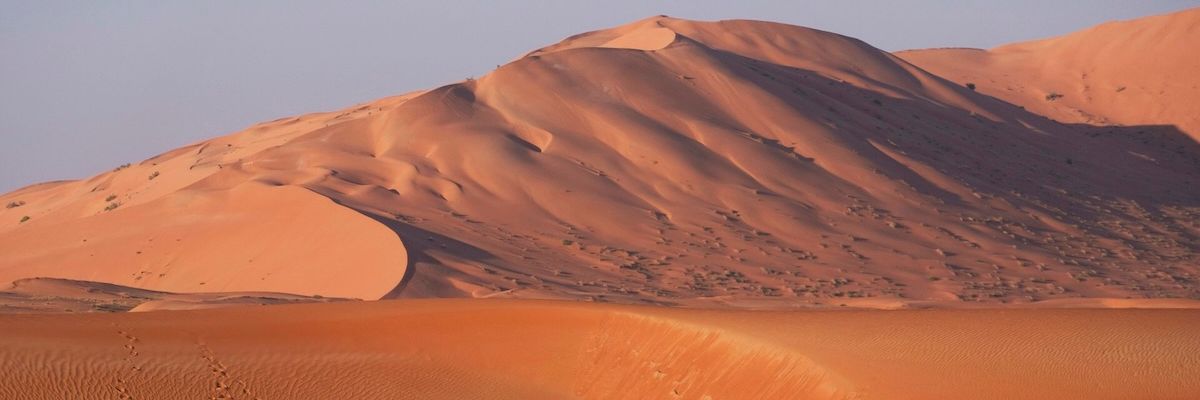
Water is not enough for settlement. Stone was equally important
30. 10. 2026
Desert settlement models have long been based on the assumption that where there was water, there were people. According to a new study published in the prestigious journal Nature, however, stone was an equally important resource. If it was absent, the area remained uninhabited despite an abundance of freshwater. Scientists from the Czech Republic, Austria, Portugal, the United Kingdom, the USA, and Oman have created a freely available model that predicts where in arid regions anywhere in the world people dependent on stone tools could permanently live.
The initial findings from Saudi Arabia led the researchers to develop a general model that couples water availability with the geology of stone raw materials and predicts potential human settlement. In other words, it can identify where in a given landscape people dependent on stone tools could permanently live. “Models built on climate and water alone can substantially overestimate how much of the desert prehistoric people were able to inhabit,” explains Roman Garba from the Prague and Brno Institutes of Archaeology of the Czech Academy of Sciences and the Nuclear Physics Institute of the CAS, who co-authored the study.
Among other sources, the researchers tested their hypotheses using data from the Czech archaeological expedition ARDUQ in Oman, led by Roman Garba under the auspices of the Institute of Archaeology of the CAS, Prague. The team's field observations regarding the presence and absence of raw materials allowed the tool's outputs to be compared with the actual distribution of prehistoric sites. The fieldwork in Oman from 2022 to 2025 was supported by a Praemium Academiae grant from the Czech Academy of Sciences, awarded to Viktor Černý from the Institute of Archaeology of the CAS in Prague.
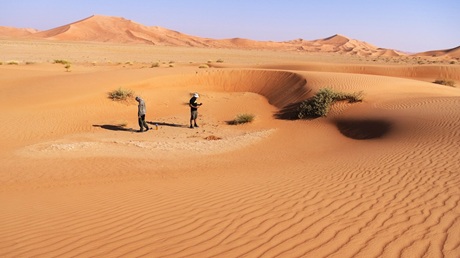
Survey of stone tool sites at the edge of the Rub' al Khali desert, southern Oman
A key source of data for testing the system was also the long-term fieldwork of anthropologist Jeffrey Rose from the University of Algarve in Portugal. “Two decades of research in Oman taught us exactly where good stone is to be found. When we carry that knowledge over into the sand desert, the model predicts an empty interior – and that is precisely what our fieldwork confirmed,” says Jeffrey Rose.
Water without stone was a dead end
Where vast deserts lie today, an area known as “Green Arabia” – full of lakes and grassy plains – once flourished. Despite an abundance of water, which the Arabian Peninsula owed to monsoon rains during the Pleistocene, humans migrated into the interior only for short periods and solely to certain locations. For permanent settlement, water alone was not enough; wherever stone suitable for tool manufacture was missing, the interior remained empty.
This finding is based in part on data from an approximately 1,500-kilometer journey across the Rub' al Khali desert in Saudi Arabia. Although scientists discovered numerous traces of former freshwater lakes along the route, they found no stone tools or raw materials to manufacture them. Suitable stone is exposed only at the desert margins, whereas toward the interior it disappears beneath a thick layer of sand and salt flats. “We stood on the shore of one ancient lake after another, yet found nothing made by human hands. Water without stone was a dead end,” summarizes Rudolf Dellmour from the University of Vienna, the study's lead author.
A universal tool that anyone can use
One of the advantages of the new model is that it is not restricted to Arabia alone. The authors have released it as an open-source tool under a free license, allowing anyone to use it for their own research by simply inputting local geological and hydrological maps. The study itself is published in open access, with the underlying data and code freely available in the public OSF and Zenodo repositories.
We previously covered Professor Viktor Černý’s research in the article "Anthropologist Viktor Černý in search of modern human origins".
Written and translated by: Aneta Ryntová, drawing on a press release from the CAS
Photo: R. Garba / expedition archive, study authors
Read also
- A / Magazine: Toxins, languages, and lightning on Jupiter
- ERC-funded CLOSER Project Highlights the Middle East and North Africa Region
- Bernard Bolzano: An Inconvenient Genius Ahead of His Time
- Our Health in the Hands of AI: How to Regulate It and What to Watch Out For?
- CAS condemns attack on National Academy of Sciences of Ukraine
- New CAS Program Already Has First ERC Grant Winners to Its Credit
- Three researchers from the Czech Academy receive prestigious ERC grants
- Ombudswoman of the CAS Dana Plavcová: I'm glad when things change for the better
- Early-Career Researchers from the CAS Received the 2026 Otto Wichterle Award
- Jackal Expansion Across Europe Facilitated by Humans, Curbed by Wolves
The Czech Academy of Sciences (the CAS)
The mission of the CAS
The primary mission of the CAS is to conduct research in a broad spectrum of natural, technical and social sciences as well as humanities. This research aims to advance progress of scientific knowledge at the international level, considering, however, the specific needs of the Czech society and the national culture.
President of the CAS
Prof. Radomír Pánek started his first term of office in March 2025. He is a prominent Czech scientist specializing in plasma physics and nuclear fusion.