
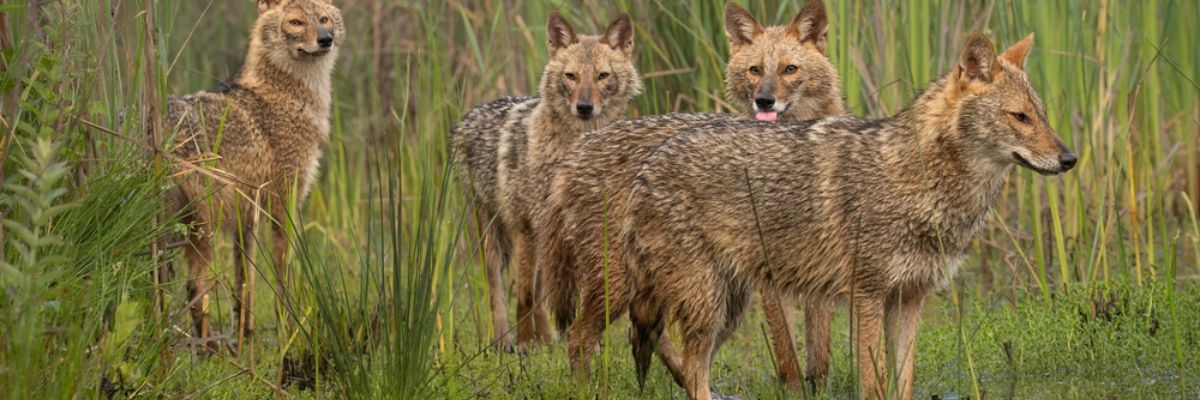
Jackal Expansion Across Europe Facilitated by Humans, Curbed by Wolves
15. 06. 2026
Over the past few decades, the golden jackal has been pushing into parts of Europe where it had never been recorded before. An international study, published in Nature Ecology & Evolution, outlines the reasons why. According to our researchers from the Institute of Vertebrate Biology of the CAS, who contributed to the study, the expansion is driven by a combination of climate change, landscape modification, and the long-term decline of large predators, especially wolves.
The golden jackal (Canis aureus) is among the fastest-expanding mammals in Europe today. As recently as the nineteenth century and for much of the twentieth century, this wolf-like canid chiefly inhabited the Balkans and regions around the Black Sea. Since the 1980s, however, it has been spreading rapidly into Central, Western, and Northern Europe. Today it is found, for instance, in Germany, Austria, Poland, the Baltic states, Scandinavia, and France. The first confirmed jackal in the Czech Republic appeared in 1998 in South Moravia, and the first pups were born there in 2017 in Milovice near Prague.
What is it that has drawn these canids to more northern regions? Researchers analyzed nearly 9,000 acoustic monitoring records from 13 European countries, tracking which factors promote or limit jackal presence. The results show that jackals benefit from short winters, heterogeneous landscapes, and proximity to bodies of water. The most important factor, however, is the declining presence of the gray wolf.
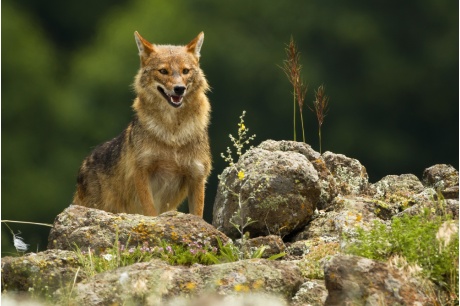
For millennia, the golden jackal inhabited primarily southeastern Europe, but in recent decades, it has expanded westward to Spain and northward toward the Arctic.
THE IMPACT OF HUMAN ACTIVITY
Humans also play a key role; that’s because settlements provide jackals with a “shield” of sorts. Wolves tend to reduce their activity near human habitation, which allows jackals to survive more safely even in areas where their enemies are permanently present. “Our results show that humans are now significantly shaping relationships among predators in European landscapes. Jackals benefit not only from climate change and landscape fragmentation, but also by finding refuge from wolves near human settlements,” explains Martin Šálek from the Institute of Vertebrate Biology of the CAS.
The golden jackal is an exceptionally adaptable species. It can make use of agricultural land, urban fringes, and heavily altered habitats alike. This ecological flexibility is the reason behind its rapid and successful spread across Europe. The authors of the study note that the return of wolves to European regions could partly slow further jackal expansion. The recovery of apex predator populations can thus function as a natural regulatory mechanism for medium-sized carnivorans. At the same time, however, this effect is being weakened by human presence.
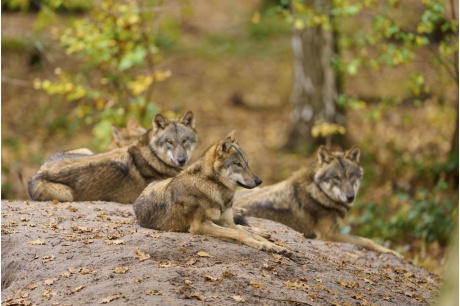
The return of wolves to European regions could partly slow the expansion of jackals.
“Protecting large carnivorans is not just about the individual species themselves, but about the functioning of entire ecosystems. Once humans alter relationships among predators, it can affect the distribution of animals on a continental scale,” adds Šálek, who has been involved since 2011 in building the international network GOJAGE, which brings together specialists on the golden jackal.
The current research integrates data from extensive international monitoring and offers the most comprehensive overview to date of the ecological factors driving the golden jackal’s ongoing expansion in Europe. It also suggests that jackals could eventually occupy up to 75% of the European continent – nearly six times their current range.
*
The research was supported by the Global Biodiversity Crisis program, which is part of the CAS Strategy AV21.
Written and prepared by: Markéta Wernerová, External Relations Division, CAO of the CAS, drawing on the CAS press release
Translated by: Tereza Novická, External Relations Division, CAO of the CAS
Photo: Shutterstock
 The text is released for use under the Creative Commons license.
Read also
- Three researchers from the Czech Academy receive prestigious ERC grants
- Ombudswoman of the CAS Dana Plavcová: I'm glad when things change for the better
- Early-Career Researchers from the CAS Received the 2026 Otto Wichterle Award
- Languages Don’t Overload the Brain, Psycholinguists Say
- Czech Academy of Sciences Evaluation – Beyond Metrics, Accent on Peer Review
- Ordovician Fauna Beneath Prague – New Arthropod Found During Metro Line Dig
- Wildfires on the Rise in Europe and Set to Double by 2100. What Can We Do?
- The CAS Photogenic Science Contest Invites Entries
- The CAS Launches New Research Programs as Part of Its Strategy AV21
- Academy Assembly – Thirteen Priorities to Boost Basic and Applied Research
The Czech Academy of Sciences (the CAS)
The mission of the CAS
The primary mission of the CAS is to conduct research in a broad spectrum of natural, technical and social sciences as well as humanities. This research aims to advance progress of scientific knowledge at the international level, considering, however, the specific needs of the Czech society and the national culture.
President of the CAS
Prof. Radomír Pánek started his first term of office in March 2025. He is a prominent Czech scientist specializing in plasma physics and nuclear fusion.