
Academy Assembly – Thirteen Priorities to Boost Basic and Applied Research
15. 04. 2026
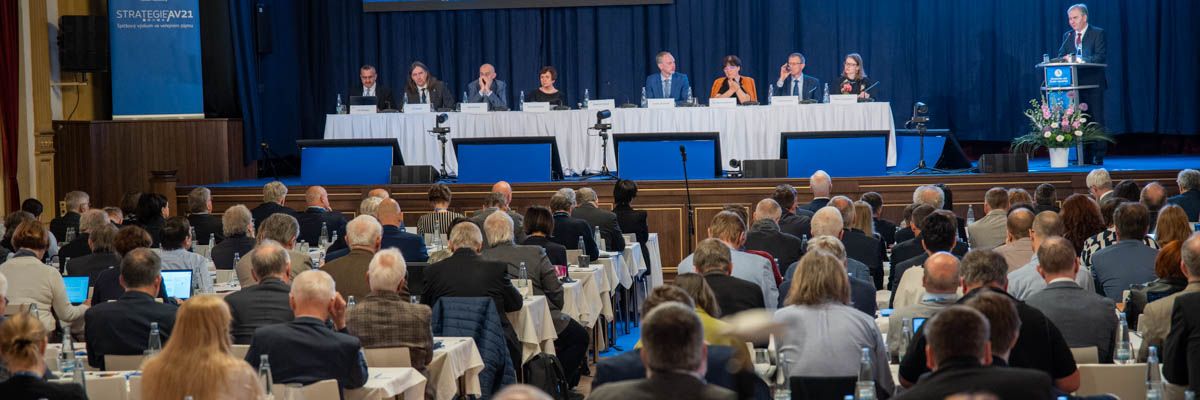
The Czech Academy of Sciences aims to fulfill its mission of conducting top research and producing results that benefit society even more consistently, defining thirteen strategic priorities to support this effort. The Academy Assembly of the CAS adopted them at its 67th session on 14 April 2026, held at the National House Vinohrady in Prague, which traditionally hosted representatives of both science and politics. Among other topics, participants also addressed the funding of science and research.
More than 7,000 researchers across 54 institutes make up the Czech Academy of Sciences – the largest non-university research institution in the Czech Republic. The Academy Council of the CAS plans to boost its performance both nationally and internationally and strengthen its stability by 2029 by implementing a new program strategy. At the 67th session of the Academy Assembly, CAS President Radomír Pánek emphasized that the strategic priorities combine organizational and legislative changes: “They will allow us to fulfill the public mission of the Czech Academy of Sciences more consistently and efficiently.”
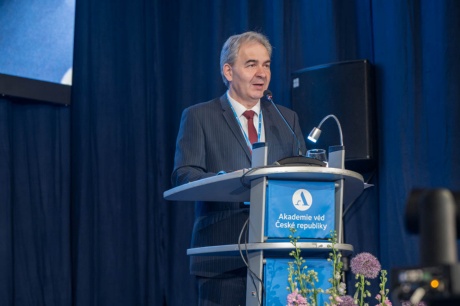
The CAS President, Radomír Pánek, introducing the strategic priorities of the Czech Academy of Sciences.
THIRTEEN PRIORITIES TO FOSTER EXCELLENCE IN SCIENCE
Through these strategic priorities, the Academy Council of the CAS will build on the institution’s strengths, respond to current challenges, and raise the quality of research at its institutes. They are structured around 13 thematic areas:
- Legislation and strategic management
- Property management, internal regulations, and supervisory board agenda
- Economy
- Public policy and European funding
- Knowledge and technology transfer
- International cooperation
- Evaluation of research activity
- Excellent research and support for scientific careers
- Cooperation with universities
- Digital transformation and sustainable development
- Research security
- Communication with the public
- Implementation of the CAS Strategy AV21
The area of excellent research and career support includes, among other initiatives, the Academy of the Future program and the so-called ERC Incubator, both launched this year.
To strengthen support for knowledge and tech transfer, the Czech Academy of Sciences has already taken several key steps this year. One example is the establishment of the joint-stock company CAS Innovations (CASI), designed to translate research results into real-world applications. It will consolidate and ensure unified procedures for the creation and management of spinoffs and startups. The CAS President stressed that – alongside the Strategy AV21, the PRAK program (Program for Application Development and Commercialization of the CAS), and its subprogram PRAK SHAPE – CASI represents another pillar of cooperation between the Czech Academy of Sciences and the application sphere. “I believe it will soon become our flagship,” Radomír Pánek added.

The 67th session of the Academy Assembly of the CAS, traditionally held at the National House Vinohrady in Prague.
FUNDING FOR SCIENCE? BELOW THE EU AVERAGE
At the beginning of 2026, the Czech Academy of Sciences completed an internal evaluation of the results of its institutes for 2020–2024. As Pánek noted, the assessment showed that many of the CAS institutes and their teams rank among the global elite – both in terms of quality and applicability of research results: “Seventy percent of the selected outputs achieved the highest ratings of ‘Outstanding’ or ‘Excellent.’”
However, the current level of funding for science threatens the sustainability of this exceptional research quality. Moreover, the Czech Republic entered this year under a provisional budget, and spending on research, development, and innovation stagnated.
According to Pánek, the Czech research system has long suffered from underfunding. “The data refute the claim that there is enough money and that the problem lies only in its distribution,” he noted. Data from Eurostat and the OECD show that the share of expenditure on research, development, and innovation in the Czech Republic has long remained below the European Union average. In addition, the share of state spending is declining.
“The share of GDP allocated to science fell to 0.5% last year and, according to the outlook of the newly approved budget, is expected to drop further to 0.42% by 2028. That is why our shared ambition must be a decisive improvement – only then can we catch up with scientifically and technologically advanced countries,” Pánek warned.
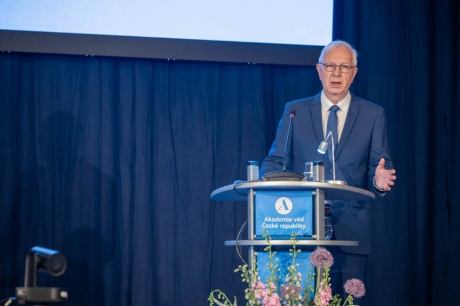
Increasing funding for science and research was also supported by Jiří Drahoš, First Vice-President of the Senate of the Parliament of the Czech Republic.
Pánek welcomed the Czech government’s new economic strategy, which envisages increasing spending on research, development, and innovation to 2% of GDP as early as 2027. One third of this growth is expected to come from public funding, with the remaining two thirds from private sources.
In closing, the CAS President emphasized that the Czech Academy of Sciences has never relied passively on external support. “On the contrary – despite economic challenges, we are actively creating platforms and tools that foster the development of transfer activities,” he concluded.
Documents from the Academy Assembly of the CAS are available here (in Czech only).
The next session of the Academy Assembly will take place on 8 December 2026.
Prepared by: Zuzana Dupalová and Luděk Svoboda, External Relations Division, CAO of the CAS
Translated by: Tereza Novická, External Relations Division, CAO of the CAS
Photo: Josef Landergott, External Relations Division, CAO of the CAS
 The text and photos are released for use under a Creative Commons license.


Read also
- Bernard Bolzano: An Inconvenient Genius Ahead of His Time
- Our Health in the Hands of AI: How to Regulate It and What to Watch Out For?
- CAS condemns attack on National Academy of Sciences of Ukraine
- New Academy of Sciences Program Already Has First ERC Grant Winners to Its Credit
- Three researchers from the Czech Academy receive prestigious ERC grants
- Ombudswoman of the CAS Dana Plavcová: I'm glad when things change for the better
- Early-Career Researchers from the CAS Received the 2026 Otto Wichterle Award
- Jackal Expansion Across Europe Facilitated by Humans, Curbed by Wolves
- Languages Don’t Overload the Brain, Psycholinguists Say
- Czech Academy of Sciences Evaluation – Beyond Metrics, Accent on Peer Review
The Czech Academy of Sciences (the CAS)
The mission of the CAS
The primary mission of the CAS is to conduct research in a broad spectrum of natural, technical and social sciences as well as humanities. This research aims to advance progress of scientific knowledge at the international level, considering, however, the specific needs of the Czech society and the national culture.
President of the CAS
Prof. Radomír Pánek started his first term of office in March 2025. He is a prominent Czech scientist specializing in plasma physics and nuclear fusion.