
The CAS Photogenic Science Contest Invites Entries
07. 05. 2026
Cameras at the ready! Photogenic Science returns with its 13th edition of the popular photo contest for which CAS staff can capture remarkable moments from their research. In addition to the main category, entries can also be submitted to a secondary category – this year’s theme is Scientists in Action – until 15 June 2026.
Through the lens of a camera, Photogenic Science offers a glimpse into labs, archives, research projects, and the day-to-day work not only of researchers, but also of other staff across the institutes of the Czech Academy of Sciences (CAS).
“In today’s visual age, the language of photography plays an important role in popularizing science. Photography can serve as a bridge between the complexity of scientific knowledge and its accessible storytelling. At the same time, these images are not only aesthetically striking, they also bear witness to the work of researchers and their drive to understand the world,” says Ondřej Beránek, Vice-President of the CAS.
DO YOU HAVE A PHOTO WITH A STORY? LET’S SEE IT!
The main category of Photogenic Science traditionally features images with a scientific theme. “Participants capture objects and processes of scientific inquiry – from details of microscopic structures to experiments and scientific instruments, natural phenomena, and topics from the social sciences,” explains Zuzana Všetečková from the Centre of Administration and Operations of the CAS, which organizes the contest.
“When evaluating entries, we look not only at their content, but also at their visual and aesthetic quality – that is, their ability to communicate science as a visually compelling world,” emphasizes Soňa Ehlerová from the Academy Council of the CAS, who is serving on the expert jury.
In the secondary category, Scientists in Action, participants will be able to portray science as a living process unfolding in labs, in the field, and in everyday research activities. The photo entries can capture focus, collaborations, movement, and even unexpected moments – of which there tend to be more of in research than you might think.
Up to six photos (a maximum of three per category) can be submitted via the Photogenic Science registration website by 15 June 2026. An expert jury will select the best entries for the semifinals, from which images will be chosen for the CAS calendar and the annual Photogenic Science exhibition. Awards will also be given for the best photos in each scientific field. The public can also take part in the contest by voting on the Academy’s Facebook page.
INSPIRATION CAN STRIKE BY CHANCE
A deep-sea predator lunges at its defenseless, fleeing prey – moments before devouring it… Yet the seemingly dramatic photo titled Anglermoss, which won the 2025 edition of Photogenic Science, tells a far less terrifying story. Its author, Tomáš Figura from the Institute of Botany of the CAS, explains that chance – and a small mishap – played a key role in its creation, when a grain of pollen ended up where it didn’t belong.
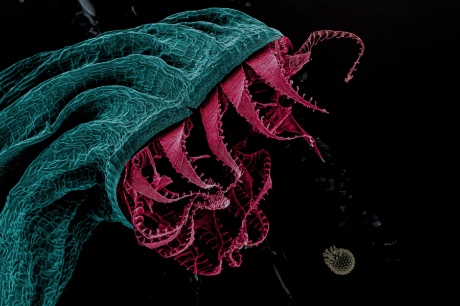
The winner of last year’s Photogenic Science contest, titled Anglermoss.
“On the sample stub where I place specimens, there’s always some space left that would be a shame not to use. So I usually add something that could look visually appealing,” Figura says. He explains that the photo shows a moss seta with a capsule: “Since it was growing as a weed in the greenhouse, it practically ‘popped’ into view. And mallow pollen is visually striking as well.”
And this is where chance comes in: “I picked up a mallow anther together with the moss, and they got mixed up in my hand. The mallow ended up next to the moss as a kind of debris. The moss capsule was open, so it resembled the gaping mouth of a deep-sea anglerfish about to catch its prey. That prey is the mallow pollen.”
*
You can enter the Photogenic Science contest here.
|
THE DIVERSE WORLD OF THE CZECH ACADEMY OF SCIENCES The first ten years of the Photogenic Science contest are summed up in the Czech-English photo book Science through Photography 2014–2023. You can view last year’s winning photos in the article Moss as a predator? Photogenic Science reveals the beauty and humor in research. |
Prepared by: Luděk Svoboda, External Relations Division, CAO of the CAS
Translated by: Tereza Novická, External Relations Division, CAO of the CAS
Photo: Shutterstock; Tomáš Figura, Institute of Botany of the CAS
 This text is released for use under a Creative Commons license.
Read also
- Three researchers from the Czech Academy receive prestigious ERC grants
- Ombudswoman of the CAS Dana Plavcová: I'm glad when things change for the better
- Early-Career Researchers from the CAS Received the 2026 Otto Wichterle Award
- Jackal Expansion Across Europe Facilitated by Humans, Curbed by Wolves
- Languages Don’t Overload the Brain, Psycholinguists Say
- Czech Academy of Sciences Evaluation – Beyond Metrics, Accent on Peer Review
- Ordovician Fauna Beneath Prague – New Arthropod Found During Metro Line Dig
- Wildfires on the Rise in Europe and Set to Double by 2100. What Can We Do?
- The CAS Launches New Research Programs as Part of Its Strategy AV21
- Academy Assembly – Thirteen Priorities to Boost Basic and Applied Research
The Czech Academy of Sciences (the CAS)
The mission of the CAS
The primary mission of the CAS is to conduct research in a broad spectrum of natural, technical and social sciences as well as humanities. This research aims to advance progress of scientific knowledge at the international level, considering, however, the specific needs of the Czech society and the national culture.
President of the CAS
Prof. Radomír Pánek started his first term of office in March 2025. He is a prominent Czech scientist specializing in plasma physics and nuclear fusion.