
Ordovician Fauna Beneath Prague – New Arthropod Found During Metro Line Dig
19. 05. 2026
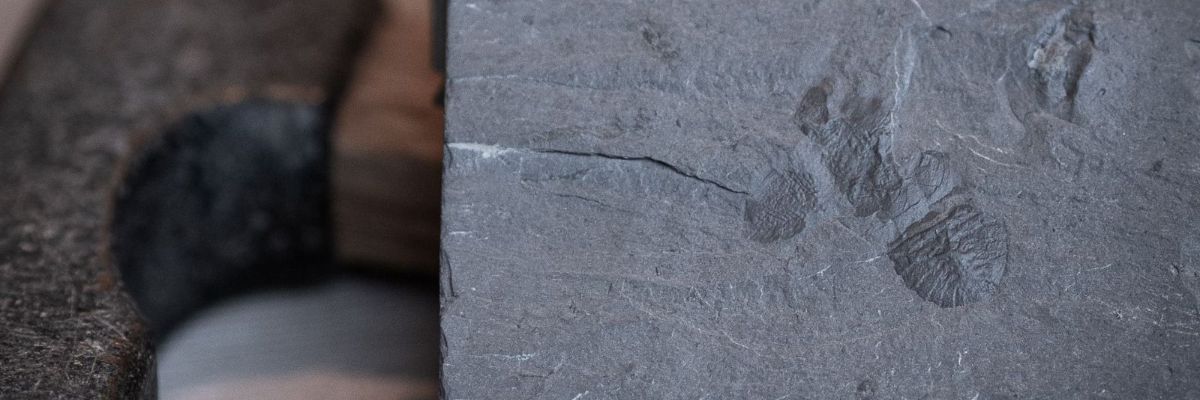
At first glance, it looks like a cross between a spider and a trilobite. However, the unassuming fossil unearthed in Prague during the construction of Metro Line D represents an entirely new species of arthropod. This ancient creature lived roughly 448 million years ago. Its closest known relative comes from southern Africa. The discovery is reshaping our understanding of how these animals were distributed and offering new insights into life at the time of the first mass extinction.
Much of the Czech capital sits atop rocks dating back to the Paleozoic. Larger construction projects regularly turn up fossils – trilobites, cephalopods, or ancient echinoderms. Yet among the spoil piles from the Prague Metro D excavation, fossil collector and Trilopark Museum owner Radek Labuťa found something far rarer – a small fossil about two centimeters long, resembling a hybrid of a spider and a trilobite. He brought the find to Lukáš Laibl from the Institute of Geology of the CAS, who specializes in fossil arthropods.
“It turned out to be a previously unknown species, closely related to trilobites. But unlike them, it had only a soft exoskeleton. We named it Soomaspis labutai in honor of its discoverer, Radek Labuťa,” Laibl explains.
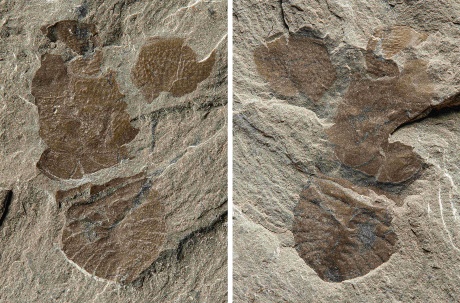
The tiny fossil was discovered at the construction site of Metro Line D in Prague.
Soomaspis labutai was a small arthropod with an oval “tail,” the surface of its body covered in shallow pits. It lived at the end of the Ordovician, around 448 million years ago – just before the onset of extensive glaciation that led to the first mass extinction on Earth.
“Determining its age was relatively straightforward,” says Jana Bruthansová from the National Museum, a co-author of the study published in a special issue of Bulletin of Geosciences. “I’ve been monitoring the Metro Line D excavation long-term and keeping detailed records of the rocks and fossils from virtually every section of the dug tunnel.” Although the specimen was found in a spoil pile, researchers were able to trace its origin to the lower part of the so-called Králův Dvůr Formation, which was deposited precisely at the end of the Ordovician.
RELATIVES FROM AFRICA
The closest known relative of this species – Soomaspis splendida – was discovered in southern Africa in the 1990s. It comes from rock formations about 443 million years old, meaning it lived during a time when glaciers during the Late Ordovician were retreating and the climate was warming.
According to Laibl, Soomaspis splendida had long been considered an exceptionally rare species. “For a long time, we thought it was just a local curiosity – basically an Ordovician endemic,” the researcher says. “Thanks to the Prague find, we now know that various species of the genus Soomaspis must have inhabited vast areas of the ancient supercontinent Gondwana.”
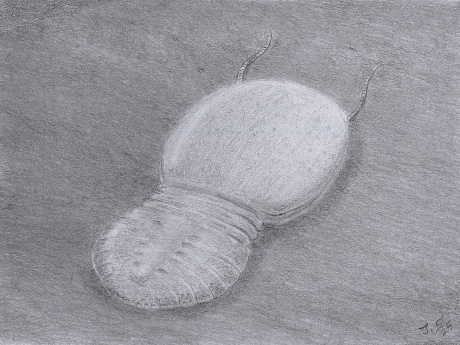
Soomaspis labutai will be on display as part of the permanent exhibition of the National Museum, to which it was donated by its discoverer, Radek Labuťa. (Reconstruction: Jiří Svoboda.)
SURVIVORS OF THE DEEP
The new species also provides important clues about how organisms survived major climatic upheavals. While Soomaspis labutai lived before the Late Ordovician glaciation and mass extinction, its South African relative appeared only afterward.
It seems these inconspicuous arthropods were able to withstand dramatic climate fluctuations that wiped out many other species. “You could say they were ancient ‘survivors.’ Their secret likely was that they inhabited deeper parts of the sea, which were less affected by climate change, and that they could endure environments with low oxygen levels,” Laibl concludes.
Prepared by: Markéta Wernerová, External Relations Division, CAO of the CAS, drawing on the CAS press release
Translated by: Tereza Novická, External Relations Division, CAO of the CAS
Photo: Institute of Geology of the CAS
 This text is released for use under a Creative Commons license.
Read also
- Our Health in the Hands of AI: How to Regulate It and What to Watch Out For?
- CAS condemns attack on National Academy of Sciences of Ukraine
- New Academy of Sciences Program Already Has First ERC Grant Winners to Its Credit
- Three researchers from the Czech Academy receive prestigious ERC grants
- Ombudswoman of the CAS Dana Plavcová: I'm glad when things change for the better
- Early-Career Researchers from the CAS Received the 2026 Otto Wichterle Award
- Jackal Expansion Across Europe Facilitated by Humans, Curbed by Wolves
- Languages Don’t Overload the Brain, Psycholinguists Say
- Czech Academy of Sciences Evaluation – Beyond Metrics, Accent on Peer Review
- Wildfires on the Rise in Europe and Set to Double by 2100. What Can We Do?
The Czech Academy of Sciences (the CAS)
The mission of the CAS
The primary mission of the CAS is to conduct research in a broad spectrum of natural, technical and social sciences as well as humanities. This research aims to advance progress of scientific knowledge at the international level, considering, however, the specific needs of the Czech society and the national culture.
President of the CAS
Prof. Radomír Pánek started his first term of office in March 2025. He is a prominent Czech scientist specializing in plasma physics and nuclear fusion.