
Wildfires on the Rise in Europe and Set to Double by 2100. What Can We Do?
12. 05. 2026
Fire has returned to Bohemian Switzerland National Park, just years after the devastating wildfire in 2022. Although last week’s flames have now been safely extinguished, they have reignited urgent calls for action to reduce the growing risk of wildfires in the coming years. Europe’s academic community has laid out key findings and demands for policymakers. The real question isn’t how quickly a blaze can be put out, but how we can prepare our landscapes so they don’t ignite so easily in the first place.
Last week, flames swept through forest in Bohemian Switzerland National Park – in early May, when morning temperatures can still hover around freezing. That is, not at the height of summer, after weeks of scorching heat, when the land is parched and desperate for rain.
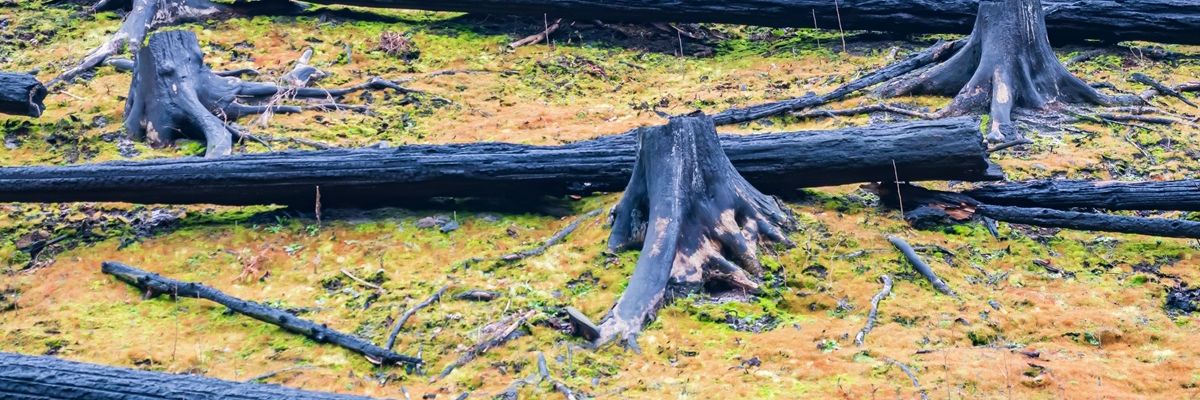
This time around, the fire was relatively small, affecting about 100 hectares of forest. But the blaze of July 2022 in the very same region remains fresh in memory: 1,060 hectares were reduced to ash, and it took three long weeks to bring the fire under control. The wildfire near Hřensko became the largest in modern Czech history. In recent centuries, wildfires had nearly vanished from temperate regions, even though they shaped landscapes for millennia. Now, driven by global climate change, they are back – and reopening the question of their role in nature.
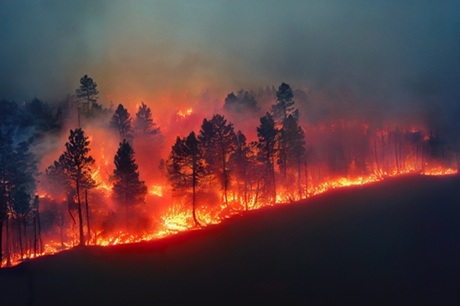
The most common cause of wildfires is human carelessness.
FIRE WALK WITH ME – LEARNING TO LIVE IT
According to a 2025 report by European Academies’ Science Advisory Council (EASAC), wildfires currently burn around 500,000 hectares across the European Union every year – an area nearly twice the size of Luxembourg. Countries in southern Europe around the Mediterranean are hit the hardest, but continental, alpine, and boreal regions must also prepare for a new reality. By 2100, experts expect wildfire risk to double due to a combination of factors, including rural depopulation, land-use changes, more frequent droughts, and reduced summer rainfall.
The conclusion is clear – Europe must stop delaying and begin rapidly implementing its climate plans, while also rethinking how land is used and how landscapes are managed. For now, at least, we have to accept that drought is here to stay – and learn to live with fire.
EASAC outlines three key recommendations for European policymakers. Foremost is the implementation of the new Nature Restoration Law, with a strong focus on restoring peatlands and improving forest management. Why peatlands? They are among the planet’s most carbon-dense ecosystems, storing roughly twice as much carbon per hectare as boreal forests. Protecting peatlands helps prevent emissions that would otherwise accelerate warming.
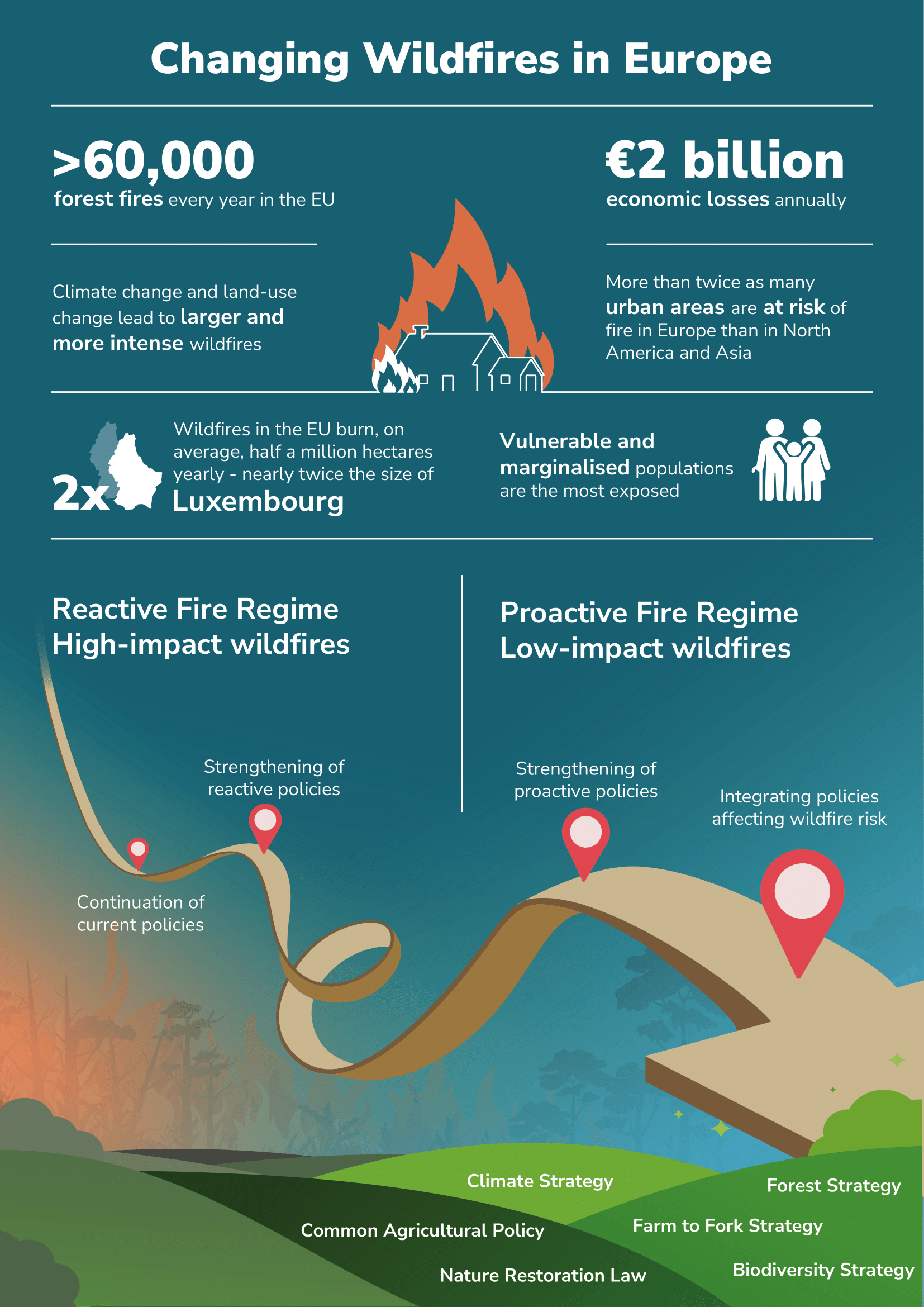
EASAC infographic for the 2025 policy report, Changing Wildfires in Europe.
Second comes prevention within restoration efforts. Planting dense forests without regard for fire safety creates vast fuel reserves that can ignite during the first major drought. The solution is to avoid monoculture landscapes – instead alternating forests with pastures, orchards, and open areas – supporting grazing animals that naturally reduce dry undergrowth, and making use of controlled burning where appropriate.
The third recommendation concerns fire literacy. Experts stress that education about wildfire risks should begin in childhood. The goal is to build a society that understands how to prevent fires – and how to coexist with them when they do occur – rather than simply being afraid of them.
A VULNERABLE CZECH REPUBLIC
The Czech Republic is not yet sufficiently resilient to wildfires. This follows from an expert statement (AVex, in Czech only) prepared by the Czech Academy of Sciences to inform Czech legislators and policymakers. Risk is on the rise especially around large urban areas. Statistics show that roughly 1,300 natural fires break out annually in the country, though nearly 90 percent of them affect areas smaller than one hectare.
Looking more closely at the numbers, the main causes are: smoking in forests (22%), open (camp)fires (22%), and ignition linked to forestry operations (10%). Fires without human involvement are extremely rare – for instance, lightning strikes account for just 0.4% of cases.
In line with European academic authorities, Czech scientists are thus calling for managing and maintaining landscapes in ways that will reduce wildfire exposure and vulnerability. Ecosystem resilience can be increased by altering species composition – for instance, planting fire-resilient vegetation – and by strengthening prevention and community preparedness for crisis situations.
LIKE A PHOENIX FROM THE ASHES
Fire symbolizes destruction, devastation, and chaos – but also renewal. Nature, in fact, depends on it. Fire helps maintain biodiversity and contributes to healthy ecosystems – as long as fires do not occur too frequently or with extreme intensity.
Events like the 2022 wildfire are exceptional. Even in Bohemian Switzerland, however, the ecosystem began recovering quickly. Following the fire, researchers from the Institute of Botany of the CAS focused promptly on the development of three main forest types. In beech forests, the fire did not alter soil chemical properties, but it reduced canopy cover, leading to greater temperature fluctuations at the soil surface. In pine forests – which are adapted to fire – the burn consumed the soil organic horizon, thereby reducing soil carbon stocks and nutrient pools. In spruce forests, already weakened by bark beetle infestation, the organic soil layer was also partly combusted, while the soil became enriched with nutrients from ash and soot deposition.
By the following year, burned areas were already covered with pioneer vegetation – birch, alder, bramble, and bracken. Researchers from the Biology Centre of the CAS, who studied the site, recorded hundreds of animal species in the burned area, including endangered ones. And according to the researchers, forests that regenerate naturally, without human intervention, may prove more resilient to future fires.
Why are we afraid of fire – and how does fire affect nature? These questions were explored directly in Bohemian Switzerland just months after the disaster in 2022 by science communicator Zvěd together with experts from the Czech Academy of Sciences (the video series is in Czech only).
Written by: Jana Kuřátková, External Relations Division, CAO of the CAS
Translated by: Tereza Novická, External Relations Division, CAO of the CAS
Photo: EASAC; Shutterstock; External Relations Division archive, CAO of the CAS
 The text is released for use under the Creative Commons license.
Read also
- New Academy of Sciences Program Already Has First ERC Grant Winners to Its Credit
- Three researchers from the Czech Academy receive prestigious ERC grants
- Ombudswoman of the CAS Dana Plavcová: I'm glad when things change for the better
- Early-Career Researchers from the CAS Received the 2026 Otto Wichterle Award
- Jackal Expansion Across Europe Facilitated by Humans, Curbed by Wolves
- Languages Don’t Overload the Brain, Psycholinguists Say
- Czech Academy of Sciences Evaluation – Beyond Metrics, Accent on Peer Review
- Ordovician Fauna Beneath Prague – New Arthropod Found During Metro Line Dig
- The CAS Photogenic Science Contest Invites Entries
- The CAS Launches New Research Programs as Part of Its Strategy AV21
The Czech Academy of Sciences (the CAS)
The mission of the CAS
The primary mission of the CAS is to conduct research in a broad spectrum of natural, technical and social sciences as well as humanities. This research aims to advance progress of scientific knowledge at the international level, considering, however, the specific needs of the Czech society and the national culture.
President of the CAS
Prof. Radomír Pánek started his first term of office in March 2025. He is a prominent Czech scientist specializing in plasma physics and nuclear fusion.