
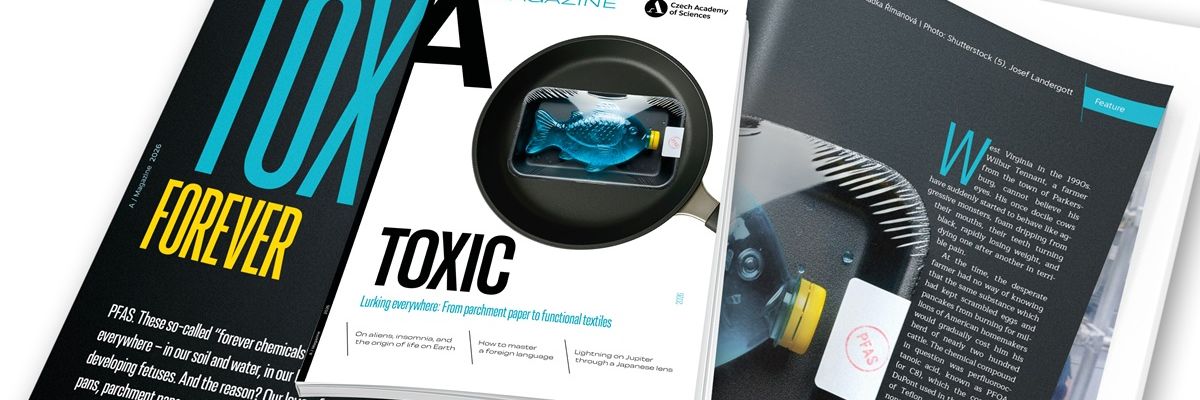
A / Magazine: Toxins, languages, and lightning on Jupiter
26. 10. 2026
They have been found in the snow on the peak of Mount Everest and in the depths of the Mariana Trench. We drink them in our water, and they rain down on us. And because they essentially don’t decompose, they accumulate in the environment. In other words: every milligram of “forever chemicals” ever created on Earth is still circulating somewhere in the ecosystem, with more added every single day. While the chemicals known as PFAS are human-made, many animals also produce remarkable cocktails of toxic substances. Common bees are a case in point. What happens when one stings us, and what toxins unleash a cascade of pain, burning, and itching?
Poisons take center stage in the latest issue of A / Magazine.
2026 | TOXIC
(version for browsing)
2026 | TOXIC
(version for download)
The feature in the 2026 English issue of A / Magazine explores the topic of toxins across two articles:
Toxic Forever (pp. 16–23) PFAS. The toxic substances hidden behind this acronym circulate in the blood of every single one of us – even in the veins of unborn children. The reason? Our love of nonstick pans, parchment paper, and waterproof clothing.
A Chemical Agent in a Stinger (pp. 24–25) It can kill and destroy – but also heal. Bee venom contains a sophisticated cocktail of up to one hundred different substances. How is it that a nearly invisible droplet of this liquid can cause so much trouble?
More from this issue:
You Are What You Speak (pp. 30–37)People who speak multiple languages tend to be more flexible – and their brains resist dementia for longer. How many languages can the mind hold? And why is it worth taking inspiration from infants and toddlers when learning languages?
INTERVIEW: Reaching for the Stars (pp. 38–45) As a child, she struggled with insomnia. Instead of drifting off, she would spend hours thinking about the origin of life or whether we are alone in the universe. Today, Klára Hlouchová is still searching for answers – only now, sleepless nights have been replaced by her lab.
Cartilage, Step on the Gas (pp. 46–51) People with achondroplasia are documented throughout history – from ancient Egypt to the courts of European kings. But only now are scientists beginning to unravel what causes the condition. Will it one day be possible to completely counteract its effects?
Bolzano: A Treasure Rediscovered (pp. 58–63) Czech, German, Austrian or Italian? Preacher, philosopher, or mathematician? Prague's Bernard Bolzano was all these things. Now, all his works are to become accessible online.
Jupiter: Lord of Lightning (pp. 64–69) The planet bears the name of a mighty ancient Roman god and is our Solar System’s stormy giant. In Prague, Japanese scientist Masafumi Imai is helping uncover the nature of lightning on Jupiter.
All Czech and English issues of A / Magazine – the official magazine of the Czech Academy of Sciences – are available online.
Would you like every issue delivered straight to your mailbox? We provide complimentary print copies of current and upcoming issues in both Czech and English. Get in touch with us at predplatne@ssc.cas.cz to order.
Text: Jana Kuřátková, External Relations Division, CAO of the CAS
Translated by: Aneta Ryntová, External Relations Division, CAO of the CAS
Photo: Josef Landergott, External Relations Division, CAO of the CAS
 The text and photos are released for use under the Creative Commons license.
Read also
- ERC-funded CLOSER Project Highlights the Middle East and North Africa Region
- Bernard Bolzano: An Inconvenient Genius Ahead of His Time
- Our Health in the Hands of AI: How to Regulate It and What to Watch Out For?
- CAS condemns attack on National Academy of Sciences of Ukraine
- New CAS Program Already Has First ERC Grant Winners to Its Credit
- Three researchers from the Czech Academy receive prestigious ERC grants
- Ombudswoman of the CAS Dana Plavcová: I'm glad when things change for the better
- Early-Career Researchers from the CAS Received the 2026 Otto Wichterle Award
- Jackal Expansion Across Europe Facilitated by Humans, Curbed by Wolves
- Languages Don’t Overload the Brain, Psycholinguists Say
The Czech Academy of Sciences (the CAS)
The mission of the CAS
The primary mission of the CAS is to conduct research in a broad spectrum of natural, technical and social sciences as well as humanities. This research aims to advance progress of scientific knowledge at the international level, considering, however, the specific needs of the Czech society and the national culture.
President of the CAS
Prof. Radomír Pánek started his first term of office in March 2025. He is a prominent Czech scientist specializing in plasma physics and nuclear fusion.