
Bernard Bolzano: An Inconvenient Genius Ahead of His Time
05. 10. 2026
Czech, German, Austrian or Italian? Preacher, philosopher, or mathematician? Prague's Bernard Bolzano, born exactly 245 years ago, was all these things. Now, all his works are to become available online, thanks to Mexican researcher Elías Fuentes Guillén, who has been based at the Institute of Philosophy of the Czech Academy of Sciences since 2018, making the immensely rich legacy of this versatile National Revival intellectual accessible to the public. In the latest issue of A / Magazín, he explains why Bolzano became a crucial figure for subsequent generations of researchers and why he was a thorn in the side of some of his contemporaries.
When the revolution broke out in France, he was turning eight. As Napoleon's armies marched across Europe, he was finishing his university studies. Throughout his life, figures like Beethoven and Goethe created their masterpieces. The era into which Bernard Bolzano was born to a German mother and an Italian father in Prague was full of revolutionary events which have helped shape our present.
Yet history is not forged by grand gestures and battles on the barricades alone. Bolzano’s story shows that European scientific and spiritual culture can also be advanced through quiet intellectual work in solitude, whose significance for modern logic, mathematics, and humanism might only be fully appreciated by a generation a century or two later.
He made his mark across several fields – some might recall his mathematical theories of collections and functions, while others view him mainly in connection with the emerging Czech National Revival. Yet his influence was also powerful in Catholic circles, as well as in the social sciences, logic, and political philosophy.
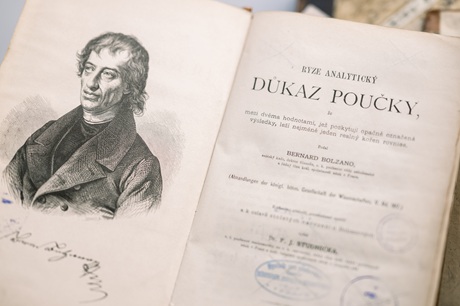
A lithographic portrait of Bernard Bolzano by Josef Kriehuber accompanies the Czech edition of one of the mathematician's early works. (CC)
Given his foreign-sounding surname, we tend to associate him less with Czech history than we do Dobrovský or Němcová. Perhaps that is for the best, though. The dust does not settle on his busts as heavily as it does on their monuments, allowing us to view him with fresh eyes from a historical distance. An unexpected perspective is now offered by a researcher who moved to Prague all the way from Mexico just because of Bolzano.
A Dissertation Overhauled
“I was working on a dissertation on the 19th-century history of mathematics, focused on its German figures, especially Georg Cantor. I wanted to explore the thought of Cantor's teacher, Karl Weierstrass, and in a transcript of his lectures, I came across an unexpected name – Bernard Bolzano,” says Mexican historian of science Elías Fuentes Guillén, recalling his formative encounter with the Prague scholar. Fuentes Guillén first came to the Institute of Philosophy of the Czech Academy of Sciences since 2018.
Karl Weierstrass, sometimes referred to as the father of modern mathematical analysis, mentioned Bolzano as the author of a key theorem that both he and Georg Cantor later expanded upon. Wanting to trace these ideas back to their roots, Fuentes Guillén decided to take a closer look at Bolzano.
He set off on a six-month research stay in Paris, where he met a philosopher of Czech origin and Bolzano expert, Jan Šebestík, and began collaborating with Hourya Benis-Sinaceur, a Franco-Moroccan thinker who translated the Prague scholar's work into French. Suddenly, a whole new world opened up to him. “The more I learned about Bolzano, the more he fascinated me. In many ways, he was completely different, to a certain extent isolated and unknown, yet his work was innovative and remarkable. He came up with certain ideas half a century before some German scholars did,” he says.
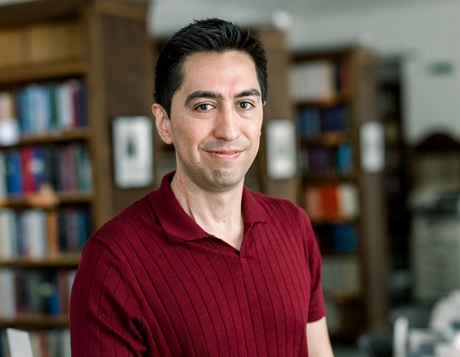
Elías Fuentes Guillén from the Institute of Philosophy of the CAS (CC)
Upon returning to his home university in Salamanca, he informed his advisor that he would add a chapter on Bernard Bolzano's mathematical writings to his dissertation. “In the end, though, I gathered so much material that I decided to completely overhaul the dissertation and focus solely on Bolzano,” Fuentes Guillén smiles. His next professional steps led him to the Czech capital, as Prague held the key to the entire story.
A Mathematician, or a Priest?
Bernard Bolzano was born here on October 5, 1781. His mother, Cecilie, was from a traditional Prague German family, while his father, Bernard, was born in northern Italy but had lived in Prague since childhood. At the time, both northern Italy and Bohemia were part of the multinational Habsburg Monarchy, ruled by Emperor Joseph II. Joseph implemented reforms in education, among other fields. High schools and universities were to teach in German rather than the traditional Latin, and greater emphasis was placed on subjects like mathematics, geography, physics, and astronomy. At age 10, the talented Bernard entered secondary school at the Piarist Gymnasium, and in 1796 enrolled in the three-year philosophical studies at Charles-Ferdinand University, designed to prepare students for advanced study in theology, law, or medicine.
At first, math did not capture the young student's interest at all; he was put off by his teacher's rather coarse behavior, as he later recalled in his autobiography. His view shifted when he encountered a different approach to the discipline. “My special pleasure in mathematics was actually based only on its purely speculative side, or rather, I valued in it only that which is simultaneously philosophy,” Bolzano writes in his autobiography, published in 1981 to mark the bicentennial of the scholar's birth.
He fell in love with mathematical thinking, while his parents instilled in him a deep respect for people and led him to help others and work for the public good from an early age. After lengthy deliberation, the young Bernard therefore decided to study theology with the goal of becoming a teacher and “publicly lecturing on the good cause of religion.”
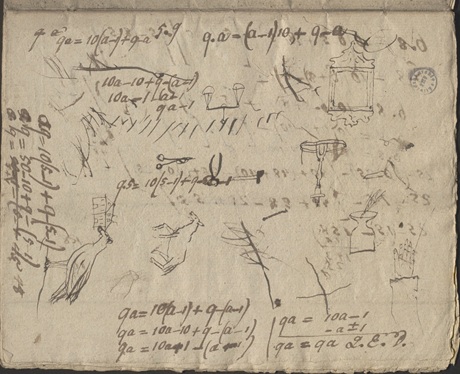
Bernard Bolzano's manuscripts also include his student notes, such as those from the 1797/1798 academic year. *
In the Whirlwind of Revolutions
However, he was reluctant to give up mathematics, choosing to pursue both fields. After all, the concurrent roles of a priest and a scientist were not so exceptional in the past. For instance, Josef Dobrovský, who was a generation older and had been ordained in 1786, dedicated himself to research as well, specifically in linguistics and Czech studies. Bernard Bolzano completed his theological studies in 1804, and various career paths opened up before him.
Yet Bolzano entered the “job market,” as one might say today, in rather turbulent times. A decade earlier, revolutionary changes in France had established an atmosphere of chaos and violence across all of Europe. Among those who met their end there under the guillotine was Marie Antoinette, the aunt of Austrian Emperor Francis II. Having ascended the throne in 1792, Francis differed from his predecessors by beginning to curb reforms, fearing that they might escalate into revolutionary madness within the Habsburg Empire as well.
To protect the monarchy, the ruler tightened his grip on power. Society was permeated by secret police, aided by a vast network of informants. Strict censorship took hold as well, which encompassed not only books and other publications, but the curricula at universities and gymnasia alike, where lectures could only be delivered according to pre-approved textbooks. One of the measures to keep the population under control was the establishment of chairs of religious doctrine at the philosophical faculties across the monarchy.
By a strange twist of fate, the fresh theology graduate Bernard Bolzano came to head this chair. It should be noted that the authorities were not very pleased with his work and practically from the beginning he faced attempts at his removal as well as legal proceedings. It is almost unbelievable that he managed to keep his position for a full fifteen years.
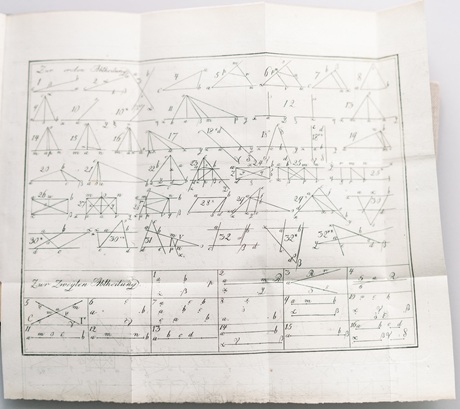
In his early work Betrachtungen über einige Gegenstände der Elementargeometrie (Considerations on Some Objects of Elementary Geometry), Bolzano sought to reform the foundations of geometry. (CC)
He may not have won over the leading figures of the church and state, but the students grew quite fond of him relatively quickly, despite initially harboring great distrust toward him. Before his opening lecture, they even plotted to start stomping their feet at the very first statement that offended them. They were expecting a planted puppet who would moralize from a position of authority – instead, a man appeared who was only slightly older than themselves and whose ideas they found inspiring.
Bolzano motivated his listeners, supported those from socially disadvantaged backgrounds, and always advocated for the pursuit of truth and justice. His pupils would transcribe and share his sermons, which were also listened to and read by many Prague intellectuals, captivated by his unconventional thinking. This was all despite the fact that he did not possess rhetorical skills, which Bolzano himself noted in his autobiography. However, he carefully drafted every lecture in advance.
“Throughout his preaching career at the Prague university, he influenced entire generations of students, who went on to become doctors, lawyers, writers, civil servants, and scientists,” says Fuentes Guillén, “I believe that this very aspect – his significant influence on Czech society and on European society in general – is what we should study further.”
In Search of the Essence
Throughout his priesthood, Bolzano could only pursue science in his free time. Yet, he published his first mathematical work as early as 1804 and the next one six years later. From the very beginning, he wanted to redefine all the established concepts. He was not satisfied with them being passed down for centuries – he believed that contemporary mathematicians were working with terms and using methods that were not sufficiently defined and interconnected.
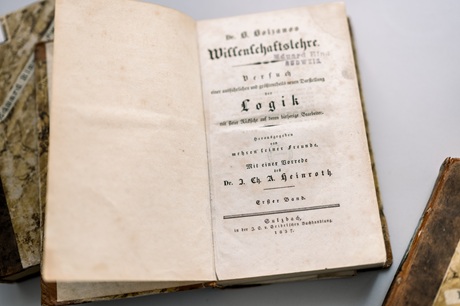
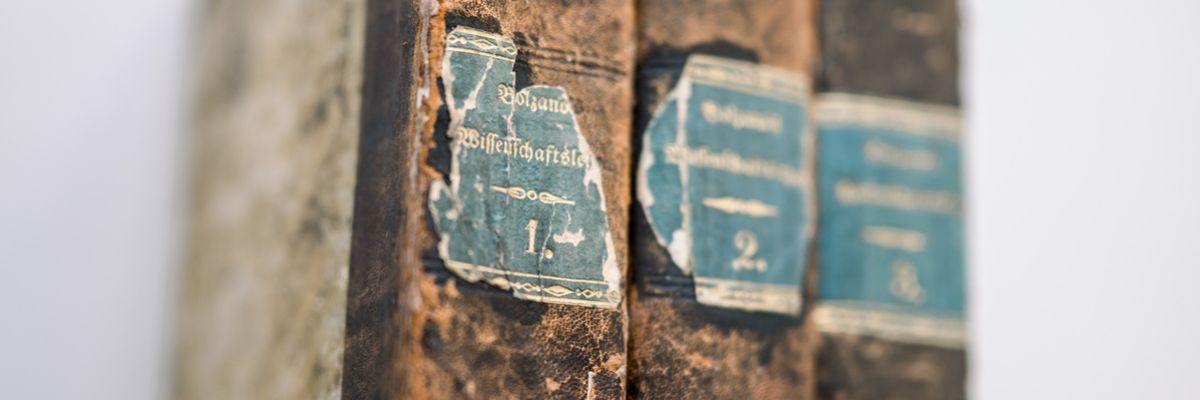
In his monumental four-volume work Wissenschaftslehre (Theory of Science), Bolzano defined concepts such as a "proposition in itself" or an "idea in itself". (CC)
“He went to the very foundations. He wanted to understand and describe concepts such as a line, a point, or a curve anew. Thanks to this, he introduced very innovative ideas, for instance in the theory of functions,” the Mexican researcher points out. Thus, in one of his 1817 works, Bolzano presented a precise definition of the continuity of a function on an interval, which he explained purely through the means of mathematical analysis without reference to traditional geometric representation.
In another treatise, he described a special function that is continuous everywhere and, at the same time, “jagged”. Today known as Bolzano's function, it is depicted as a curve that is not interrupted anywhere, has a “spike” at every point, and whose direction cannot be determined anywhere. However, this very treatise on functions remained in manuscript during the scholar's lifetime – it was not published until 1930.
Somewhat earlier, yet also posthumously, the treatise Paradoxes of the Infinite was published, containing reflections on the possibility of actually infinite collections, such as the collection of truths in themselves. Bolzano was led to this idea by his concept of the proposition in itself (Satz an sich) – which is the objective content of a statement that exists independently of whether it is expressed in any language or whether anyone thinks of it. If such a proposition is true, it is a truth in itself (Wahrheit an sich).
Geometry, which through Euclid's Elements seemed to be a rigid model, also prompted new questions in his mind. He even subjected the work of the ancient Greek “father of geometry” to criticism; however, only fragments of the intended treatise entitled Anti-Euclid have survived, and it is not certain whether its complete version was ever created.
|
In Numbers 1786 – The year the Bolzano family began living on Celetná Street. Today, a commemorative plaque marks the mathematician and philosopher's former residence there. 1849 – A lithograph was created by Josef Kriehuber bearing Bolzano's life motto: "To be happy and to make others happy – that is the human destiny." 1881 – The publication of the first biographical study on Bolzano, authored by František Palacký's granddaughter, the writer Marie Červinková-Riegrová. 1999 – The Faculty of Mathematics and Physics of Charles University established the Bernard Bolzano Endowment Fund, which awards prizes for the best scientific work in physics, computer science, and mathematics. 36,000 – The number of pages of Bolzano's manuscripts housed in the Museum of Czech Literature that have been digitized in collaboration with the PragMatika research team. 11,000 – The number of pages of Bernard Bolzano's manuscripts (predominantly mathematical writings) managed by the Austrian National Library, which will also be digitized and made accessible. |
Fall from Grace
The repeated attempts to dismiss Bolzano, who was popular among students and the public alike, from his position as the chair of religious doctrine succeeded in late 1819. Such a volume of denunciations and “evidence” regarding his alleged anti-state activities had piled up at both the imperial court and the archbishop's palace that they could no longer be ignored. The scholar was strictly forbidden from hearing confessions and preaching, and the publication of his writings, both religious and purely mathematical, was also barred. Bolzano was not too troubled by being removed from the chair position, but the publication ban caused him deep concern.
“The only thing that truly weighs on me in my present position is that I have such poor prospects of anything I have discovered ever being published,” he complains in his autobiography. “Whatever is submitted to censorship under my name is not only denied an imprimatur, but the manuscript itself is immediately confiscated, and repeated pleas for the return of my property are not even deemed worthy of a reply,” he writes further.
The bright side of his forced departure from the university was the peace and time that Bolzano newly gained for developing his ideas. He found asylum on the Hoffmann family estate in Těchobuz, South Bohemia, where he spent nearly the next twenty years. It was precisely there that Bolzano's most extensive work, Wissenschaftslehre (Theory of Science), dedicated to logic, was created; after great effort, it was successfully published in 1837 in Sulzbach, Germany.
Waves of Interest
Bernard Bolzano did not favor radical solutions. Although he was dismissed from his position as a teacher of religion on the grounds of alleged sedition, he never encouraged his students to revolt nor supported them in doing so. Nevertheless, his life was framed by major upheavals – beginning with the French Revolution and ending with the series of European revolutions in 1848. He died on December 18 of that year at the age of sixty-seven.
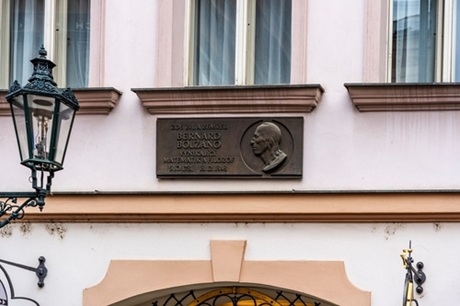
A commemorative plaque hangs on the wall of the house on Prague’s Ovocný trh where Bernard Bolzano lived and died.
Some of his works were successfully published during his lifetime, while others were released following a brief easing of restrictions in 1848. A second wave of posthumous publication of his works occurred in the 1880s in connection with the centenary of his birth. For the first time, a Czech translation of Purely Analytic Proof was published in 1881, and in the same year, the Czech-language biography Bernard Bolzano: A Biographical Outline by Marie Červinková-Riegrová hit the bookshelves.
Czech intellectuals in particular began searching for his other works, the existence of which was known, but whose whereabouts were unclear. For instance, towards the end of his life, the scholar passed a substantial portion of his mathematical research on to Robert Zimmermann in the hopes that he might further develop his ideas, which unfortunately did not happen. Instead, the manuscripts entrusted to Zimmermann ended up in the Imperial Academy of Sciences in Vienna. They remain in the Austrian capital to this day, and for many decades Czech researchers had only limited access to them.
Bolzano's work is essentially divided into the Prague part, preserved at the Museum of Czech Literature, and the Vienna part, held at the Austrian National Library. The goal of Elías Fuentes Guillén's project is to reunite both parts – to digitize all available writings and make them accessible to the scientific community for research.
The Legacy in the Modern Era
The Bernard Bolzano Archive is emerging nearly 180 years after the scholar's death, thanks to the patient work of the Mexican researcher's team. They have successfully digitized and reviewed 36,000 pages of the Prague part of Bolzano's writings so far, and through an agreement with the Austrian National Library, they will add another 11,000 predominantly mathematical writings. Some of these have not yet been seen by anyone today, and their contents remain a mystery.
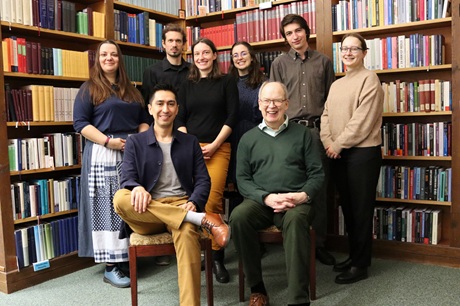
Elías Fuentes Guillén and his team are working on digitizing Bernard Bolzano’s extensive body of work.
“I am very curious about what we will find there. In some of his mathematical works, Bolzano mentioned developments he had reportedly worked on earlier. However, we don't know them, nor do we know where they are located,” says Funtes Guillén. Perhaps they are hidden precisely within those thousands of pages that are currently passing through the hands of the research team.
It is also quite possible that these works will reveal other interesting ideas that remain inspiring for the present day. The more the Mexican scholar explores Bolzano's reflections, the more convinced he is that one cannot examine the mathematical part of his work without context from other fields. He therefore plans to establish a Bernard Bolzano research center at the Institute of Philosophy of the Czech Academy of Sciences, which will allow for a better understanding of the scholar's intellectual heritage.
Bolzano never quite fit in – he was and was not a Czech, German, Austrian, Italian... In an era of rising nationalism, he often met with resistance because of this, and the 20th century, full of national conflicts, was hardly favorable to the spread of his intellectual legacy. Today, the world at times resembles a global village, borders and differences between people are partially blurring, and perhaps an ideal opportunity is opening up to dust off Bolzano's works. It is no coincidence that behind this is a scientist who hails neither from the Czech lands, Austria, nor Italy, but all the way from Mexico.
|
Elías Fuentes Guillén He used to run long-distance races and was considering a career as an athlete, but an |
 (CC)
(CC)The article was first published in Czech in the 3/2026 issue of A / Magazín.
3/2026 (version for browsing)
3/2026 (version for download)
All Czech and English issues of A / Magazine – the official quarterly of the Czech Academy of Sciences – are available online.
Would you like every issue delivered straight to your mailbox? We provide complimentary print copies of current and upcoming issues in both Czech and English. Get in touch with us at predplatne@ssc.cas.cz to order.
Written and prepared by: Leona Matušková, External Relations Division, CAO of the CAS
Translated by: Aneta Ryntová, External Relations Division, CAO of the CAS
Photo: Pavlína Černoch Jáchimová, External Relations Division, CAO of the CAS; the Museum of Czech Literature; Shutterstock
* LA PNP, Bernard Bolzano, C II 14/2. Manuscript digitised in collaboration between the Museum of Czech Literature and the Institute of Philosophy of the CAS through the research group PragMatika (grant project GA ČR 23-06540M). Licence CC BY-NC 4.0.
 The text and photos marked CC are released for use under the Creative Commons license.
Read also
- Our Health in the Hands of AI: How to Regulate It and What to Watch Out For?
- CAS condemns attack on National Academy of Sciences of Ukraine
- New Academy of Sciences Program Already Has First ERC Grant Winners to Its Credit
- Three researchers from the Czech Academy receive prestigious ERC grants
- Ombudswoman of the CAS Dana Plavcová: I'm glad when things change for the better
- Early-Career Researchers from the CAS Received the 2026 Otto Wichterle Award
- Jackal Expansion Across Europe Facilitated by Humans, Curbed by Wolves
- Languages Don’t Overload the Brain, Psycholinguists Say
- Czech Academy of Sciences Evaluation – Beyond Metrics, Accent on Peer Review
- Ordovician Fauna Beneath Prague – New Arthropod Found During Metro Line Dig
The Czech Academy of Sciences (the CAS)
The mission of the CAS
The primary mission of the CAS is to conduct research in a broad spectrum of natural, technical and social sciences as well as humanities. This research aims to advance progress of scientific knowledge at the international level, considering, however, the specific needs of the Czech society and the national culture.
President of the CAS
Prof. Radomír Pánek started his first term of office in March 2025. He is a prominent Czech scientist specializing in plasma physics and nuclear fusion.