
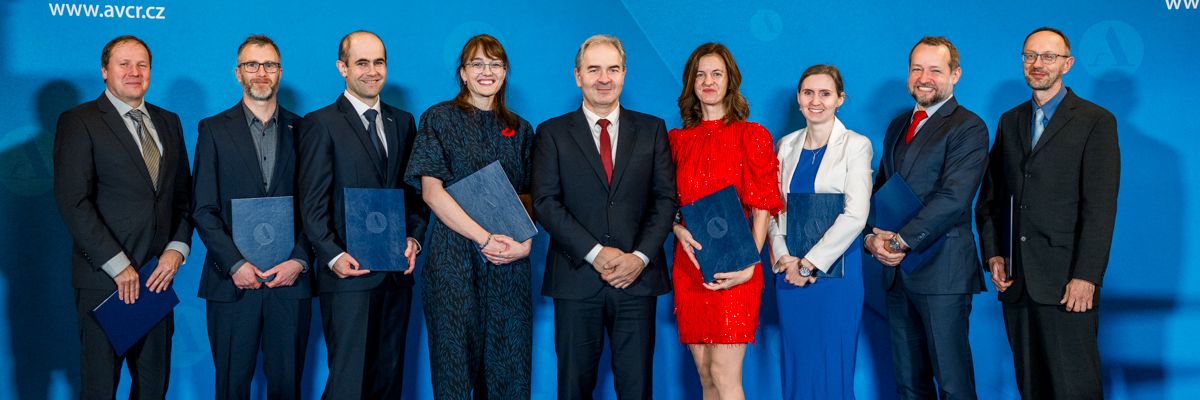
Czech Academy of Sciences to Support Groundbreaking Research by Nine Scientists
10. 11. 2026
Three experienced researchers and six promising scientists received the Academic Award – Praemium Academiae and the Lumina Quaeruntur fellowship on 9 November 2026. Each of these awards targets a different group of researchers at various stages of their careers, but there is one thing the honours have in common: they are the highest form of grant support that the Czech Academy of Sciences offers. Thanks to this funding, the laureates can focus on research with the potential to transform their fields and influence people’s lives.
The award ceremony for the Praemium Academiae and Lumina Quaeruntur took place at the Czech Academy of Sciences headquarters on Národní Street in Prague. As CAS President Radomír Pánek noted, the event was held one day after the conclusion of the science popularisation festival Week of the Czech Academy of Sciences – a timing he considers symbolic: “The projects we support with these awards are not created solely for a small circle of experts. Each of them directly or indirectly touches our lives, and their results are intended to serve society as a whole.”
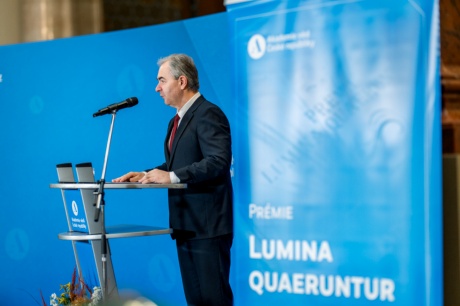
President of the Czech Academy of Sciences Radomír Pánek
According to Radomír Pánek, both awards are not only a recognition of the work the laureates have carried out so far, but also an expression of the trust the institution places in them: “The Academy of Sciences financially supports the award recipients for several years, allowing them to pursue questions they find the most important.”
With this year's ceremony, the total number of laureates for both the Academic Award and the Lumina Quaeruntur fellowship has passed the fifty mark.
Academic Award – Praemium Academiae
The Academic Award – Praemium Academiae is granted to experienced, internationally recognised scientists. Over the next six years, they are eligible to draw up to CZK 30 million to cover research expenses, salaries, and technical equipment.
”The presentation of the Praemium Academiae is an exceptional moment every year, but this year's edition is particularly special: this is the twentieth time we are awarding it,” highlighted Radomír Pánek.
This year, the award was presented to Jan Čížek from the Institute of Plasma Physics of the CAS, Martin Lux from the Institute of Sociology of the CAS, and Martin Reichard from the Institute of Vertebrate Biology of the CAS.
Metal Layers Without Melting
Jan Čížek from the Institute of Plasma Physics of the CAS is advancing the cold spray method, which allows metal components to be manufactured and repaired without melting the material. Using this technique, his team became the first in the world to create a continuous layer of pure tungsten, a crucial material for the nuclear energy sector. He aims to understand exactly what happens inside the material upon the impact of metal particles, enabling him to design materials with properties that would otherwise be difficult to achieve.
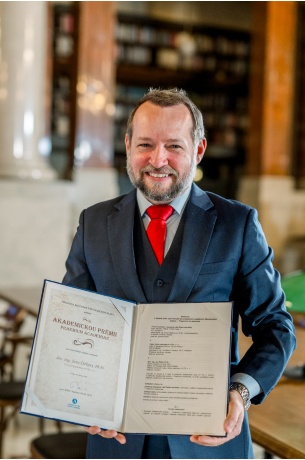
Jan Čížek
The Ageing and Life Cycles of Fish
Evolutionary ecologist Martin Reichard from the Institute of Vertebrate Biology of the CAS studies why some fish mature within a few months while others live for many years. He is a pioneer in ageing research using killifish – small fish with extraordinarily short lifespans that are now also used in biomedical research.
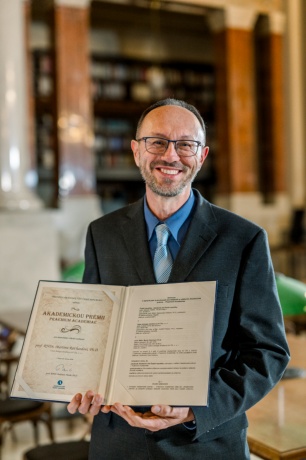
Martin Reichard
Housing as an Investment
Over the past two decades, housing has shifted from a place to call home into an investment, creating property inequalities that can threaten social cohesion. Through his project HouStab, Martin Lux from the Institute of Sociology of the CAS seeks to answer why these disparities are widening faster in some European countries than in others. His findings are intended to inform European regulations as well as Czech housing policy.
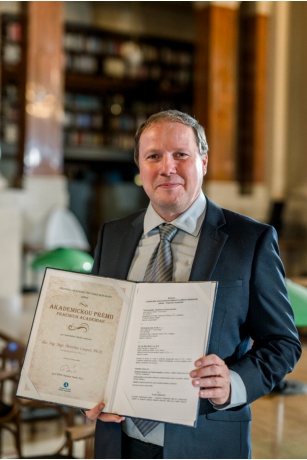
Martin Lux
Lumina Quaeruntur Fellowship
The Lumina Quaeruntur fellowship is intended to award scientists in their mid-career, including those returning to work after parental leave. It is intended to help the laureate establish their own research group, with support of up to CZK 4 million per calendar year for a maximum of five years. At least 20% of the budget is covered by the academic institution where the laureate will work.
This year, the fellowship was awarded to Veronika Brychová from the Nuclear Physics Institute of the CAS, Pavlína Modlitbová from the Institute of Scientific Instruments of the CAS, Ondřej Mrózek from the Institute of Inorganic Chemistry of the CAS, Hana Polášek-Sedláčková from the Institute of Biophysics of the CAS, Václav Hrnčíř from the Institute of Archaeology of the CAS, Prague, and Kieran O’Mahony from the Institute of Ethnology of the CAS.
More Precise Dating of Finds
Radiocarbon dating reaches its limits wherever the original material has not been preserved or has been contaminated. Veronika Brychová from the Nuclear Physics Institute of the CAS is therefore developing a methodology to determine the age of specific organic substances within archaeological samples, such as residues preserved in prehistoric pottery. These substances can reveal not only the age of a find, but also what it was used for.
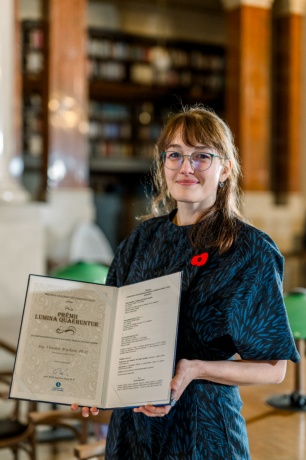
Veronika Brychová
How Microplastics Enter Plants
Microplastics in plants represent an increasingly pressing environmental concern. Pavlína Modlitbová from the Institute of Scientific Instruments of the CAS aims to uncover how microplastics enter plants, where they accumulate, and how they affect surrounding tissue. For instance, she wants to find out whether the particles merely adhere to the surface or penetrate deeper into the plant.
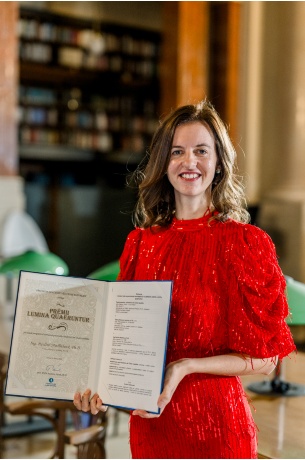
Pavlína Modlitbová
Carbon Instead of Rare Metals
OLED displays currently rely on rare, expensive, and toxic heavy metals such as iridium. Ondřej Mrózek from the Institute of Inorganic Chemistry of the CAS aims to replace them with more accessible carbon compounds in a low-valent form. However, these compounds tend to be unstable. Successfully stabilising them could also open up applications in catalysis and materials chemistry.
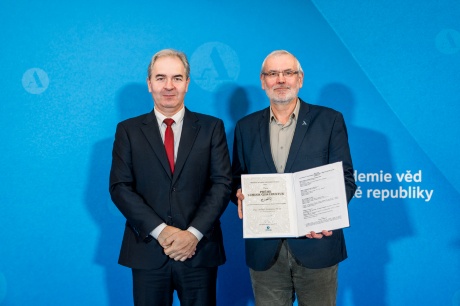
Kamil Lang, director of the Institute of Inorganic Chemistry of the CAS, accepted the award on behalf of Ondřej Mrózek.
How Cells Replicate DNA
Before dividing, a cell must accurately copy its DNA. Hana Polášek-Sedláčková from the Institute of Biophysics of the CAS investigates how cells choose where to initiate replication under both normal and stress conditions, and how this process changes in cells with multiple copies of the genome. Her research aims to clarify how DNA replication relates to tissue growth and renewal, as well as to the protection of genetic information from damage.
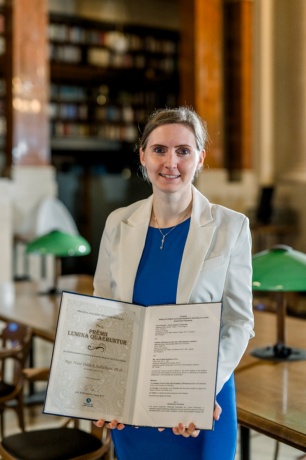
Hana Polášek-Sedláčková
The Beginnings of Technology
It remains unclear how and why human technological sophistication began, because most early tools were made of organic materials that have not survived. Václav Hrnčíř from the Institute of Archaeology of the CAS, Prague, will therefore combine archaeology with insights on contemporary traditional societies, such as hunter-gatherers, to investigate why some groups develop an array of complex technologies while others make do with a much simpler toolkit. 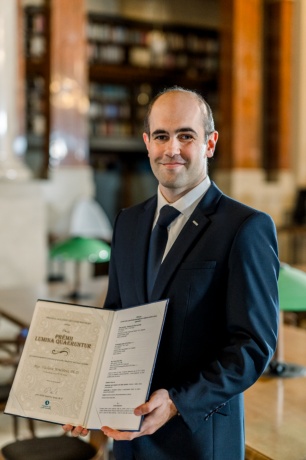
Václav Hrnčíř
Rewilding and the Perception of Death
Rewilding is an approach to nature conservation based on returning natural processes to the landscape and letting it develop more spontaneously. Kieran O’Mahony from the Institute of Ethnology of the CAS explores how this approach is changing our perception of death in nature and why we consider certain forms of death natural while trying to prevent others. He demonstrates that it is not only about how much life we can return to the landscape, but also about how willing we are to accept death.
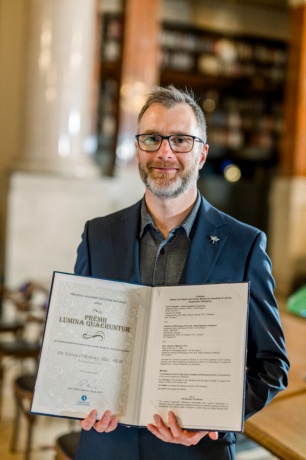
Kieran O’Mahony
More information about the Academic Award – Praemium Academiae and the Lumina Quaeruntur fellowship can be found on the CAS website. Further details regarding the laureates are available in the press release (in Czech).
Want to stay up to date? The A / From the Academy newsletter brings you the highlights from across the Czech Academy of Sciences – interviews, features, events, and news from our institutes. We send it out once a month in both Czech and English to CAS employees and other interested readers. You can subscribe here.
Prepared by: Zuzana Dupalová, External Relations Division, Centre of Administration and Operations of the CAS
Translated by: Aneta Ryntová, External Relations Division, CAO of the CAS
Photo: Pavlína Černoch Jáchimová, External Relations Division, CAO of the CAS
 The text and photos are released for use under the Creative Commons license.


Read also
- Cartilage, Step on the Gas: New Treatments for Rare Growth Disorders
- Water Is Not Enough for Settlement. Stone Was Equally Important
- A / Magazine: Toxins, Languages, and Lightning on Jupiter
- ERC-funded CLOSER Project Highlights the Middle East and North Africa Region
- Bernard Bolzano: An Inconvenient Genius Ahead of His Time
- Our Health in the Hands of AI: How to Regulate It and What to Watch Out For?
- CAS Condemns Attack on National Academy of Sciences of Ukraine
- New CAS Program Already Has First ERC Grant Winners to Its Credit
- Three researchers from the Czech Academy receive prestigious ERC grants
- Ombudswoman of the CAS Dana Plavcová: I'm glad when things change for the better
The Czech Academy of Sciences (the CAS)
The mission of the CAS
The primary mission of the CAS is to conduct research in a broad spectrum of natural, technical and social sciences as well as humanities. This research aims to advance progress of scientific knowledge at the international level, considering, however, the specific needs of the Czech society and the national culture.
President of the CAS
Prof. Radomír Pánek started his first term of office in March 2025. He is a prominent Czech scientist specializing in plasma physics and nuclear fusion.