
New Cobalt Irradiator to Aid Radiobiology and Space Research
13. 11. 2026
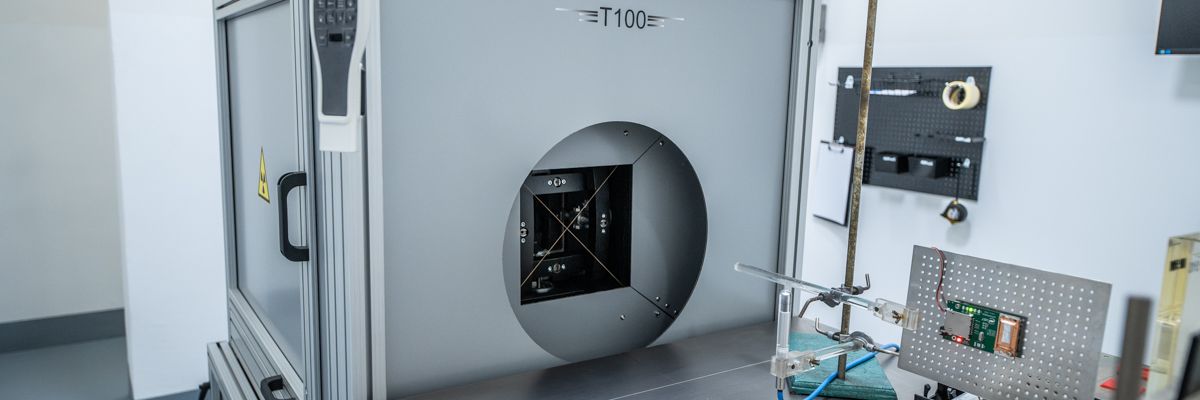
Next year, Czech astronaut Aleš Svoboda is set to participate in a mission to the International Space Station. Experts from the Nuclear Physics Institute of the Czech Academy of Sciences are testing some of the equipment and experiments he will bring on board. A new high-performance T100 cobalt irradiator, officially inaugurated on 30 September 2026 by CAS President Radomír Pánek, will be a key asset in this process. The T100 is one of the most powerful devices of its kind in the Czech Republic and is located at the institute’s Bulovka facility in Prague.
Few would expect to find a top-tier research facility of the Nuclear Physics Institute of the CAS in an unassuming building on the edge of the Bulovka University Hospital grounds. Yet it has not only a long-standing tradition, but also a promising future. In the 1950s, renowned physicist, science populariser, and writer František Běhounek established and led research in dosimetry – the measurement and assessment of ionising radiation – here. His work is commemorated by a plaque outside the entrance and by display cases featuring historical instruments and items from his office. However, the newest addition to the scientific equipment proves that the institute is certainly not only looking back to the past – quite the contrary.
“The T100 irradiator represents a significant boost to domestic research infrastructure and confirms the Academy’s long-term commitment to supporting cutting-edge research,” says President of the Czech Academy of Sciences Radomír Pánek.
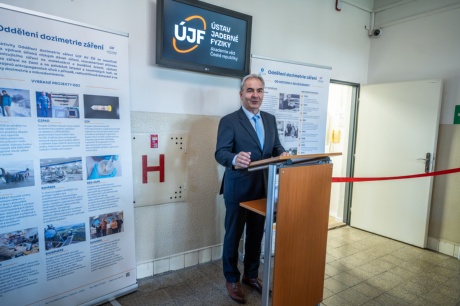
President of the Czech Academy of Sciences Radomír Pánek at the inauguration of the T100 cobalt irradiator.
Roughly the size of a large fridge, the device is housed in a dedicated, well-shielded room. The T100 can generate intense and precisely defined fields of ionising radiation and target samples under controlled conditions. It replaces an older irradiator that had been in operation at the site for several decades.
The radiation source of the new apparatus is significantly more powerful than that of its predecessor, yet it is simpler to operate and safer for conducting experiments. “We strictly adhere to the rules approved by the State Office for Nuclear Safety. We operate within a Category III workplace – a controlled area housing a high-activity source,” confirms Jakub Šlegl from the Nuclear Physics Institute of the CAS. The presence of a person with special professional competence is always required, and the device will also undergo regular inspections.
SPACE EMBRYOS AND DOSIMETERS
Some of the first experiments to be conducted using the irradiator are related to space research. The ZOE project, selected by the European Space Agency for the Czech astronaut’s mission to the ISS, investigates the embryonic development of vertebrates using Japanese quail eggs. “We will measure how microgravity and cosmic radiation might affect the development of the foetus inside the egg. We will subject it to intense irradiation to find out right here on Earth what happens to it,” says Jakub Šlegl.
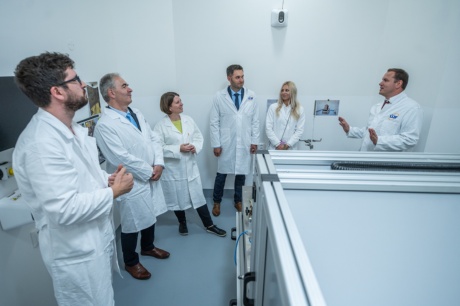
Ondřej Svoboda, Director of the Nuclear Physics Institute of the CAS, explains how the T100 works to CAS President Radomír Pánek and other guests.
The second space experiment the irradiator will assist with is CZPAD, which involves scientists developing a personal dosimeter for Aleš Svoboda. The project will help enhance astronaut safety during future long-duration crewed missions. In addition, the new insights will be applicable in areas such as aviation, nuclear energy, and healthcare.
The T100 will be used to calibrate and verify dosimeters as well as detectors used in radiotherapy. Other potential applications include radiobiological research and testing the radiation resistance of materials and electronics.
“The new irradiator will significantly expand our research capabilities and connect areas that the NPI has long been pursuing. It will also open up new opportunities for cooperation with other research institutions and industry,” says Ondřej Svoboda, Director of the Nuclear Physics Institute of the CAS.
The acquisition of the T100 irradiator and the renovation of the associated premises represented an investment of CZK 21 million by the Czech Academy of Sciences. “It is, of course, a major investment, but I am convinced that without investment we cannot move forward,” concludes CAS President Radomír Pánek, who also highlighted the device’s strong potential for practical application.
Written by: Leona Matušková, External Relations Division, CAO of the CAS
Translated by: Aneta Ryntová, External Relations Division, CAO of the CAS
Photo: Josef Landergott, External Relations Division, CAO of the CAS
 The text and photos are released for use under a Creative Commons licence.


Read also
- Czech Academy of Sciences to Support Groundbreaking Research by Nine Scientists
- Cartilage, Step on the Gas: New Treatments for Rare Growth Disorders
- Water Is Not Enough for Settlement. Stone Was Equally Important
- A / Magazine: Toxins, Languages, and Lightning on Jupiter
- ERC-funded CLOSER Project Highlights the Middle East and North Africa Region
- Bernard Bolzano: An Inconvenient Genius Ahead of His Time
- Our Health in the Hands of AI: How to Regulate It and What to Watch Out For?
- CAS Condemns Attack on National Academy of Sciences of Ukraine
- New CAS Program Already Has First ERC Grant Winners to Its Credit
- Three researchers from the Czech Academy receive prestigious ERC grants
The Czech Academy of Sciences (the CAS)
The mission of the CAS
The primary mission of the CAS is to conduct research in a broad spectrum of natural, technical and social sciences as well as humanities. This research aims to advance progress of scientific knowledge at the international level, considering, however, the specific needs of the Czech society and the national culture.
President of the CAS
Prof. Radomír Pánek started his first term of office in March 2025. He is a prominent Czech scientist specializing in plasma physics and nuclear fusion.