
Decoding Barley: Scientists Reveal It Acquired Genes from Distant Grasses
23. 11. 2026
Barley is one of the most significant agricultural crops, yet it still holds surprises. An international team of researchers from seven countries, including Olomouc-based scientists from the Institute of Experimental Botany of the CAS, compared the genomes of 25 barley species. They discovered that the plant’s evolutionary history is much more turbulent than previously assumed. The results of the study, published in the journal Nature, can aid in barley breeding.
Traces of ancient interspecific hybridisation and major chromosomal rearrangements. All this was revealed through detailed analysis and comparison of 27 samples representing 25 barley species. Additionally, the researchers identified 611 genes that wild barley species acquired during evolution from distantly related grasses of the subfamily Panicoideae.
The extensive study, which demonstrated that the plant doesn’t exactly have a simple family tree, was coordinated by Martin Mascher from the Leibniz Institute of Plant Genetics and Crop Plant Research (IPK) in Gatersleben, Germany.
FLOWERING EVEN WITHOUT THE COLD
Scientists from the Institute of Experimental Botany of the Czech Academy of Sciences were a crucial part of the 41-member international team. The IEB researchers, based at the Institute’s Olomouc facility, focused on genes that influence flowering time and the plants’ response to winter cold. In wild barley, they discovered several variants of the VRN1 and VRN2 genes. Some of these allow the plants to grow and flower without prior exposure to low winter temperatures, similar to spring barley.
“It’s not about finding a single ‘miracle’ gene for better barley. What’s important is to know what variants nature has created during evolution and what they influence in the plant. For genes that control the response to cold and the flowering period, we now see a much broader spectrum of possibilities than what we know solely from cultivated barley,” says Jan Šafář from the Centre of Plant Structural and Functional Genomics at the IEB CAS, one of the study’s authors. “We can further investigate some of these to determine whether they might also be useful for breeding,” adds the researcher.
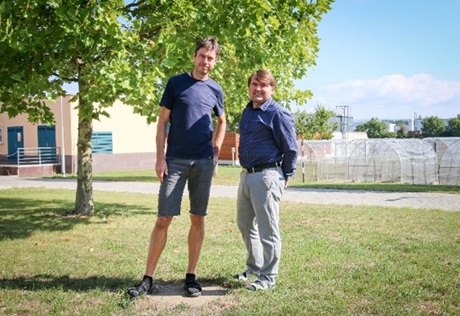
Two of the study’s lead authors, David Kopecký (left) and Jan Šafář (right).
Proper timing of development and flowering helps plants adapt to environmental changes. Greater genetic diversity can therefore be a valuable resource for breeding, especially in light of climate change. Scientists in Olomouc are already testing under real-world field conditions how selected changes in the VRN1 gene affect the development and flowering of spring barley.
GENES FROM DISTANT RELATIVES
Together with his colleagues, plant geneticist and study co-author David Kopecký investigated genes that entered barley genomes over the course of evolution from distantly related grasses through what is known as horizontal gene transfer. Through this unusual process, a plant acquires genetic material from another species – outside the normal line of descent from parent to offspring.
“The results show that these events have left a significant mark on the genomes of wild barley and that some of the transferred genes are still active. The next step will be to determine what function these genes serve in the plants and whether any of them may have helped the plants adapt to various conditions,” explains the researcher.
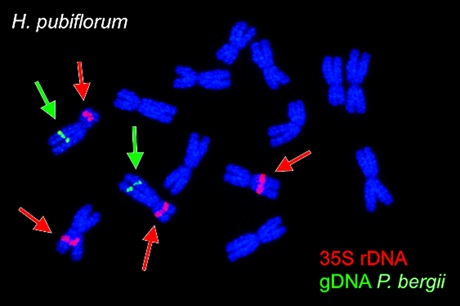
Chromosomes of a wild barley species under a fluorescence microscope. DNA segments acquired during evolution from distantly related grasses are marked in green.
Alongside scientists from the Institute of Experimental Botany, researchers from two other Czech Academy of Sciences institutes – the Institute of Biophysics and the Institute of Botany – also contributed to the study. The genome comparison has provided scientists with the most detailed picture to date of how barley has changed over the course of evolution and how individual species differ genetically. This knowledge can help researchers better understand the characteristics of cultivated barley and its wild relatives, which could help breed modern crops that are more resilient to stress and a changing climate in the future.
Prepared by: Radka Římanová, External Relations Division, CAO of the CAS, drawing on an IEB CAS press release
Translated by: Aneta Ryntová, External Relations Division, CAO of the CAS
Photo: Shutterstock, IEB CAS Archive
 The text is released for use under the Creative Commons licence.
Read also
- Ombudspersons at the CAS Practised Navigating Difficult Conversations
- Highlights from the 2026 Week of the Czech Academy of Sciences
- New Cobalt Irradiator to Aid Radiobiology and Space Research
- Czech Academy of Sciences to Support Groundbreaking Research by Nine Scientists
- Cartilage, Step on the Gas: New Treatments for Rare Growth Disorders
- Water Is Not Enough for Settlement. Stone Was Equally Important
- A / Magazine: Toxins, Languages, and Lightning on Jupiter
- ERC-funded CLOSER Project Highlights the Middle East and North Africa Region
- Bernard Bolzano: An Inconvenient Genius Ahead of His Time
- Our Health in the Hands of AI: How to Regulate It and What to Watch Out For?
The Czech Academy of Sciences (the CAS)
The mission of the CAS
The primary mission of the CAS is to conduct research in a broad spectrum of natural, technical and social sciences as well as humanities. This research aims to advance progress of scientific knowledge at the international level, considering, however, the specific needs of the Czech society and the national culture.
President of the CAS
Prof. Radomír Pánek started his first term of office in March 2025. He is a prominent Czech scientist specializing in plasma physics and nuclear fusion.