
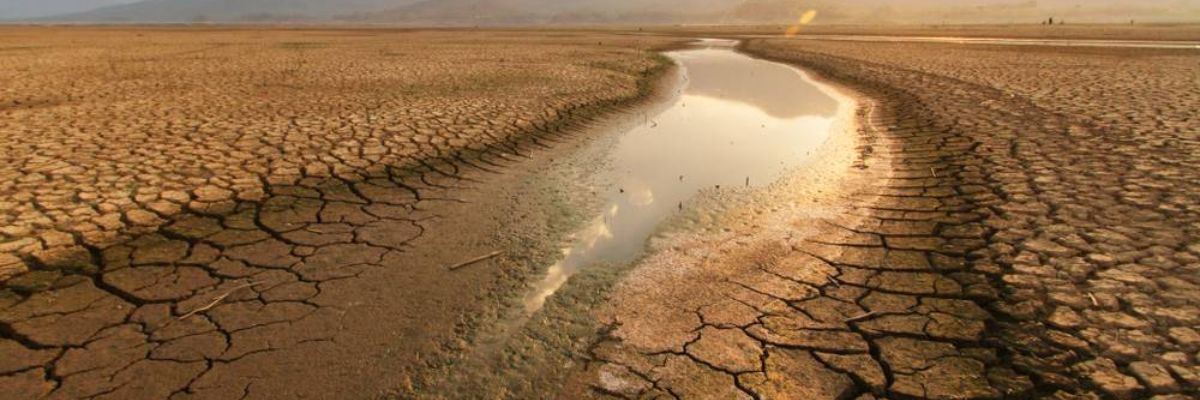
Alarming increase in soil drought in a third of the world, researchers find
02. 01. 2024
At the start of each new year, people usually look to the future to speculate what it will bring. Experts from CzechGlobe have looked back into the past, however, to map the drying of the planet’s soil. They discovered that in the one third of our planet that is not permanently glaciated, soil moisture has been declining significantly over the last four decades. In contrast, only five percent of non-glaciated land has seen a long-term and significant increase in soil moisture. The study was published in the international scientific journal Environmental Research Letters.
According to the study worked on by an international team led by Jan Řehoř from the Global Change Research Institute of the CAS – CzechGlobe and the Faculty of Science of Masaryk University, the regions most affected by ever-increasing intense drought include equatorial Africa, much of South America, the continental U.S., and a belt extending from eastern Europe to eastern Asia.
The increase in drought in certain regions, which researchers have been recording since the 1980s, is linked to climate change. The main drivers of this trend are rising temperatures, which are also the cause of higher evapotranspiration, and a change in the spatiotemporal distribution of precipitation.
Analyses over the past four decades
The experts involved analysed the time period spanning from 1981 to 2021, for which they modelled soil moisture based on ERA5-Land atmospheric reanalysis data with a 0.1° resolution and calculated trends of increasing or decreasing moisture.
“The results for South America came out worst. Fifty-four percent of the continent was significantly affected by drought, while soil moisture increased in only one percent of the region,” Řehoř says. This primarily concerns the central part of the continent, while the north and south have not been affected. Argentina and Paraguay have been drying out the fastest, along with the south-western part of Brazil, where soil moisture decreased by up to ten percent every decade.
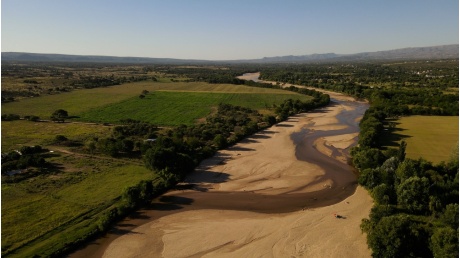
More than half of South America has been significantly affected by drought. Pictured here: a dried-up riverbed near Córdoba, Argentina.
The other continents are less impacted by the drying. In Africa, significant drought has affected 40 percent of the continent, while soil moisture has increased in eight percent of the region. In Asia, 32 percent of the region has dried up and six percent has had an increase in soil moisture. In Europe, 37 percent of the land has seen a decrease and one percent has had an increase in soil moisture. North America was the least affected by the negative trend. “We found a statistically significant decrease in soil moisture in sixteen percent of the region and an increase in soil moisture in seven percent,” the scientist explains. In contrast, however, a drought “hotspot” was identified in the American Midwest. Australia and Oceania, on the other hand, were affected relatively little.
Drought is also hitting the old continent
In Europe, soil drought is most pronounced in summer and has mainly been affecting the central and eastern parts of the continent. “In central Europe, drying is occurring more rapidly in the central and north-western parts including the Czech Republic and the Carpathian arc, while the trend is slower in the Pannonian Basin, mainly in Hungary,” Řehoř says.
Areas where there has been a significant increase in soil moisture include western India, the Tibetan Plateau, Canada, and parts of arid and semiarid Africa.
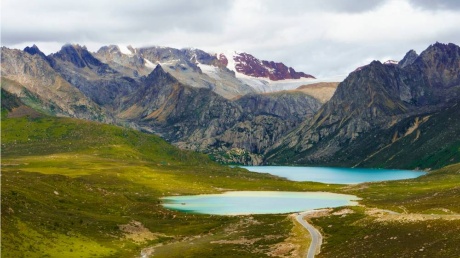
The Tibetan Plateau is one of the places where soil moisture has increased significantly.
The vulnerability of worldwide agriculture and ecosystems is on the rise due to the significant decrease of soil moisture on a global scale. The atmosphere heats up more rapidly when the soil water capacity is lower than normal. And the combination of extremely warm weather and drought, which the observed trends of declining soil moisture have affirmed, has led to more widespread fires in certain areas, including tropical and subtropical Africa, South America, and parts of Siberia. With the occurrence of droughts and the course of heat waves getting significantly worse, this is truly a hot topic that deserves urgent attention.
The study was published in Environmental Research Letters.
Prepared by: Markéta Wernerová, External Relations Division, CAO of the CAS, drawing on the press release of the CAS
Translated by: Tereza Novická, External Relations Division, CAO of the CAS
Photo: Shutterstock
 The text is released for use under the Creative Commons license.
Read also
- New Academy of Sciences Program Already Has First ERC Grant Winners to Its Credit
- Three researchers from the Czech Academy receive prestigious ERC grants
- Ombudswoman of the CAS Dana Plavcová: I'm glad when things change for the better
- Early-Career Researchers from the CAS Received the 2026 Otto Wichterle Award
- Jackal Expansion Across Europe Facilitated by Humans, Curbed by Wolves
- Languages Don’t Overload the Brain, Psycholinguists Say
- Czech Academy of Sciences Evaluation – Beyond Metrics, Accent on Peer Review
- Ordovician Fauna Beneath Prague – New Arthropod Found During Metro Line Dig
- Wildfires on the Rise in Europe and Set to Double by 2100. What Can We Do?
- The CAS Photogenic Science Contest Invites Entries
The Czech Academy of Sciences (the CAS)
The mission of the CAS
The primary mission of the CAS is to conduct research in a broad spectrum of natural, technical and social sciences as well as humanities. This research aims to advance progress of scientific knowledge at the international level, considering, however, the specific needs of the Czech society and the national culture.
President of the CAS
Prof. Radomír Pánek started his first term of office in March 2025. He is a prominent Czech scientist specializing in plasma physics and nuclear fusion.