

A special method to detect drug-induced liver injury
16. 09. 2021
How can physics help in a medical matter such as drug-induced liver injury? The answer is in cutting-edge imaging techniques. Czech scientists created a procedure for studying the liver cells in 3D in the real time. And thus, they generated new knowledge and approaches to dealing with drug-induced liver injury.
Every now and then, a discussion about side-effects of different drugs comes up. One of those side-effects is liver injury. All medical drugs go through tests, of course, but the standard pre-clinic screening of their possible toxicity uses traditional in-vitro tools. As a result, in the cases when a cell adapts early to a drug-induced injury, its changes cannot be reliably detected by those tests.
Super-resolution microscopy in medicine service
Physicists from the Institute of Physics of the Czech Academy of Sciences (the CAS) found a way how to study liver cells in 3D, within the cells, and in the real time. This all is possible due to super-resolution confocal microscope based on a spinning disc. “These non-invasive technologies improve cellular system imaging, and they can be very helpful when screening drug-induced liver injury models,” Oleg Lunov from the Institute of Physics of the CAS says.
Along with the biochemical and molecular biology methods, the imaging techniques have provided another useful tool for detailed cellular process observations.
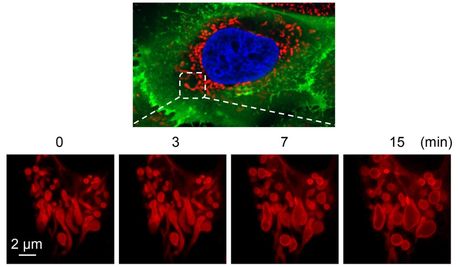
Interval imaging of mitochondrial damage in liver cells, provided with a super-resolution spinning disc microscope
The new evaluation of liver injury
The Czech physicists joined an international interdisciplinary research team focused on the drug-induced liver injury problematics. Within the published research, the international team gave a detailed description of how researchers should evaluate liver injury while testing drug safety. There are no reliable drug-induced injury models available that are accepted by regulatory bodies in Europe and the USA, the scientists further emphasized. “It is worth noting, that up to 30 % of drug withdrawals are attributed to hepatoxicity (i.e. drug-induced liver injury). That’s why we feel the need to develop new physiologically relevant pre-clinical models for drug screening for liver injury,” Alexandr Dejneka from the Institute of Physics of the CAS adds.
For this reason, the whole research aims to create a robust and reliable liver model for timely detection of drug toxicity, too. The study was published in the prestigious Journal of Hepatology.
Unique, co-operative, interdisciplinary network for “better livers”
This unique multidisciplinary research is carried out as a part of the European Drug-Induced Liver Injury Network (PRO-EURO-DILI-NET), involving active participation of the researchers from the Institute of Physics of the CAS.
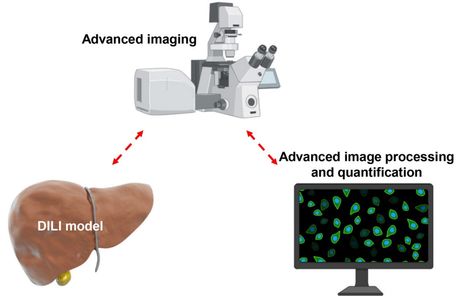
Using advanced imaging techniques in solving drug-induced liver injury
The objectives of the PRO-EURO-DILI-NET are to create a unique, co-operative, interdisciplinary European-based DILI network of stakeholders. That would help to coordinate efforts in DILI, to facilitate mutual exchange of discovered knowledge and generated hypotheses among different disciplines, and to promote clinically impactful knowledge discovery and its translation into clinical practice.
Text: Eliška Zvolánková, Division of External Relations, CAS Centre of Administration and Operations
Photos: Shutterstock, Institute of Physics of the CAS
Read also
- Three researchers from the Czech Academy receive prestigious ERC grants
- Ombudswoman of the CAS Dana Plavcová: I'm glad when things change for the better
- Early-Career Researchers from the CAS Received the 2026 Otto Wichterle Award
- Jackal Expansion Across Europe Facilitated by Humans, Curbed by Wolves
- Languages Don’t Overload the Brain, Psycholinguists Say
- Czech Academy of Sciences Evaluation – Beyond Metrics, Accent on Peer Review
- Ordovician Fauna Beneath Prague – New Arthropod Found During Metro Line Dig
- Wildfires on the Rise in Europe and Set to Double by 2100. What Can We Do?
- The CAS Photogenic Science Contest Invites Entries
- The CAS Launches New Research Programs as Part of Its Strategy AV21
The Czech Academy of Sciences (the CAS)
The mission of the CAS
The primary mission of the CAS is to conduct research in a broad spectrum of natural, technical and social sciences as well as humanities. This research aims to advance progress of scientific knowledge at the international level, considering, however, the specific needs of the Czech society and the national culture.
President of the CAS
Prof. Radomír Pánek started his first term of office in March 2025. He is a prominent Czech scientist specializing in plasma physics and nuclear fusion.