
Optical fiber research in Czechia started 40 years ago
02. 04. 2019
Optical fiber: originally an underestimated invention which later completely changed the world of telecommunications technologies. In former Czechoslovakia, its research started in 1979 in laboratories of the Academy of Sciences. Today, the Institute of Photonics and electronics of the CAS is among the top laboratories capable of preparing special optical fibers for high-power fiber lasers. This is one of the reasons why scientists will meet this April in Prague at the SPIE Optics + Optoelectronics symposium.
The principle of light propagation in optical fibers is surprisingly simple – it basically utilises the phenomenon of total internal reflection on the boundary of the core and the coating of the fiber. Therefore, optical fibers are widely used in communications, replacing metal conductors, because signals in optical fibers are carried with less loss. At the same time, the fibers are immune to electromagnetic interference.
At the dawn of transfer of scientific knowledge into international practice was a scientist of Czech origin, Erich Spitz, who emigrated from Czechoslovakia to France in the 1950s. There he led a laboratory dealing with research of optical fibers for telecommunications in the beginning of 1960s. “Later, Erich Spitz also conducted the first successful attempt at image transfer through a single multi-mode optical fiber,” says Jiří Homola, director of the Institute of Photonics and Electronics of the CAS, regarding the mark of the Czech science on the worldwide engineering.
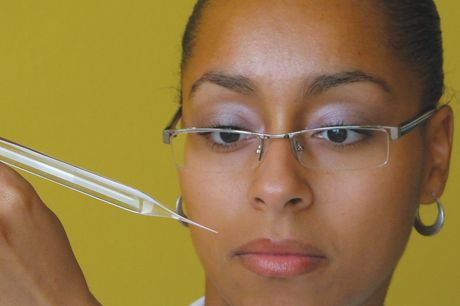
Transition between a glass preform and an optical fiber
Erich Spitz himself will be an important guest of the Optics + Optoelectrics symposium, held by the international society for optics and photonics SPIE from April 1 till April 4 in Prague.
The future belongs to fiber lasers
The so-called fiber lasers are now finding more and more uses in industry. They have a very high electro-optical efficiency (as much as circa 50 %), high output power and high-quality beam which can be focused over large distances. “Their use in the area of security, such as in protection against drones or improvised explosives, is also currently investigated,” says Pavel Honzátko, a team leader of Fiber Lasers and Nonlinear Optics at the Institute of Photonics and Electronics of the CAS, praising the unique properties of fiber lasers. “Thanks to the fact that the fibers are connected with welds, fiber lasers show a high resilience. What’s more, they require virtually no maintenance,” emphasises Pavel Honzátko.
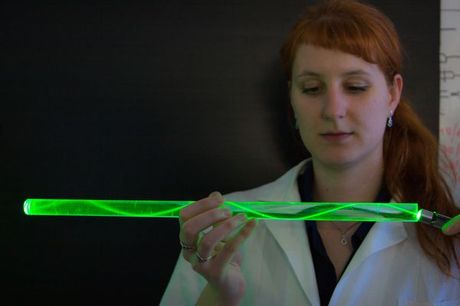
Waveguide principle of light
The special optical fibers and fiber devices from the Institute of Photonics and Electronics are used in many other research institutes both in the Czech Republic and other countries, as well as in industry.
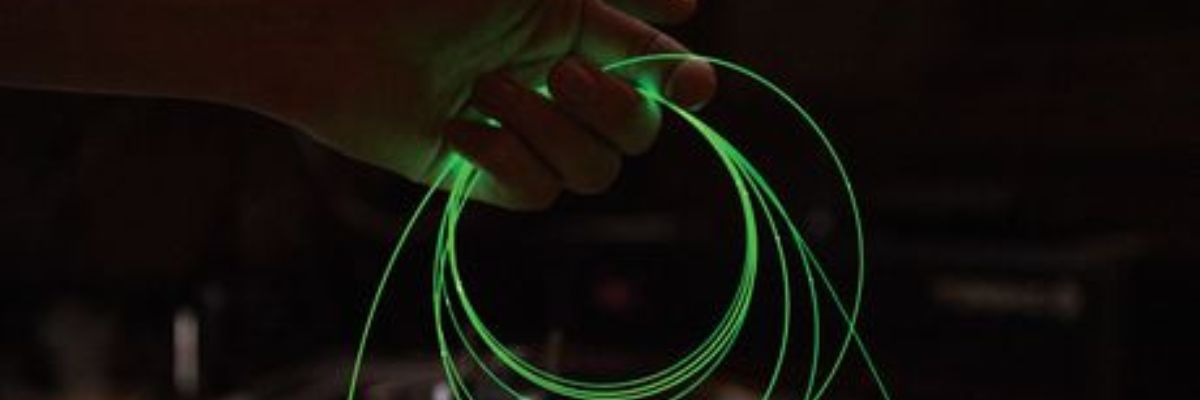
The title photo shows an optical fiber
Prepared by: Petra Palečková, Institute of Photonics and Electronics of the CAS, in cooperation with Markéta Růžičková, Department of Media Communication of the Head Office of the CAS
Photo: Institute of Photonics and Electronics of the CAS
Read also
- Bernard Bolzano: An Inconvenient Genius Ahead of His Time
- Our Health in the Hands of AI: How to Regulate It and What to Watch Out For?
- CAS condemns attack on National Academy of Sciences of Ukraine
- New Academy of Sciences Program Already Has First ERC Grant Winners to Its Credit
- Three researchers from the Czech Academy receive prestigious ERC grants
- Ombudswoman of the CAS Dana Plavcová: I'm glad when things change for the better
- Early-Career Researchers from the CAS Received the 2026 Otto Wichterle Award
- Jackal Expansion Across Europe Facilitated by Humans, Curbed by Wolves
- Languages Don’t Overload the Brain, Psycholinguists Say
- Czech Academy of Sciences Evaluation – Beyond Metrics, Accent on Peer Review
The Czech Academy of Sciences (the CAS)
The mission of the CAS
The primary mission of the CAS is to conduct research in a broad spectrum of natural, technical and social sciences as well as humanities. This research aims to advance progress of scientific knowledge at the international level, considering, however, the specific needs of the Czech society and the national culture.
President of the CAS
Prof. Radomír Pánek started his first term of office in March 2025. He is a prominent Czech scientist specializing in plasma physics and nuclear fusion.