
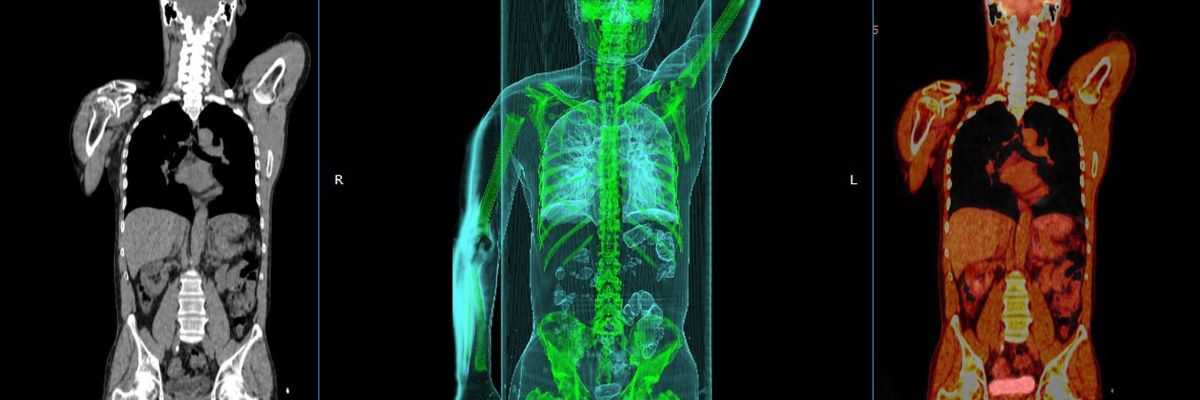
New type of contrast agent will help with early detection of covert diseases
09. 08. 2024
It can be used in both magnetic resonance imaging (MRI) and positron emission tomography (PET). This breakthrough, contributed to significantly by researchers from the IOCB of the CAS, promises a substantial improvement in diagnostics and subsequent treatment, particularly for kidney diseases and tumors. The research was published in Angewandte Chemie.
While MRI is mainly suitable for detailed examinations of internal organs and the brain, PET is ideal for detecting malignant diseases, such as tumors, because it has the ability to clearly image pathologically changed cells.
There was no doubt that combining these two imaging methods would improve diagnostics. However, the strong magnetic field in MRI obstructs the functioning of the electronics required for PET. Once the researchers solved this problem, they still needed to develop a dual-purpose contrast agent that would work with both methods. This is precisely what the scientists from the Institute of Organic Chemistry and Biochemistry of the Czech Academy of Sciences (CAS), in collaboration with colleagues from the University of Tübingen (Germany) and the Faculty of Science at Charles University (Prague), achieved.
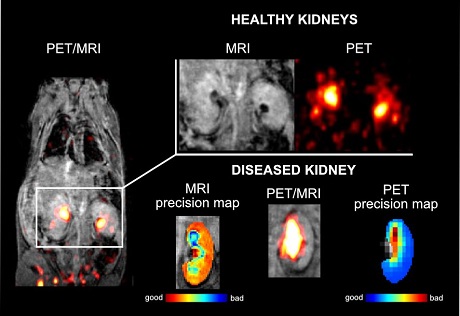
Simultaneous PET/MRI imaging of healthy and diseased mouse kidneys using a dual-purpose contrast agent.
Smart molecule
“Previous attempts to make PET/MRI probes aimed to achieve advanced and specialized functions, which led to complicated molecules with difficult synthesis and a narrow scope of use. We turned this around by designing a molecule that is simple to use and has broad applicability, one that radiologists will intuitively know how to use. It replicates all the favorable properties of current clinical MRI contrast agents and also provides a PET signal. This adds another dimension of information, improving accuracy and opening new diagnostic applications,” explains Miloslav Polášek, head of the Coordination Chemistry group at the IOCB of the CAS, where the work started.
Moreover, scientists can produce the new agent quickly and efficiently. The designed molecule combines gadolinium and radioactive fluorine-18, substances commonly used in medical scans, which makes them easy to obtain. Researchers can prepare enough of the contrast agent in just thirty minutes to treat five patients.
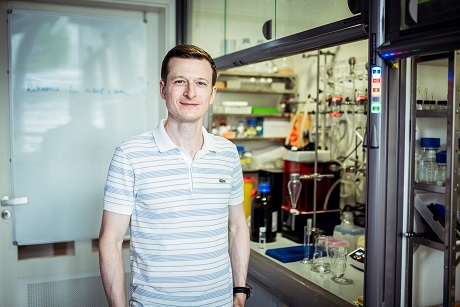
Miloslav Polášek from the Institute of Organic Chemistry and Biochemistry of the CAS.
“Connecting these two parts required overcoming several problems, including the large difference in the amounts needed for MRI and PET images. We solved this by using an innovative technique to swap nonradioactive fluorine atoms in the MRI contrast agent for radioactive fluorine-18 atoms. The reaction is elegant, fast, and effective,” says Jan Kretschmer, one of Dr. Polášek’s former PhD students and the first co-author of the study, who currently works in André Ferreira Martins’ group at the Werner Siemens Imaging Center at the University of Tübingen.
A revolutionary discovery
The resulting contrast agent remains stable within the body, which is promising for future clinical use. Additionally, during animal model testing, researchers made a potentially groundbreaking discovery. They found that one seemingly healthy mouse had kidney problems, which could only be and was detected thanks to the simultaneous PET and MRI monitoring. This non-invasive form of imaging allows real-time tracking of biochemical processes in organs by way of the accumulation and subsequent excretion of the contrast agent.
“This method represents a pioneering step toward personalized diagnostics, showcasing the significant diagnostic potential of our hybrid molecule. This is a revolutionary discovery in the field of precise imaging. We are on a path that will eventually allow us to determine not only what disease a patient has but also the stage, type, and aggressiveness of the condition,” André Ferreira Martins adds.
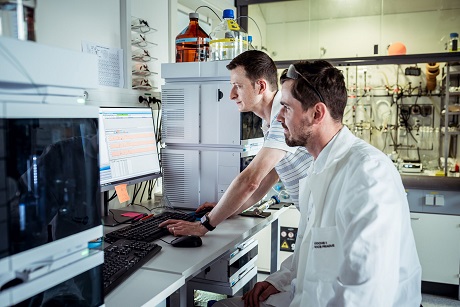
Miloslav Polášek (left) from IOCB Prague and Jan Kretschmer from the University of Tübingen.
According to Polášek, the new hybrid contrast agent has properties that make it the first serious candidate for a PET/MRI agent usable in a clinical setting. It is patented, and researchers are now seeking potential investors.
Written and prepared by: Radka Římanová, External Relations Division, CAO of the CAS, drawing on the IOCB Prague press release
Translated by: Tereza Novická, External Relations Division, CAO of the CAS
Photo: Shutterstock; Tomáš Belloň, IOCB Prague
 The text is released for use under the Creative Commons license.
Read also
- Early-Career Researchers from the CAS Received the 2026 Otto Wichterle Award
- Jackal Expansion Across Europe Facilitated by Humans, Curbed by Wolves
- Languages Don’t Overload the Brain, Psycholinguists Say
- Czech Academy of Sciences Evaluation – Beyond Metrics, Accent on Peer Review
- Ordovician Fauna Beneath Prague – New Arthropod Found During Metro Line Dig
- Wildfires on the Rise in Europe and Set to Double by 2100. What Can We Do?
- The CAS Photogenic Science Contest Invites Entries
- The CAS Launches New Research Programs as Part of Its Strategy AV21
- Academy Assembly – Thirteen Priorities to Boost Basic and Applied Research
- We Must Prioritize Science, Czech President Petr Pavel Says on His Academy Visit
The Czech Academy of Sciences (the CAS)
The mission of the CAS
The primary mission of the CAS is to conduct research in a broad spectrum of natural, technical and social sciences as well as humanities. This research aims to advance progress of scientific knowledge at the international level, considering, however, the specific needs of the Czech society and the national culture.
President of the CAS
Prof. Radomír Pánek started his first term of office in March 2025. He is a prominent Czech scientist specializing in plasma physics and nuclear fusion.