

Czech scientists contribute to developing eco-friendly, affordable solar cells
03. 01. 2025
Photovoltaics have become increasingly popular in recent years. People are looking for ways to save on energy costs, while environmental considerations also play a role. But in this field, there is still room for improvement. Researchers from the Institute of Macromolecular Chemistry of the CAS, working together with scientists from Linköping University in Sweden, have made significant progress in the development of eco-friendly solar cells. They have created organic solar cells that offer a more sustainable alternative to traditional silicon-based panels. The results of their research were published in Nature Energy.
The roots of photovoltaic (PV) technologies date back to the 1880s when American inventor Charles Fritts constructed the “great-grandfather” of modern solar panels. He used selenium and gold for his device which he installed on the roof of a building in New York. However, its efficiency was extremely low. Over the following decades, researchers from around the world worked on advancing PV. A breakthrough came in the 1950s when Bell Laboratories in the USA developed the modern form of silicon solar cells.
Originally intended for space exploration and powering remote locations, PV technology gradually gained widespread use and became a key element in reducing dependence on fossil fuels and combating climate change.
Organic solar cells
Czech and Swedish researchers have now achieved a significant breakthrough. Their new technology is comparable to silicon-based panels but has the advantage of lower environmental impact and reduced production costs. It eliminates the need for toxic solvents and employs functional organic materials.
Organic solar cells contain no heavy metals, and their production does not require toxic solvents. Due to their lighter weight, they can be used in applications unsuitable for conventional solar panels – for instance, as transparent window films or as a roofing material with interlocking modules that snap together like roof tiles.
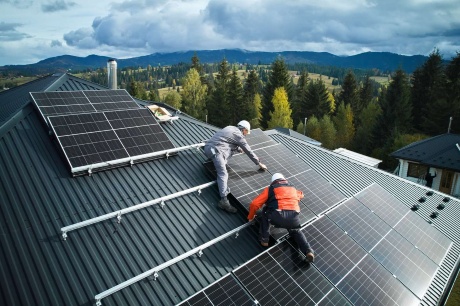
Compared to conventional PV panels (pictured), the newly developed organic solar cells will be more eco-friendly and less expensive to produce.
The scientists employed a revolutionary approach, using polymers and functional organic materials for the production of the solar cells. “These are complex multi-component systems that include a polymeric component and small organic molecules which interact with one another, which helps facilitate charge transport,” explains Libor Kobera from the Structural Analysis Department at the Institute of Macromolecular Chemistry of the CAS.
The Czech team has contributed to the collaboration through structural analysis using nuclear magnetic resonance (NMR) spectroscopy. “Our task is to reveal the structure of the studied material and how the individual components are organized. Subsequently, we strive to identify the relationship between the structure and the properties of these materials,” says Jiří Brus, Head of the Structural Analysis Department.
Collaboration with Linköping University
The Solid-State NMR Spectroscopy Laboratory at the Institute of Macromolecular Chemistry of the CAS has been successfully collaborating with Professor Feng Gao’s team at Linköping University for over five years. Their research focuses on solar cells, with Professor Gao’s team dedicated to discovering new materials and methods to enhance efficiency and environmental sustainability. Special attention is given to perovskite materials, which have attractive properties – but also drawbacks, such as low stability and environmental concerns due to their heavy metal content.
Written and prepared by: Markéta Wernerová, External Relations Division, CAO of the CAS, drawing on the CAS press release (in Czech)
Translated by: Tereza Novická, External Relations Division, CAO of the CAS
Photo: Shutterstock
 The text is released for use under a Creative Commons license.
Read also
- Bernard Bolzano: An Inconvenient Genius Ahead of His Time
- Our Health in the Hands of AI: How to Regulate It and What to Watch Out For?
- CAS condemns attack on National Academy of Sciences of Ukraine
- New Academy of Sciences Program Already Has First ERC Grant Winners to Its Credit
- Three researchers from the Czech Academy receive prestigious ERC grants
- Ombudswoman of the CAS Dana Plavcová: I'm glad when things change for the better
- Early-Career Researchers from the CAS Received the 2026 Otto Wichterle Award
- Jackal Expansion Across Europe Facilitated by Humans, Curbed by Wolves
- Languages Don’t Overload the Brain, Psycholinguists Say
- Czech Academy of Sciences Evaluation – Beyond Metrics, Accent on Peer Review
The Czech Academy of Sciences (the CAS)
The mission of the CAS
The primary mission of the CAS is to conduct research in a broad spectrum of natural, technical and social sciences as well as humanities. This research aims to advance progress of scientific knowledge at the international level, considering, however, the specific needs of the Czech society and the national culture.
President of the CAS
Prof. Radomír Pánek started his first term of office in March 2025. He is a prominent Czech scientist specializing in plasma physics and nuclear fusion.