
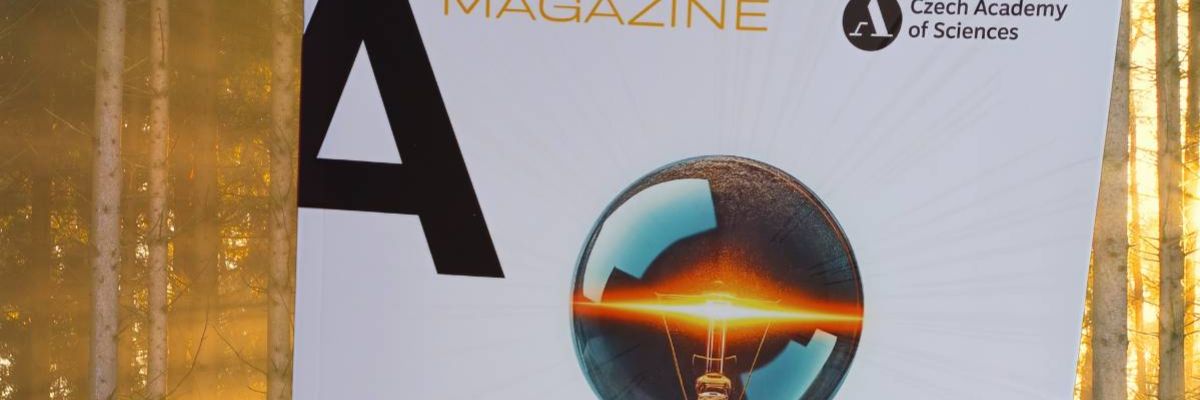
A / Magazine: light, the dawn of quantum computing, and no man’s lands
12. 11. 2024
Light is a key condition for life on Earth. But it’s also a remarkable tool, particularly in fields like microscopy. We now use light to probe previously unreachable depths – such as examining the inner workings of the living brain or observing biomolecules in real time. Light also has applications in laser micro-machining, which enables the creation of bacteria-resistant functional surfaces. Learn more in this special English issue of A / Magazine – the official quarterly magazine published by the Czech Academy of Sciences.
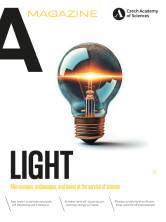
2024 (version for browsing)
2024 (version for download)
The feature of the 2024 English issue of A / Magazine covers the topic of light (two articles):
Light – Illuminating the Invisible (pp. 16–25)
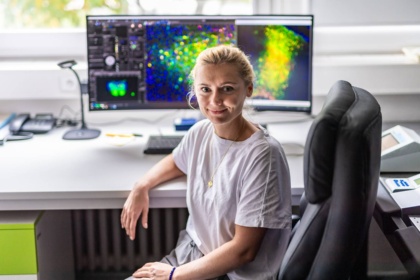
The article focuses on the development of a unique holographic endoscope, currently being advanced by Tomáš Čižmár and his teams at the Institute of Scientific Instruments of the CAS and the Leibniz Institute of Photonic Technology in Germany. The second part discusses nanofluidic scattering microscopy, an area of research led by Barbora Špačková, head of the Dioscuri Center for Single-Molecule Optics at the Institute of Physics of the CAS.
Inspired by Sharks (pp. 26–31)
Bacteria-resistant shark scales, sticky gecko feet, or lotus leaves that repel water – nature designs ingenious surfaces. But can we replicate them? Thanks to laser micro-machining, the answer is yes, as explored by Petr Hauschwitz from the HiLASE Center at the Institute of Physics of the CAS.
Selected additional articles from the issue:
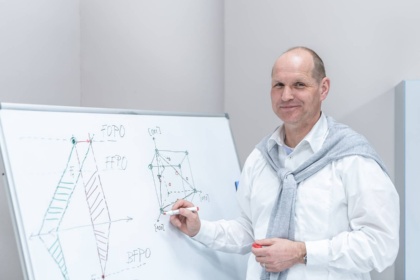
Outside the Box (pp. 58–63) – The trial-and-error method has long been the modus operandi for developing stronger and more flexible metallic materials. Computational technology has greatly accelerated and simplified their advancement. However, even the most powerful computers have their limits. Materials physicist Martin Friák from the Institute of Physics of Materials of the CAS sees the future in quantum computing, which holds the key to overcoming these obstacles.
No Man’s Land (pp. 46–51) – Between March 1938 and September 1939, tens of thousands of Jewish men, women, and children struggled to survive in the forests, fields, and abandoned buildings on the borders of East-Central Europe, involuntarily inhabiting “no man’s land” – a lesser-known chapter in the history of the Holocaust. Discover more in an article on the research of historian Michal Frankl from the Masaryk Institute and Archives of the CAS.
INTERVIEW: The Enfant Terrible of Czech Science (pp. 38–45) – Years ago, parasitologist Julius Lukeš inadvertently made a name for himself by swallowing tapeworm eggs, nurturing the parasite inside his body for years. He lives and breathes parasitology and is considered one of the world’s leading experts in the field. Lukeš is not one to stick to conventions, though, nor is he afraid to stir the pot. Check out the interview with Lukeš from the Biology Center of the CAS.
Can We Repair the Spinal Cord? (pp. 32–37) – In the Czech Republic alone, up to 300 people suffer spinal cord injuries every year. The aftermath of damaging this delicate bundle of nerve fibers is generally irreversible. Or is it? This article discusses the research of Kristýna Kárová from the Institute of Experimental Medicine of the CAS.
*
All issues of A / Magazine – the official quarterly of the Czech Academy of Sciences, including its predecessor A / Science and Research – are available online. We offer free print subscriptions (of the Czech version) to anyone interested – please contact us at predplatne@ssc.cas.cz.
Written and prepared by: Leona Matušková, External Relations Division, CAO of the CAS
Translated by: Tereza Novická, External Relations Division, CAO of the CAS
Photo: Jana Plavec, External Relations Division, CAO of the CAS; Shutterstock
 The text and photos are released for use under the Creative Commons license.
Read also
- Three researchers from the Czech Academy receive prestigious ERC grants
- Ombudswoman of the CAS Dana Plavcová: I'm glad when things change for the better
- Early-Career Researchers from the CAS Received the 2026 Otto Wichterle Award
- Jackal Expansion Across Europe Facilitated by Humans, Curbed by Wolves
- Languages Don’t Overload the Brain, Psycholinguists Say
- Czech Academy of Sciences Evaluation – Beyond Metrics, Accent on Peer Review
- Ordovician Fauna Beneath Prague – New Arthropod Found During Metro Line Dig
- Wildfires on the Rise in Europe and Set to Double by 2100. What Can We Do?
- The CAS Photogenic Science Contest Invites Entries
- The CAS Launches New Research Programs as Part of Its Strategy AV21
The Czech Academy of Sciences (the CAS)
The mission of the CAS
The primary mission of the CAS is to conduct research in a broad spectrum of natural, technical and social sciences as well as humanities. This research aims to advance progress of scientific knowledge at the international level, considering, however, the specific needs of the Czech society and the national culture.
President of the CAS
Prof. Radomír Pánek started his first term of office in March 2025. He is a prominent Czech scientist specializing in plasma physics and nuclear fusion.