

British historian Mark Cornwall honoured by the Czech Academy of Sciences
31. 03. 2022
The Czech Academy of Sciences has awarded British historian Prof. Mark Cornwall the František Palacký Honorary Medal for Merit in Historical Sciences. The expert on 19th- and 20th-century Central European history received the award on 28 March 2022 at the Goethe-Institut in Prague on the occasion of the presentation of the Czech edition of his book, The Devil’s Wall, in which he tackles the long-taboo subject of how youth, homosexuality, and nationalism intersected in a fascist environment.
Mark Cornwall, Professor of Modern European History at the University of Southampton, focuses mainly on the late Habsburg Empire and Czech-German relations. “Just as František Palacký played a very important role in the development of Czech national life and culture, so too does Prof. Cornwall deserve thanks for the care and attention he has devoted to various topics related to our history,” said Ondřej Beránek, Vice President and member of the CAS Academy Council Presidium, during the ceremony. He also thanked the historian for his long-term services to cultivating Anglo-Czech relations and promoting Czech studies in the United Kingdom.
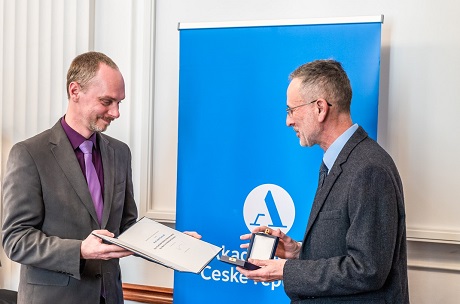
The František Palacký Honorary Medal was presented to Mark Cornwall by Ondřej Beránek, Vice President and member of the CAS Academy Council Presidium. (CC)
A forgotten story revived
Mark Cornwall presented the Czech translation of his book, The Devil’s Wall: The Nationalist Youth Mission of Heinz Rutha, at the Goethe-Institut in Prague. In it, he introduces a new perspective on Czech-German relations. He challenges the notion that all Sudeten Germans must necessarily have been Nazis and supplies a fresh explanation for Britain’s appeasement of Hitler. The author also addresses the issue of repressed sexuality. In the book, the historian revives the forgotten story of Heinz Rutha, an associate of Konrad Henlein who was charged with sexual deviance and corrupting adolescent men in 1937. Following his imprisonment, Rutha committed suicide. Germans subsequently attempted to erase this pioneer of the Sudeten German youth movement from living memory.
The Devil’s Wall: The Nationalist Youth Mission of Heinz Rutha was published in Czech translation by the Academia publishing house in cooperation with the Masaryk Institute and Archives of the CAS in 2021. However, it was only now possible for the author to come to Prague due to travel restrictions during the COVID-19 pandemic.
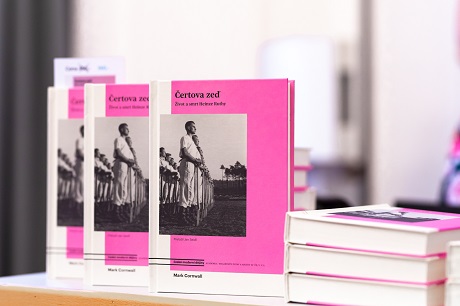
In the book, the author tackles the taboo topic of homosexuality and nationalism. (CC)
Meeting Václav Havel
Professor Cornwall has visited the Czech Republic many times thanks to his research. He first visited Brno in 1987, where he spent time improving his knowledge of the Czech language after having studied it at Oxford. On the anniversary of Jan Palach’s death, he experienced the violent suppression of the demonstration on Wenceslas Square in Prague, met Václav Havel, and was put under surveillance by StB, i.e., State Security (the secret police), due to the nature of his work in Czechoslovakia. “It was an exciting time for me. As a Brit I experienced a bit of modern Czech history: the end of Communist rule,” Mark Cornwall said, adding, “I find the dynamics of Czech history fascinating.”
Mark Cornwall received his PhD in History at the University of Leeds and has worked at the University of Exeter, the University of Oxford, and the University of Dundee. Since 2004 he has been Professor of Modern European History at the University of Southampton. In addition to The Devil’s Wall, Cornwall is the author of the seminal book on propaganda during the First World War, The Undermining of Austria-Hungary: The Battle for Hearts and Minds. He is currently researching and writing a history of treason in the Habsburg monarchy during the era of Emperor Franz Joseph I.
Text: Zuzana Šprinclová, Division of External Relations of the CAS
Photo: Jana Plavec, Division of External Relations of the CAS
 Texts and photographs labelled (CC) are released for use under the Creative Commons license.
Read also
- Czech Academy of Sciences Evaluation – Beyond Metrics, Accent on Peer Review
- Ordovician Fauna Beneath Prague – New Arthropod Found During Metro Line Dig
- Wildfires on the Rise in Europe and Set to Double by 2100. What Can We Do?
- The CAS Photogenic Science Contest Invites Entries
- The CAS Launches New Research Programs as Part of Its Strategy AV21
- Academy Assembly – Thirteen Priorities to Boost Basic and Applied Research
- We Must Prioritize Science, Czech President Petr Pavel Says on His Academy Visit
- Radomír Pánek Visits CAS Institutes, Aiming to Strengthen the Academy’s Unity
- Small but Mighty – The Enceladus Moon Is Flexing with Saturn’s Magnetic Field
- Light vs. Antibiotics – Can We Get Harmful Substances Out of Our Water?
The Czech Academy of Sciences (the CAS)
The mission of the CAS
The primary mission of the CAS is to conduct research in a broad spectrum of natural, technical and social sciences as well as humanities. This research aims to advance progress of scientific knowledge at the international level, considering, however, the specific needs of the Czech society and the national culture.
President of the CAS
Prof. Radomír Pánek started his first term of office in March 2025. He is a prominent Czech scientist specializing in plasma physics and nuclear fusion.