
SciComm 360° Tackled How to Communicate Science in the Age of Disinformation
09. 02. 2026
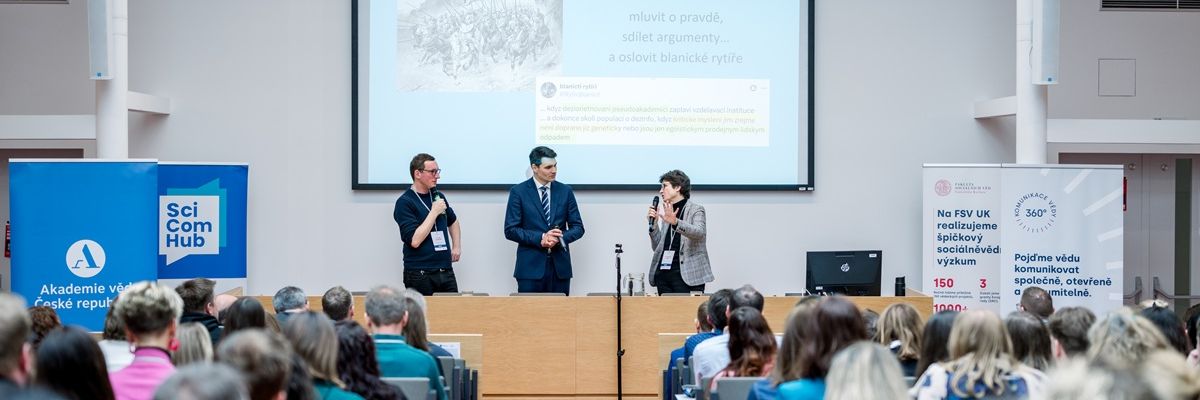
Efforts to present research findings in clear, accessible language are becoming a standard part of scientific work, but new challenges keep emerging – like how to communicate science in a society that is growing ever more polarized. Or how a scientist should react when their media appearance triggers a wave of hateful reactions. These and other issues were discussed at the Science Communication 360° conference held on 5 February 2026 in Prague. The keynote talks were given by Christina Beck, Head of Communication at the Max Planck Society, and philosopher of language Tomáš Koblížek from the Czech Academy of Sciences.
The conference was organized by the Czech Academy of Sciences (CAS) and the Faculty of Social Sciences, Charles University, in cooperation with the SciComHub platform. The event was opened by Charles University Rector Jiří Zima and Petra Dachtler, Deputy Ambassador of Germany to the Czech Republic. CAS Vice President Ondřej Beránek delivered the opening remarks on behalf of the Academy. “As an Arabist and scholar in Islamic studies, I know very well what stepping into the public arena and trying to explain complex realities can entail. It is often a very tough confrontation with an environment where accuracy or an effort at objectivity is not necessarily an advantage,” Beránek said at the opening.
THE GERMAN EXPERIENCE
Social polarization is also affecting science communication at Germany’s largest research institution, the Max Planck Society. In late 2025, partly for this reason, it left the social media platform X (formerly Twitter), owned by Elon Musk, American billionaire and de facto Head of the “Department of Government Efficiency” during the second Trump administration. “It was a difficult decision for us – we had more than 180,000 followers – but it isn’t possible to stay on this platform anymore,” said Christina Beck, Head of Communication at the Max Planck Society.
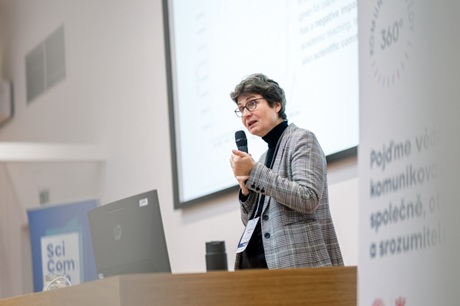
Christina Beck, Head of Communication at the Max Planck Society.
Thanks to their own research, German colleagues had been observing that X’s algorithm was amplifying anti-democratic views while suspending critical journalists. Instead of X, the Max Planck Society is now building profiles on Bluesky and Mastodon, though their reach is still much smaller. Incidentally, several Czech research institutions have also left X – the Czech Academy of Sciences did so in September 2025, and Charles University earlier that same year in the spring.
Beck also sees the issue of polarization on other social media platforms, which is why the Max Planck Society is reconsidering whether to continue investing in them in the future at all. “Personally, I see more hope in a return to face-to-face contact and in building community in the real world,” Beck noted.
One example is the new Heimspiel project, in which scientists travel to rural areas to their hometowns to give talks and hold discussions with local residents. The events take place in libraries, community centers, or parish halls and have been received quite positively. German science communicators hope that this approach will help strengthen public trust in researchers, who might otherwise be perceived as members of a distant elite shut away in their ivory tower.
RESISTANCE TO SCIENCE – OR TO SCIENTISTS?
The phenomenon of growing mistrust in science was examined in the second keynote talk by Tomáš Koblížek from the Institute of Philosophy of the CAS. He specializes in the analysis of language, including hate speech, disinformation, and lies in the public sphere. After a series of media appearances in which he spoke about disinformation and hate speech, the researcher experienced an enormous wave of backlash. Even so, he believes it is essential not to withdraw from public commentary on science and to keep trying to engage even outspoken critics.
He also reflects on whether mistrust in science is truly increasing, or whether the nature of this mistrust is changing instead. “Science communicators need to keep in mind that mistrust of science is becoming part of the identity of populist movements, and that hostility is increasingly directed at the very figure of the scientist,” Koblížek explained.
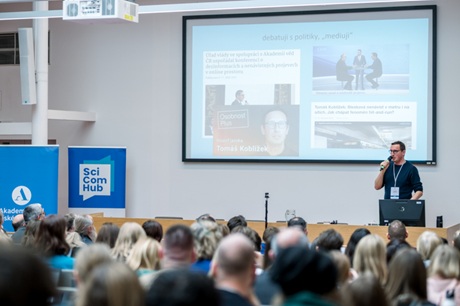
Tomáš Koblížek from the Institute of Philosophy of the CAS.
Drawing on the work of historian Richard Hofstadter on anti-intellectualism, Koblížek distinguishes between two phenomena: anti-rationalism and anti-elitism. The former is directed against rationality, the latter against elites. In the first case, scientists are accused of playing the role of “holders of truth” who “dictate what people should think.” One possible response to this is to present science as a gradual process of uncovering reality, where scientific hypotheses are either proven or disproven, rather than as the delivery of absolute truths.
The second phenomenon – anti-elitism – sets experts against “ordinary people,” whose interests science is allegedly said to ignore. To counter these tendencies, Koblížek tries to rely as much as possible on examples and illustrations from everyday life in his arguments, such as photos of hate speech taken in the Prague subway, and to directly address the strongest counterarguments.
A recording of the entire morning program of the conference, including the talks by Christina Beck and Tomáš Koblížek, is available online:
WORKING GROUPS
The afternoon part of the conference was divided into several working blocks. Science communicators split into discussion forums focusing on support mechanisms, new perspectives, and interdisciplinary challenges in science communication.
For example, in a session focusing on institutional support, Petr Caletka, a PR officer at the Institute of Experimental Medicine of the CAS, emphasized that backing from the research institution is crucial. Researchers engage in science communication alongside their main professional duties, so it is important that they feel motivated by leadership. What matters is not only recognition, but also taking science communication into account when evaluating a laboratory’s or department’s research output, or even offering financial bonuses.
The Science Communication 360° conference was first held in 2025, making this year its second edition. The organizers hope to establish a new tradition and are planning to prepare a program for future years as well. The event is aimed primarily at science popularizers, PR specialists, and researchers interested in presenting the results of their work to the public.
Written and prepared by: Leona Matušková, External Relations Division, CAO of the CAS
Translated by: Tereza Novická, External Relations Division, CAO of the CAS
Photo: Pavlína Černoch Jáchimová, External Relations Division, CAO of the CAS
 Released for use under the Creative Commons license.


Read also
- Radomír Pánek Visits CAS Institutes, Aiming to Strengthen the Academy’s Unity
- Living with a Genetic Growth Disorder: Can Achondroplasia Be Eradicated?
- Small but Mighty – The Enceladus Moon Is Flexing with Saturn’s Magnetic Field
- Light vs. Antibiotics – Can We Get Harmful Substances Out of Our Water?
- Better ECGs and Industrial Superlasers – Real-World Results of CAS Research
- Czech Academy of Sciences to launch a joint-stock company
- In the Age of AI, Spotting a Fake Photo Is Harder Than Ever, Expert Says
- How to Turn Ideas into Successful Grants: The New ERC Incubator Is Offering Help
- The Academy of the Future? A New Vision for Attracting Scientific Talent
- When Cars Fly and Bullets Swerve – Physics Gone Wrong on the Silver Screen
The Czech Academy of Sciences (the CAS)
The mission of the CAS
The primary mission of the CAS is to conduct research in a broad spectrum of natural, technical and social sciences as well as humanities. This research aims to advance progress of scientific knowledge at the international level, considering, however, the specific needs of the Czech society and the national culture.
President of the CAS
Prof. Radomír Pánek started his first term of office in March 2025. He is a prominent Czech scientist specializing in plasma physics and nuclear fusion.