
In the Age of AI, Spotting a Fake Photo Is Harder Than Ever, Expert Says
20. 02. 2026
As a child, Barbara Zitová loved to draw and do math. Her affection for both mathematics and images of all kinds has stayed with her ever since. In digital images, she detects what the naked eye misses – whether traces of crime, symptoms of disease, or the brushstrokes of old masters. Barbara Zitová from the Institute of Information Theory and Automation of the Czech Academy of Sciences invited A / Magazine to peek into the realm beyond the image.
*
In every other procedural cop show, investigators identify the culprit thanks to security camera footage from which experts miraculously “pull out” a perfect portrait of the suspect. Does it work that way in real life?
Real investigators have it much harder. These types of cameras typically have fairly low resolution and often record only a few frames per second. If you simply enlarge such footage, all you get are bigger, blurry pixels. It is true, however, that thanks to advanced methods that use a mathematical description of how video is formed, we can combine information from multiple frames into a sharper, higher-resolution image. That can reveal things that were not visible to the human eye in the original video.
Such as the murder weapon?
In theory, yes. Every frame is blurred slightly differently, and if you cleverly integrate the undamaged data from each of them, a new crucial detail may emerge. Sharpening a license plate blurred by the car in motion, for example, is not a problem for us either. But we definitely cannot just zoom in a hundredfold the way we commonly see in movies. We can enlarge a scene by about a factor of two. The most advanced artificial intelligence algorithms can improve footage even more, but those cannot be used in police investigations.
Why not?
They fill in missing elements based on what they “saw” during training and what seems most similar to them. As a result, they may “invent” features that were not originally present in the scene. Courts therefore cannot treat such enhanced footage as genuine evidence.
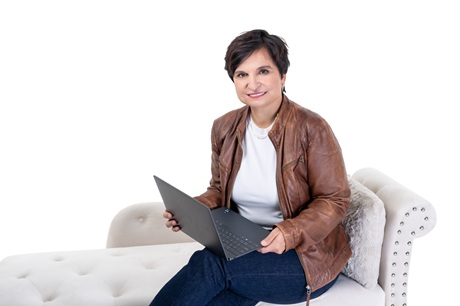
Barbara Zitová from the Institute of Information Theory and Automation of the CAS. (CC)
So artificial intelligence doesn’t actually make your work easier?
It depends. Thanks to AI tools, we can now recognize all kinds of things in photos and videos. With their help, we can also determine far more effectively than before whether a lung X-ray shows cancer or not. On the other hand, AI has also taken the falsification of images of all kinds to an entirely new level. Detecting it is becoming increasingly difficult. Focusing, for instance, only on noise analysis in a photo has long ceased to be enough.
Photos have noise?
Essentially yes, though not like a radio. Photos contain tiny irregularities in brightness and color that arise directly during image capture. These are called noise, and at a certain level, you’ll find it in every image. If someone manipulated a photo and altered it in some way, they would also disrupt the structure of this noise. A frequency analysis of such an image would then reveal mathematical inhomogeneities.
In other words, irregularities?
Exactly. In a photo of a woman whose bust someone enlarged in an editing program, we would be able to detect changes in pixel values in the incriminated area. But today, artificial neural networks are already trained to leave no traces behind when they edit images.
So how can you tell whether a photo or video “is lying”?
In the age of AI, it is difficult. We focus on the geometry of the scene, checking whether all objects cast shadows as they should. In deepfake videos, the physics of various movements is often off as well. That, however, is improving rapidly. Unfortunately, at the moment there is no technology that can confirm the authenticity of a recording with one hundred percent certainty. Various approaches are being tried, such as watermarking or certification, but even those can be circumvented by some models.
|
DEEPFAKE, a.k.a. WHEN A RECORDING CAN BE DECEPTIVE This is deep neural network technology that uses artificial intelligence to create photos, videos, or audio recordings that were never actually captured in reality. A well-known figure or a scene is depicted in situations that never happened, with the aim of misleading the viewer or listener. “Deepfakes can depict anything – from aliens landing on the pyramids in Giza, the pope in a puffer jacket, to a speech by a world leader that they never actually delivered,” explains Barbara Zitová from the Institute of Information Theory and Automation of the CAS. |
But what can we believe in a world now flooded with deepfakes?
Certainly not everything that pops up on your feed while you’re scrolling. All we can do is stay vigilant, use common sense, verify information, and adjust our level of trust to the source of our current content. After all, similar uncertainty existed in earlier times as well – in the Middle Ages, people learned about world events from pilgrims and travelers. And no one could know whether they were telling the truth or not. Today, we find ourselves in a similar situation again.
So, living with doubt is nothing new.
Nor is the effort to alter visual reality. One of the first documented photomontages was created more than 150 years ago. It is a relatively iconic image of U.S. President Abraham Lincoln, whose head was superimposed onto the body of Southern politician John C. Calhoun, allegedly to make the portrait look as dignified as possible. Photos were also doctored in communist Czechoslovakia, like the famous 1948 photograph of Klement Gottwald, from which Vladimír Clementis was later “erased” after falling out of favor with the regime.
When was the last time you yourself hesitated about whether what you were seeing in an image or video was real?
Practically every day when browsing social media. I follow various travel feeds, and I often think the images or footage look almost too perfect, that it cannot just be filters or Photoshop. Excessive perfection is often a warning sign.
What do you mean by that?
Fake images can give themselves away by depicting people with completely flawless faces. Neural networks were trained mainly on photos taken from the internet, where you mostly see attractive, smiling individuals, often straight out of advertisements. And that is exactly how women and men look in AI images – unless you explicitly specify how they should deviate from this ideal of beauty. Current models, however, already handle human anatomy extremely well.
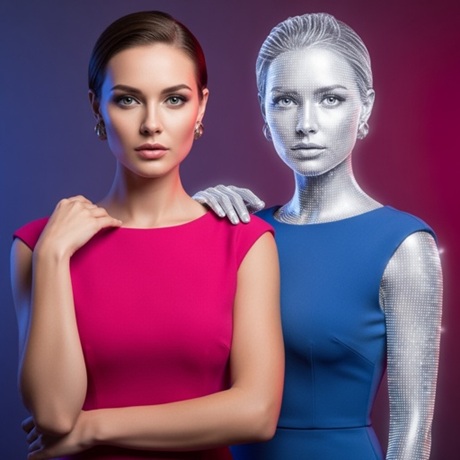
Perfect faces usually indicate the intervention of editing tools. This portrait, for example, was created by AI.
So those days when AI interference was revealed by the wrong number of fingers are over?
For images, yes. In videos, errors can still be found, but they usually relate to movement. If the creator doesn’t put much effort into it, a person’s lips, for instance, may not move in sync with what they are saying. Nowadays practically anyone can create a deepfake, so the level of sophistication varies widely.
What does it take?
If you want to generate your own avatar, all you need is a roughly two-minute video shot on a cellphone. You upload it into an app, and within five minutes, your digital alter ego is born. Then you just type in the text the avatar is supposed to say, and shortly afterward, it’s ready.
Is creating an avatar of someone else just as easy?
Apps usually require confirmation that you are the subject, but more knowledgeable users can legally circumvent this step. To generate a video of anyone saying anything, they need just a single photo, which they then animate. It takes no more than fifteen minutes.
That’s pretty alarming…
You’re right. Especially because the creators of these videos don’t stop at jokes like Pope Francis in a puffer jacket, minor scams, or risqué images of celebrities. Many of them aim to influence public opinion as well, which can ultimately affect every one of us.
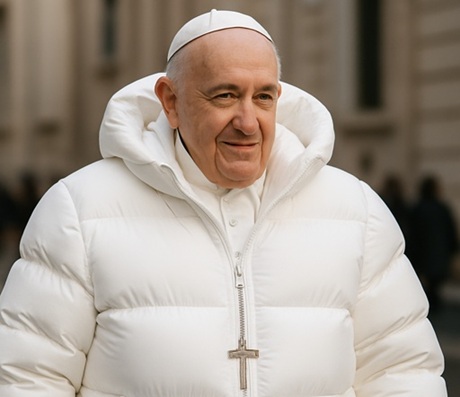
AI-generated images of Pope Francis in a puffer jacket flooded social media a few years ago.
How do we defend ourselves against it?
Legislation does, of course, ban deepfakes created without the consent of the people depicted, but the problem lies in how difficult it is to enforce such bans. Personally, I do not think a purely repressive system will work in this case – it will restrict the harmless instances, while the bad guys will always find a way around it.
Have you ever come across a video of yourself that you never recorded?
Yes. My colleagues made one as a demonstration for our talk on AI, so I knew it was being created. Fortunately, I am not an influential person or a celebrity, so I am not particularly interesting for this kind of fraud. Watching a deepfake video of myself produced by my colleagues, in which I was giving a lecture in a foreign language, was quite enough for me.
Did anything about it surprise you?
I realized how little I know myself. We only ever see ourselves in a mirror, which is already a reflection of reality. We also hear our own voice differently, because when we speak, sound travels through the bones and tissues in our head. I wasn’t even aware that I gesture with my hands so much. So whether my avatar actually resembles me or not is something others will have to judge.
If it’s so easy to generate a deepfake of basically anyone, aren’t security features like Face ID ultimately risky?
It’s possible they may become risky soon. After all, banks are already moving away from voice-based identity verification, because AI can now imitate a voice indistinguishably. I’m afraid that facial recognition will not remain a safe bet for long either. In the near future, we will more likely return to physical verification devices. Sam Altman’s company OpenAI, for example, is already testing a biometric device called Orb that scans the iris of the eye and should be able to confirm that the user is neither a generated avatar nor a robot.
So far, we have been portraying AI more as an enemy. Where, on the contrary, can it benefit us?
First and foremost, it should be said that AI tools themselves are not harmful in any way. It depends solely on whether people use them for fraud or utilize their potential for something positive. AI is widely applied in medicine, for instance. With its help, we have developed a method that makes it easier for ENT specialists to assess complex imaging data from cameras capturing vocal fold vibrations, supporting the diagnosis of voice disorders. And that certainly wasn’t our only collaboration with physicians.
Tell us more.
We were also involved in developing software for breast ultrasound examinations that improves the accuracy of the procedure. Additionally, together with speech therapists, we developed an app in which you perform various playful movement exercises for the tongue and lips at home in front of a computer, and the camera immediately evaluates how well you are doing. Incidentally, we sometimes even venture into medicine while verifying the authenticity of visual material for courts.
Are X-rays and CT scans being falsified as well?
Unfortunately, yes. For instance, we had to deal with a dispute between a dentist and a patient after unsuccessful treatment. It turned out that the X-ray images included in the evidence had been artificially modified to justify the dentist’s procedure. It was a pair of images that were allegedly taken at two different times, yet both had completely identical imaging geometry. For that to have actually occurred, the dentist would have had to place the imaging plate in the patient’s mouth in exactly the same position twice – which is practically impossible.
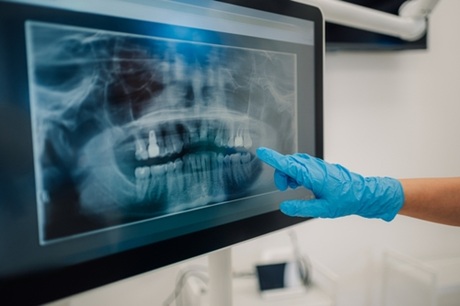
Barbara Zitová and her colleagues have used their expertise to expose a fake X-ray image.
What other cases have you helped crack?
The police contact us about low-quality videos like the ones mentioned at the beginning. Using our methods, they sometimes uncover a small detail that can move an investigation forward. But our expertise has also been applied in a case involving an illegal building, because we also analyze satellite images. This data is archived, so it allows you to retrospectively determine whether a disputed structure stood on a given plot of land at different points in time. And that can be crucial in court.
Besides forensics and medicine, your team also dabbles in art. How so?
We work with art conservators, for whom we examine images of paintings by old masters in the infrared spectrum, which is invisible to the human eye. This radiation can penetrate the top layer of pigments, revealing the underdrawing that the painter originally sketched onto the canvas. This can help art historians refine the dating of an artwork or better understand the process of its creation.
Which artists have passed through your hands?
Jan Vermeer, for example – and even Leonardo da Vinci. The latter is also connected to another fascinating project that one of my students recently worked on at the National Institute of Optics in Florence. They had at their disposal a deteriorated negative taken at the beginning of the twentieth century, which likely depicted a painting by one of the artists from da Vinci’s workshop. Our Italian colleagues spent hours painstakingly assembling the tiny black fragments.
A jigsaw puzzle for advanced players…
Exactly. But our graduate student created a method that can assemble the image with the use of neural networks in just three minutes. So, when they scan more damaged negatives in Florence, her contribution will make their work far easier.
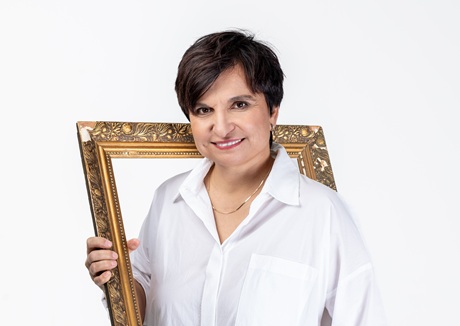
“Every image contains tiny irregularities in brightness and color that arise directly during capture,” says Barbara Zitová. (CC)
Your team clearly has a very wide range.
And I haven’t even mentioned our collaborations with scientists from many other different fields. For the Institute of Geology of the CAS, we’re planning to develop an application that should be able to identify a species of trilobite from its fragments. It won’t be easy, because individual species are relatively similar. The goal is to develop a program similar to those people use in the field to identify species of plants or mushrooms. For the Institute of Vertebrate Biology of the CAS, we analyze time-lapse microscopic images of cells – and for ornithologists, bird sperm.
Pardon?
My colleagues are trying to create a tool that would recognize sperm shape and quality, which would facilitate research of promiscuity and possible reproductive strategies in birds. And as if that weren’t enough, we occasionally cooperate with farmers as well. For instance, we worked on an app for cowsheds that evaluates images from thermal cameras monitoring heat indexes in cattle. Breeders can thus earlier detect whether one of the animals is ill and start treatment in time.
I can almost smell the healthy countryside.
That reminds me of another project – by a series of coincidences, we’re currently preparing a database (with scientists from Norway and Italy) of scents that are threatened by climate change but should be preserved for future generations.
What should we imagine by that?
For example, the smell of a walk in the forest, carp in street-side vats sold before Christmas, or roasting sausages over a campfire. Simply anything that might smell different in a few years’ time due to changes in nature. At the moment, we’re at the stage where chemists are “hunting” these odors and describing them. We’re creating a platform for archiving and planned analysis of this data, and in the future, we’re to participate in designing AI methods that would help reconstruct the scents. Exceptionally, this time it will not be about working with images – but we will again be applying our know-how using artificial intelligence.
You examine photos, videos, old paintings, images from microscopes, satellites, thermal cameras, and endoscopic footage of the body. What is it that actually connects all these “pictures”?
In the end, they are always two- or multidimensional matrices of numbers capturing external reality or its reflection. We look for methods that translate these numbers into a more digestible form, so that experts in the respective fields can more easily discover what interests them. Depending on their needs, we increase resolution, sharpen, combine, or, conversely, separate data. First, however, we have to understand what the clients are looking for and find a common language with them, which takes some time. And it makes no difference whether these are police officers, doctors, art conservators, scientists, or farmers.
You really do have a remarkably varied job. Did you dream of something like this as a kid?
As a kid, I wanted to be a writer. I loved reading science fiction and longed to write books myself. I do have a few literary notches in the form of academic publications, but fiction has unfortunately not happened yet. I also loved drawing from an early age and as a kid I enthusiastically attended an art school for years. But at the same time, I was good at mathematics, so I soon ended up in a math-oriented class.
And your relationship with art took a back seat?
Not at all – it has stayed with me to this day. What’s more, in elementary school I realized just how closely mathematics and images are intertwined. Around seventh grade, I came across a children’s magazine called Sedmička pionýrů (The Seven Pioneers), which had a beautiful colorful pattern on its cover. It said it was a mathematical model of water dripping from a tap – a so-called fractal. And that connection between math and art completely enchanted me.
Is there really something beautiful even about a dripping tap?
From a mathematician’s point of view, absolutely. Fractals are geometric shapes that, when divided, produce several self-similar copies. Nature is full of them – coastlines, snowflakes, and the branching of trees all have fractal properties. The color, hidden regularity, and aesthetics of these patterns still fascinate me today. Mathematics is, perhaps surprisingly, very close to art.
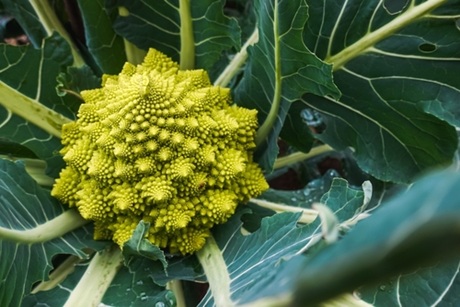
Romanesco cauliflower is an example of a natural fractal.
Do you have mathematical talent in your genes?
Both of my parents were quite technically inclined. My mother worked at the Research Institute of Ferrous Metallurgy (VÚHŽ), and my father at the State Energy Inspection Agency. Thanks to them, I fell for computer graphics relatively early on in my life. They managed to get hold of a computer from abroad at a time when that was still very rare here [in Czechoslovakia]. At first, I just played games on it at home, but I quickly learned to write code as well. At sixteen, for example, I took part in a national high school student competition and traveled from my hometown of Frýdek-Místek to Ostrava to program a database of small hydroelectric power plants, which I even ended up presenting at a meeting of their owners.
At that age, I was mostly worrying about what to wear to ballroom dance lessons…
My interests really were not very typical for a teenage girl. After high school, I enrolled at the Faculty of Mathematics and Physics at Charles University and started studying advanced mathematics. But in my third year, I realized that alongside all my math courses, I was also enrolled in every computer graphics class available. Something kept pulling me toward it.
So you “switched sides” and joined the IT crowd?
Yes. I completely changed my focus. In later years, I was absolutely captivated by a course on image processing taught by Professor Jan Flusser. That was the decisive moment. After graduating, I started working on his team at the Institute of Information Theory and Automation of the CAS. When he later became director of the institute, I eventually “drifted” into the position of head of a department that bears the same name as that fateful course.
Do you still paint sometimes, or do you only analyze images now?
From time to time, I create something with my daughter. For example, following an old TV show by the American painter Bob Ross, who explained step by step how to create each painting and which pigment or brush to use where. The result is kitschy landscapes that are not really my cup of tea, but it’s fun. We also try abstract art – we pour paints onto the canvas and let them bleed into one another. I quietly hope that one day I will have more time to paint pictures. For now, I at least express myself by generating them.
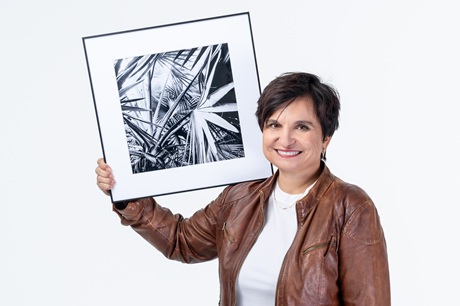
“When it comes to AI models, if you ask the wrong question, you will not get a sensible answer,” says Barbara Zitová. (CC)
So you traded your palette and paints for AI?
You could put it that way. I enjoy trying, through my prompts, to arrive at an output that I like or that captures my feelings. I am essentially trying to materialize my ideas using words. That comes more easily to me than using a real brush. For a while, I even kept a visual diary – I prompted images that reflected each of my days.
Did you stick with it for long?
Only about two months. I am not really a diary person. But I still create with generative models quite regularly. I believe that what emerges from collaboration between humans and AI is, in its own way, also art. That doesn’t mean I’ve turned my back on classical art – on the contrary, I am still very interested in it.
Do you go to galleries?
Very much so, even though I don’t get to visit them as often as I would like. But if something catches my attention, I will happily travel to an exhibition in Vienna or Amsterdam. I like, for example, the drawings of the Dutch artist M. C. Escher, who played with perspective, optical illusions, and mathematical principles in his work. I also occasionally attend auctions and sometimes even bring something home. My relationship with art and images is simply a bit outside the norm. At least according to my husband.
Is he understanding about it?
I’d say so, yes. We understand each other professionally as well. My husband owns a tech company that develops computer games, and we sometimes have joint projects. We simply speak the language of the same tribe.
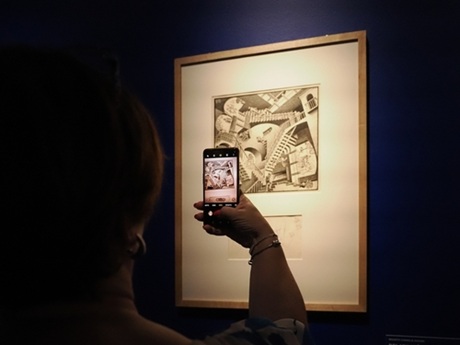
The Dutch artist Maurits Cornelis Escher plays with perspective in his drawings.
Has that rubbed off on your three children as well?
We are a bit of a computer family, so yes. Both of my sons study programming. My fourteen-year-old daughter is planning to become an interior designer, but she can program too, and she is good at math and other natural sciences. Discussions about matrices, code, or algorithms are basically an everyday occurrence in our household. As is the use of AI.
What do you use it for at home?
I consult it, for instance, on my daughter’s homework. That’s because professionally, I am interested in what all artificial intelligence can already handle. At first, AI struggled with simple logic problems that require common sense, but it has improved enormously. To be honest, I haven’t come across anything in a long time that it couldn’t cope with. It can even interpret a joke.
So AI understands humor now?
Yes. It can recognize satire and hyperbole. And jokes on the internet usually don’t come with an explanation, so the networks do not really have training data to draw on. By the way, models are also trying to make jokes themselves, but so far they aren’t exactly laugh-out-loud funny. What they are very good at, though, is explaining things. They can present university-level numerical analysis in a way that even a thirteen-year-old can grasp, which my son was happy to take advantage of while preparing for his exams. Artificial intelligence also comes in handy in our kitchen – for instance, when we don’t know how to substitute a missing ingredient in a recipe.
I hope it gives better advice than certain TV chefs who say things like “if you don’t have fish, just throw in a sausage.”
Definitely. That is exactly what it’s great at. Provided you ask the question “correctly,” which is absolutely crucial when working with AI. It’s kind of like the proverb what goes around comes around, or what you shout into the forest is what echoes back. If you ask badly, you will not get a sensible answer. People often stop talking to chatbots because they keep getting nonsense back. In reality, they just don’t know how to communicate with them properly. If you fail to focus a camera, you cannot expect a sharp picture either. And believe me, I know a thing or two about that too.
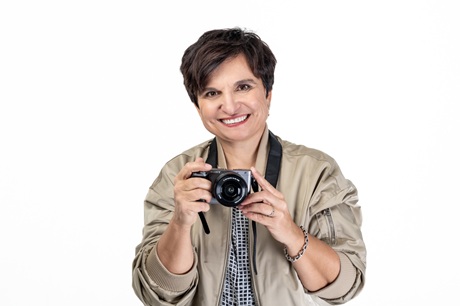
Photography is also one of Barbara Zitová’s hobbies. (CC)
Do you take a lot of photos?
It’s my great hobby. I love traveling to Nordic countries like Greenland, Iceland, Norway, Scotland, or Svalbard, where I capture images shaped by the landscape, details of moss and plants, or animals. People as photo subjects do not interest me much. Right now, for example, my laptop background is a bluish image of sea ice in the midnight sun in Greenland. Fortunately, I know how to process a photo so that it really stands out. (smiling)
Do warmer regions not tempt you?
I mainly go there for diving. And to photograph underwater. I started about five years ago, and last year my daughter and I went swimming with whale sharks in Asia – eight-meter “fishies” covered in spots. It reminded me of the end of my studies and my thesis on algorithmic generation of regular patterns in animals, such as zebras or cheetahs. It was almost as if my diploma thesis were swimming alongside us!
That is what I call an intense experience.
I surprised myself, because I am usually quite afraid of animals and do not really seek out extreme adventures either. Skiing or hiking in the mountains is more than enough for me. But when I really want to switch off, I read or listen to audiobooks.
So evening relaxation in the form of watching movies or looking at photos is probably out of the question for you.
You’d be surprised! I like to edit photos at home, trying out all kinds of tools on them, and then turning them into photo books. We also watch films pretty often, especially science fiction. I love crime shows with their satellite cameras that miraculously see around corners or into bags. Or when detectives utter the magic word “Enhance!” and, with a few clicks, conjure a perfect portrait of the perpetrator from a blurry smudge. Occupational hazard, I suppose.
Do you ever feel visually overloaded after work?
That too sometimes happens. Fortunately, we live by a forest and have a huge window facing greenery. So I can always give myself a visual detox and just stare off into nowhere for a while – as we say back home in Frýdek. (smiling)
|
Assoc. Prof. RNDr. Barbara Zitová, Ph.D.
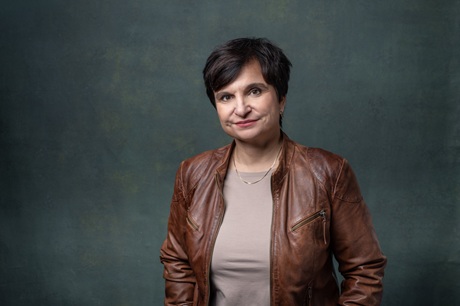
Barbara Zitová heads the Department of Image Processing, where she and her colleagues develop methods based on mathematical theories and artificial intelligence that teach computers to analyze and improve the quality of photographs and videos. She also focuses on applying these approaches in medicine, security, and art conservation. She has co-authored several scholarly monographs and is the recipient of numerous scientific awards. She lectures at the Faculty of Mathematics and Physics, Charles University, and at the Faculty of Nuclear Sciences and Physical Engineering, Czech Technical University in Prague. Last year, she was included in Forbes magazine’s selection of the Top Women Scientists in the Czech Republic. |
*
The interview first came out in the 4/2025 Czech issue of A / Magazine:
4/2025 (version for browsing)
4/2025 (version for download)
All Czech and English issues of A / Magazine – the official quarterly of the Czech Academy of Sciences, including its predecessor A / Science and Research – are available online.
We offer free print copies (of the Czech version and the two English issues from 2024 and 2025) to anyone interested – please contact us at predplatne@ssc.cas.cz.
Written and prepared by: Radka Římanová, External Relations Division, CAO of the CAS
Translated by: Tereza Novická, External Relations Division, CAO of the CAS
Photo: Jana Plavec, External Relations Division, CAO of the CAS; Shutterstock
 The text and photos marked CC (as well as the researcher's bio photo) are released for use under the Creative Commons license.
Read also
- We Must Prioritize Science, Czech President Petr Pavel Says on His Academy Visit
- Radomír Pánek Visits CAS Institutes, Aiming to Strengthen the Academy’s Unity
- Small but Mighty – The Enceladus Moon Is Flexing with Saturn’s Magnetic Field
- Light vs. Antibiotics – Can We Get Harmful Substances Out of Our Water?
- Better ECGs and Industrial Superlasers – Real-World Results of CAS Research
- Czech Academy of Sciences to launch a joint-stock company
- How to Turn Ideas into Successful Grants: The New ERC Incubator Is Offering Help
- SciComm 360° Tackled How to Communicate Science in the Age of Disinformation
- The Academy of the Future? A New Vision for Attracting Scientific Talent
- When Cars Fly and Bullets Swerve – Physics Gone Wrong on the Silver Screen
The Czech Academy of Sciences (the CAS)
The mission of the CAS
The primary mission of the CAS is to conduct research in a broad spectrum of natural, technical and social sciences as well as humanities. This research aims to advance progress of scientific knowledge at the international level, considering, however, the specific needs of the Czech society and the national culture.
President of the CAS
Prof. Radomír Pánek started his first term of office in March 2025. He is a prominent Czech scientist specializing in plasma physics and nuclear fusion.