
Beetroot sauce offsets increased intake of salt, helping stabilise blood pressure
17. 04. 2019
Epidemiological studies show that growing occurrence of high blood pressure is related to high content of salt in food. Scientists from the Institute of Physiology of the CAS, University of California in San Francisco, and Michigan State University have discovered that simultaneous consumption of salt solution and small amounts of sodium nitrate or sauce from beetroot does not cause increase of blood pressure in rats.
In their tests with rats, the scientists used 1% salt solution. To the solution they added a small amount of either sodium nitrate or beetroot juice so the salt-to-nitrate ratio in the solution was greater than 100:1. “In both cases there was no increase in blood pressure. However, in other rats who drank solely the 1% salt solution, hypertension developed,” explains Jan Šilhavý from the Institute of Physiology of the Czech Academy of Sciences.
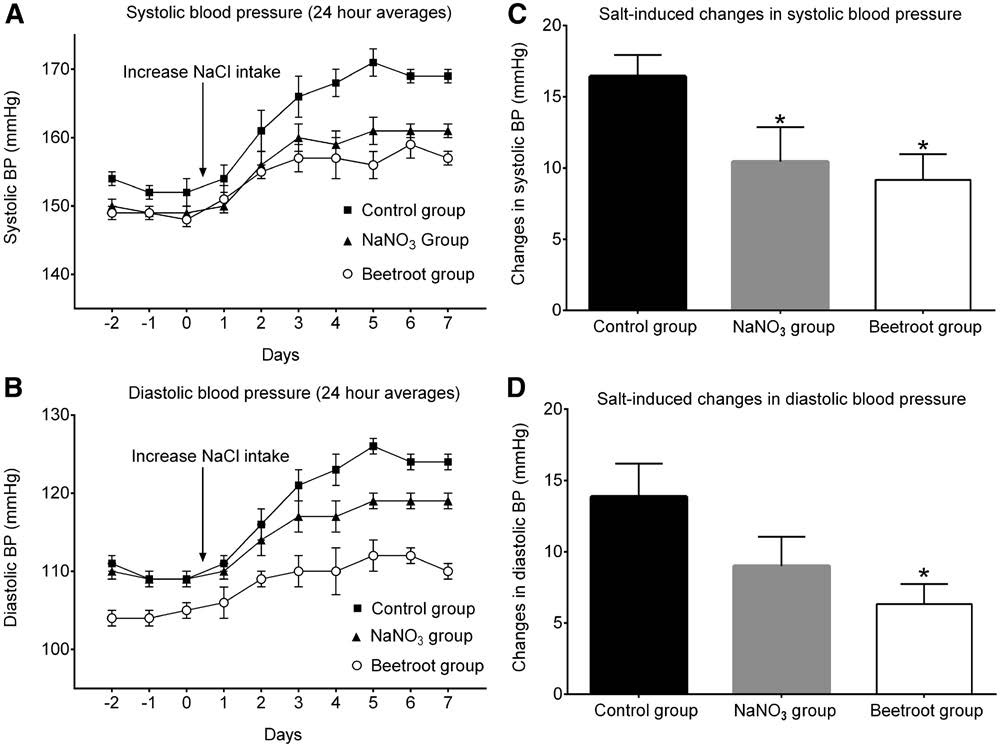
Graf znázorňující vliv červené řepy na krevní tlak
The graph shows the influence of beetroot on blood pressure
Advantages of vegetables with nitrates
Increased occurrence of high blood pressure in population is largely caused by a higher intake of salt in food. Scientists and nutrition experts therefore recommend decreasing intake of salt while simultaneously increasing intake of potassium. It has been known that diets which contain at least as much potassium as sodium from kitchen salt decrease the danger of hypertension. These diets include especially fresh vegetables, fruits, pulses, wholegrain pastries, dairy products, and fish or chicken meat. Thanks to high contents of some species of vegetables, the abovementioned diets contain not only potassium but also increased amounts of nitrates which also decrease blood pressure and may play a significant role in prevention of hypertension development.
Not many people, however, are willing to change their dietary habits and maintain the recommended potassium-sodium ratio in the long term. Adding small amounts of concentrate of some species of vegetables (beetroot, arugula, spinach) could, therefore, enrich foods and ingredients that contain large amounts of salt (e.g. soya sauce or barbecue sauce) without changing gustatory properties of these foods. “This would be a safe and simple strategy to limit risks of development of hypertension even with a higher intake of salt,” summarises Jan Šilhavý.
Original Czech text prepared by: Diana Moosová, Institute of Physiology of the CAS, in cooperation with Markéta Růžičková, Department of Media Communication of the Head Office of the CAS
Photo: iStock
Read also
- The CAS Launches New Research Programs as Part of Its Strategy AV21
- Academy Assembly – Thirteen Priorities to Boost Basic and Applied Research
- We Must Prioritize Science, Czech President Petr Pavel Says on His Academy Visit
- Radomír Pánek Visits CAS Institutes, Aiming to Strengthen the Academy’s Unity
- Small but Mighty – The Enceladus Moon Is Flexing with Saturn’s Magnetic Field
- Light vs. Antibiotics – Can We Get Harmful Substances Out of Our Water?
- Better ECGs and Industrial Superlasers – Real-World Results of CAS Research
- Czech Academy of Sciences to launch a joint-stock company
- In the Age of AI, Spotting a Fake Photo Is Harder Than Ever, Expert Says
- How to Turn Ideas into Successful Grants: The New ERC Incubator Is Offering Help
The Czech Academy of Sciences (the CAS)
The mission of the CAS
The primary mission of the CAS is to conduct research in a broad spectrum of natural, technical and social sciences as well as humanities. This research aims to advance progress of scientific knowledge at the international level, considering, however, the specific needs of the Czech society and the national culture.
President of the CAS
Prof. Radomír Pánek started his first term of office in March 2025. He is a prominent Czech scientist specializing in plasma physics and nuclear fusion.