
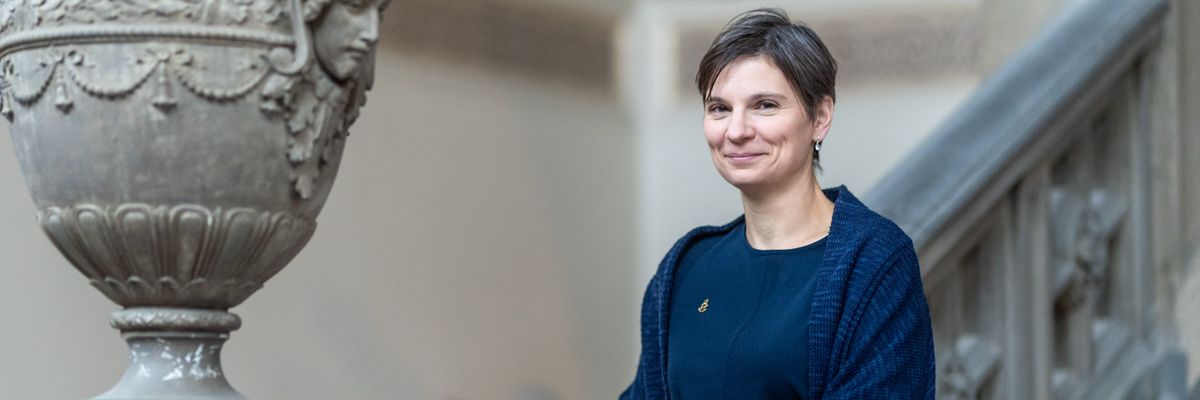
Ombudsperson Dana Plavcová: We all play a role in creating a safe workplace
16. 12. 2025
Dana Plavcová is the first ombudsperson in the history of the Czech Academy of Sciences. In her new role, she focuses on preventing inappropriate conduct and supporting respectful communication and equality across the CAS institutes. In which instances can employees turn to her, and what does her job actually involve?
*
What drew you to the position of ombudsperson at the Czech Academy of Sciences?
I’d known for a while that I wanted to move into ombudsperson work. And just as I was leaving my previous job, a call for applications at the Academy appeared as if by miracle. I’ve always considered the Academy a prestigious institution, home to the intellectual elite of our country, so the decision to apply was a no-brainer. I only realized how immense it is once I began preparing for the job interview. I appeared before the committee with humility – and that feeling has stayed with me.
What about you and your relationship to science?
I’m definitely the closest to science now than I’ve ever been (laughter).
Do you see it as an advantage that you’re coming in from a different environment?
Absolutely. Coming from the outside, without being entangled in existing dynamics or institutional history, is clearly an advantage – and I hope I’m not the only one who sees it that way.
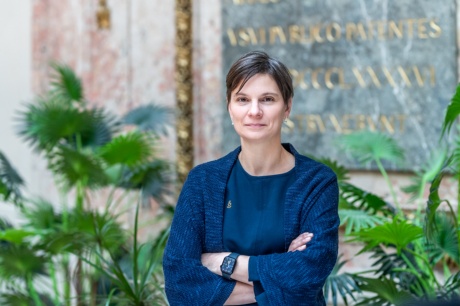
Dana Plavcová is the first ombudspersion in the history of the Czech Academy of Sciences.
What was your first impression of the Czech Academy of Sciences?
I’m fascinated – and really energized – by its diversity. So far, I’ve only visited a fraction of the CAS institutes, and only in Prague, so my impressions are still modest. But every institute feels completely different. It’s an extraordinary ecosystem, full of varied management structures and interpersonal dynamics.
Did you experience any sort of “culture shock”?
The biggest one was probably how formal things are here. I came from an organization where everyone was on a first-name basis – despite there being a few thousand of us. Dogs wandered around the offices, and everyone would queue up at the same single coffee machine for a bit of small talk, which did wonders for bonding across teams.
Where did you work before?
For over twenty years, I mainly worked in the non-profit sector, and for the last fifteen, I was with People in Need (Člověk v tísni), which will always be close to my heart.
What did you do there?
Most of the time I worked on development and humanitarian programs in Africa, where I traveled several times per year. For the past six years, I focused on program development and quality – from girls’ education in Ethiopia, sustainable water access in the semi-arid regions of Angola, and civil society development in Zambia, to treating child malnutrition in war-torn eastern Congo. As Deputy Regional Director, I managed the Program Quality Unit.
What did that involve in practice?
Among other things, I recruited candidates for senior program roles on the international job market and acted as their guide and advisor. I helped them with setting up project quality-management systems and handled countless crises.
Did this work also bring you into contact with issues of rights protection and unethical conduct?
In the African programs I mentioned, I helped introduce a robust system to protect workers and aid recipients from unethical conduct by staff. People in Need is a leader in this area in the Czech Republic; it has well-developed protection systems and clearly defined procedures. I also frequently dealt with gender-related issues in projects and introduced measures to increase the number of women on staff – their numbers were, unfortunately, far too low.
Did you also work on gender issues in the Czech Republic?
I represented People in Need in working groups, for example at the Ministry of Foreign Affairs and the Government Office of the Czech Republic. I also produced a manual for gender analysis for People in Need and led the development of the organization’s strategy for equal opportunities and the inclusion of disadvantaged groups.
Let’s focus on your current role as the Academy’s ombudsperson. What was the vision behind creating the position?
In 2024, the Academy’s leadership carried out a revision of the Code of Conduct of the CAS – an important first step. In the spring, a new guideline established the Office of the Ombudsperson, followed by the selection process to fill the position. The role has a clear mandate: to help foster a culture of open communication, respect, and safety. We want all employees, regardless of gender identity, to feel comfortable and know they have someone they can turn to if needed.
Why should institutions such as the Czech Academy of Sciences appoint an ombudsperson?
When an institution has an independent ombudsperson, it signals the health, resilience, and openness of the organization. It enhances the institution’s credibility and sends a message – both externally and, above all, internally – that it will not tolerate bullying, discrimination, abuse of power, harassment, or any kind of violence. And it shows that the voices and experiences of minorities, early-career researchers, and the cafeteria staff are taken seriously. In other words, every single individual matters and contributes to the whole.
What were the conditions of the selection process?
The selection process was based on the guideline establishing the Office of the Ombudsperson, which sets out the requirements for the position. Besides a university degree and adequate English proficiency, applicants needed professional experience in areas such as ensuring equal opportunities or investigating cases of inappropriate conduct. Otherwise, it was a standard panel job interview.
Who sat on the panel?
Alongside the current CAS President, Radomír Pánek, the former CAS President, Eva Zažímalová, was also present, as well as Oldřich Tůma, President of the Scientific Integrity Committee of the CAS, and members of the working group that helped draft the directive for the Office for the Ombudsperson and the Code of Conduct. I appreciated that the Academy’s top leadership sat on the panel – it showed that they take the protection of rights seriously.
Could you describe what your job entails in more detail?
It’s diverse. It includes educational activities as well as handling reports which cover a wide range of situations and possible procedures. Sometimes, it’s just a consultation of an issue with the person who’s reached out. Other times, I guide the parties involved towards a mutually agreeable solution. In yet other cases, we need to investigate the situation and discreetly speak with witnesses. But first I always agree on the process with the person submitting the report and clarify what I am allowed to share with whom. Confidentiality is the cornerstone of my work.
In what kind of situations can colleagues turn to you?
If they have any concerns about discrimination, bullying, violence, harassment, disrespectful behavior, gender-based violence or harassment, or abuse of power. Issues related to research ethics – such as data falsification or plagiarism – fall under the Scientific Integrity Committee of the CAS.
How can they contact you?
If their institute has its own ombudsperson, they should first reach out to that person. If this office doesn’t exist at their workplace, or if for any reason they don’t feel able to approach that person, they can contact me by email, phone, or by filling out the online form via the encrypted FaceUp platform. The procedure is described on the Academy’s website.
What guarantees your impartiality?
Organizationally, I report directly to the President of the Czech Academy of Sciences. The guideline on the Office of the Ombudsperson also states that I do not accept or follow instructions from any governing bodies or individuals.
As ombudsperson, Plavcová's job entails educational activities as well as handling reports and cases.
Do you guarantee anonymity and confidentiality for those who submit reports?
Unless the reporting person gives me explicit consent, their name is never shared. In exceptional cases, it’s even possible to submit a fully anonymous report – one where I myself cannot identify the person. Still, it’s more credible when the reporting person chooses to reveal their identity to me.
Why is that?
Mainly to prevent the system from being misused to settle personal scores and to avoid malicious reports aimed at harming or discrediting someone. Even for anonymous submissions, it’s better when the reporting person leaves an anonymous contact – so I can reach out, follow up on details, or inform them about the progress of the inquiry. Communication is always beneficial, even if anonymous – which the encrypted FaceUp platform enables.
You’ve only been at the Academy for four months. Have reports already started coming in?
In the first three months, I received thirteen reports. Some involved suspected discrimination; others concerned workplace conflicts.
What happens once you receive a report?
I confirm receipt and familiarize myself with its content. If I’m missing any information, I try to obtain it from the reporting person or available sources. Sometimes, I don’t need to know more, but it’s often better to meet the person – especially when the reported issue is sensitive. It all depends on the nature of the report: in some cases, one or two phone calls are enough; in others, I need to visit the workplace in question and conduct a more detailed inquiry.
If unethical behavior is confirmed, I prepare recommendations that usually go to the director of the CAS institute and to the head of the department where the inappropriate conduct occurred. Over time, I revisit the cases, monitor whether the recommendations have been implemented, and assess how the situation is developing. I inform the CAS President about more serious cases.
Do you expect to achieve systemic changes in rights protection?
I believe so. Part of my agenda is to contribute to systemic preventive measures. I should also be involved in commenting on directives and guidelines to ensure they contain no indirect or unconscious discrimination.
Are you also planning to raise awareness of rights protection among employees?
Definitely – although for now, I’m still in the phase of gathering inspiration and learning what the Academy needs. Every institute is different, so I expect my approach will also vary.
Which activities across the CAS institutes would you highlight in the fight against inappropriate behavior and in support of equality?
A large number of CAS institutes have taken a proactive approach to gender issues and have developed gender equality plans. While the quality varies between institutes, it’s clear that many are truly trying to strengthen the position of women researchers, increase the representation of women in decision-making bodies, and support parents during early parenthood so that a career break doesn’t put them at a disadvantage.
Can you think of a concrete example?
I like the series of short educational videos produced by the non-profit organization NORA in cooperation with the J. Heyrovský Institute of Physical Chemistry of the CAS. The videos are available in Czech and English and highlight issues such as gender bias and psychological violence (editor’s note – more information available here). Many of the CAS institutes use them for staff training.
You mentioned that some of the CAS institutes have already established their own ombudspersons.
About half of the institutes have appointed an ombudsperson or a similar role. But their approaches differ significantly.
How so?
At some of the CAS institutes, the role of ombudsperson is held by a group of trained staff; elsewhere the focus is only on conflicts and bullying; some of the institutes outsource the service; others have recorded very few cases. I’ve spoken with several ombudspersons and hope to meet them all soon. My plan is to schedule regular meetings so that we’re aware of one another and can offer mutual support.
What would you like to achieve in your role as ombudsperson?
I’d like the number of reported cases to decrease in the coming years due to many problems being resolved through open communication, and I’m hoping the very existence of ombudspersons will have a preventative effect. I’ll be pleased if we manage to strengthen a culture of respect, dialogue, and constructive feedback so that some conflicts or inappropriate conduct won’t develop at all. We’re all responsible for a healthy workplace culture – managers most of all.
Any closing thoughts you’d like to leave your colleagues with?
Speaking up about unethical behavior isn’t always easy; it often requires courage. If you’re considering reporting something but feel unsure or uneasy about the situation, do not hesitate to call me – we can talk things through informally first.
*
|
Ing. Dana Plavcová Dana Plavcová spent more than twenty years working in the non-profit sector. For fifteen of those years, she worked in the People in Need organization (Člověk v tísni), where she held various positions, including advisor for equal opportunities. Most of her work focused on the quality and advancement of humanitarian and development programs in sub-Saharan Africa. In this role, she helped establish and strengthen measures to protect workers and aid recipients from unethical conduct by staff. She assumed the position of ombudsperson of the Czech Academy of Sciences in September 2025. |
Written and prepared by: Zuzana Dupalová and Luděk Svoboda, External Relations Division, CAO of the CAS
Translated by: Tereza Novická, External Relations Division, CAO of the CAS
Photo: Jana Plavec
 The text and photos marked CC are released for use under the Creative Commons license.
Read also
- Small but Mighty – The Enceladus Moon Is Flexing with Saturn’s Magnetic Field
- Light vs. Antibiotics – Can We Get Harmful Substances Out of Our Water?
- Better ECGs and Industrial Superlasers – Real-World Results of CAS Research
- Czech Academy of Sciences to launch a joint-stock company
- In the Age of AI, Spotting a Fake Photo Is Harder Than Ever, Expert Says
- How to Turn Ideas into Successful Grants: The New ERC Incubator Is Offering Help
- SciComm 360° Tackled How to Communicate Science in the Age of Disinformation
- The Academy of the Future? A New Vision for Attracting Scientific Talent
- When Cars Fly and Bullets Swerve – Physics Gone Wrong on the Silver Screen
- The Academy to Boost Excellence and Careers in Research with New Programs
The Czech Academy of Sciences (the CAS)
The mission of the CAS
The primary mission of the CAS is to conduct research in a broad spectrum of natural, technical and social sciences as well as humanities. This research aims to advance progress of scientific knowledge at the international level, considering, however, the specific needs of the Czech society and the national culture.
President of the CAS
Prof. Radomír Pánek started his first term of office in March 2025. He is a prominent Czech scientist specializing in plasma physics and nuclear fusion.