

Living with a Genetic Growth Disorder: Can Achondroplasia Be Eradicated?
23. 03. 2026
People with achondroplasia are documented throughout history – from ancient Egypt to the courts of European kings. But only now are scientists beginning to unravel what causes the condition. Their goal is to consign this anomaly to the history books once and for all. How close they are to achieving that is something we discussed with cell biologist Pavel Krejčí from the Institute of Animal Physiology and Genetics of the CAS in the latest issue of A / Magazine.
He owned thousands of head of cattle, twenty palaces, and held numerous religious titles. Seneb, a high-ranking official in ancient Egypt in the third millennium BCE, had a beautiful wife and three healthy children. Yet he faced challenges. What set him apart from others was his unusual stature. His torso was average-sized, but his head was somewhat larger and his arms and legs were short. Seneb is the earliest known historical figure with the growth gene disorder leading to what is known as achondroplasia.
Today, an estimated 350,000 people worldwide live with this rare diagnosis; in the Czech Republic, there are fewer than one hundred. This genetic disorder arises before birth, and although the condition can be inherited, up to 90 percent of children with achondroplasia are born to parents who don’t have the disorder, as a result of a new mutation. According to some theories, the risk of errors in intricate DNA sequences increases with the father’s age, though this isn’t entirely certain. In fact, many questions about the disorder remain unanswered.
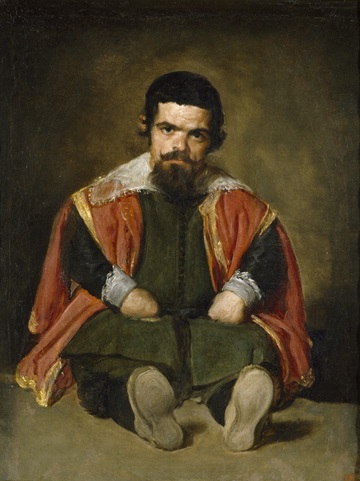 |
PEOPLE WITH DWARFISM IN HISTORY AND CULTURE Achondroplasia affects the growth of long bones, and people with this rare diagnosis don’t exceed a height of 130 centimeters. It has no impact on intellect or personality traits. History and culture offer many examples of successful and well-liked individuals with this condition. In 17th-century Spain, for instance, Sebastián de Morra served at the royal court – a man of short stature that the painter Diego Velázquez immortalized as a serious, proud individual with a direct gaze. People of short stature are also heroic figures in the works of J. R. R. Tolkien; another popular example is Tyrion Lannister in Game of Thrones, who won audiences’ sympathy with his sharp wit and clever responses to mockery about his height. |
CALIFORNIA – A MECCA FOR BIORESEARCH
Since the early 1990s, one thing has been certain: achondroplasia is caused by a mutation in a gene abbreviated as FGFR3. “An enormous amount of research was done in the first six years after the discovery in 1994. I entered the field around the turn of the millennium and, to be honest, I thought everything had already been explored. The opposite turned out to be true,” says Pavel Krejčí from the Institute of Animal Physiology and Genetics of the CAS.
“The reality is that we understand perhaps ten percent of the disorder mechanism. The rest remains largely unknown,” adds Krejčí, who in 2001 left his alma mater, Masaryk University, to gain experience at the private Cedars-Sinai Medical Center in California. At the time, this institution was at the forefront of research into growth disorders, including achondroplasia, and it’s no coincidence that the first breakthrough discoveries were made there thirty years ago.
Researchers there had access to samples from patients with growth disorders from across the USA. Thanks to a carefully maintained and continuously updated registry, they’ve identified many different types of skeletal growth disorders in humans.
A NATURAL LABORATORY
In the case of achondroplasia, one of the main suspects – and indeed the culprit – is the mutated FGFR3 gene. This gene plays a crucial role in bone development but also influences processes in other parts of the body, so its disruption can cause serious issues. It’s one of the more frequently mutated human genes, and some of its variants are associated with cancer, including liver cancer and bladder cancer.
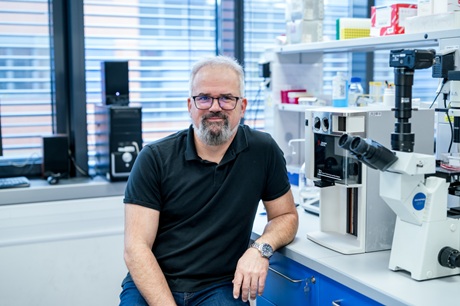
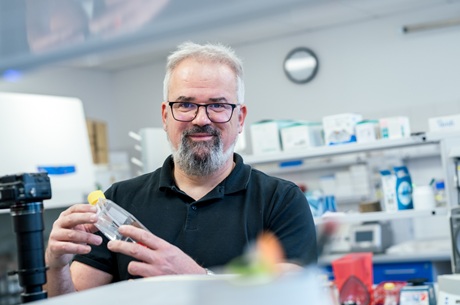
Pavel Krejčí from the Institute of Animal Physiology and Genetics of the CAS. (CC)
Many research teams around the world study the functions and defects of this insidious gene, but most focus on cancer. In those cases, FGFR3 behaves in exactly the opposite way to what we see in achondroplasia. While cancer involves accelerated and uncontrolled cell proliferation, growth disorders are characterized by suppressed cellular activity.
A mutation in the gene leads to dysfunction of the protein of the same name, FGFR3, which stands for fibroblast growth factor receptor 3. A receptor is a molecule on the surface of a cell that enables communication. This particular receptor is located on the surface of a chondrocyte – a cell responsible for the growth and formation of cartilage (connective tissue).
When FGFR3 malfunctions due to a genetic mutation, the transmission of information falters, and development in the body goes awry. “We can view growth disorders – and achondroplasia in particular – as an ideal lab for studying cellular communication. Pathologies actually teach us how the organism is supposed to function properly,” Krejčí says.
To better understand this, we can liken the FGFR3 protein to a guardian of bone growth that determines how quickly or slowly growth cells can divide and mature. Under normal conditions, it acts as a gentle brake regulating the entire process. It tells the body: “Wait, it’s not yet time to lengthen the bones,” or “Proceed, but gradually and steadily.” However, if the guardian becomes overactive due to a genetic mutation, the brake gets stuck and cannot be released. The growth of long bones slows down or ceases altogether. This is exactly what happens in patients with achondroplasia. Their braking system is excessively active, and the bones of the arms and legs stop lengthening around the age of four.
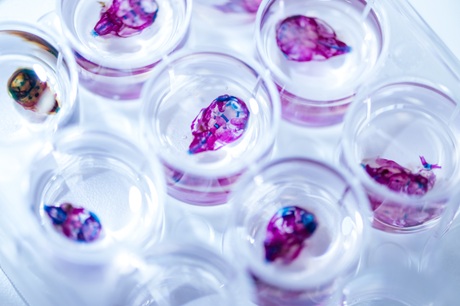
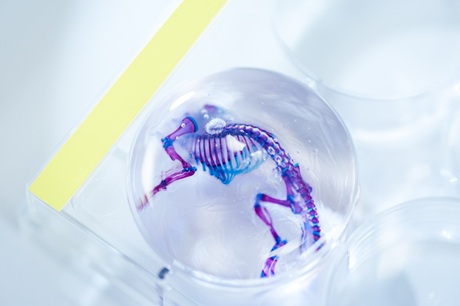
In achondroplasia research, scientists work with mouse models. The image shows colorized skulls – purple indicates bone, blue indicates cartilage. (CC)
LESS BRAKE, MORE GAS
If scientists were able to determine how to effectively influence the inordinate activity of this braking system, they could solve the problem of halted bone growth. It sounds simple, but the entire communication system between the receptor and the cell is far more complex. Information is transmitted through intercellular signals known as ligands – in this case, growth factors from the FGF family. If we visualize the receptor (such as FGFR3) as a lock, then the ligand (FGF) is the key that opens it.
Pavel Krejčí’s team, together with colleagues from the University of Baltimore, is currently trying to determine experimentally how a single receptor can distinguish among four different ligands. It’s similar to an ear listening to four voices at once and the brain understanding what each of them is saying at any given moment.
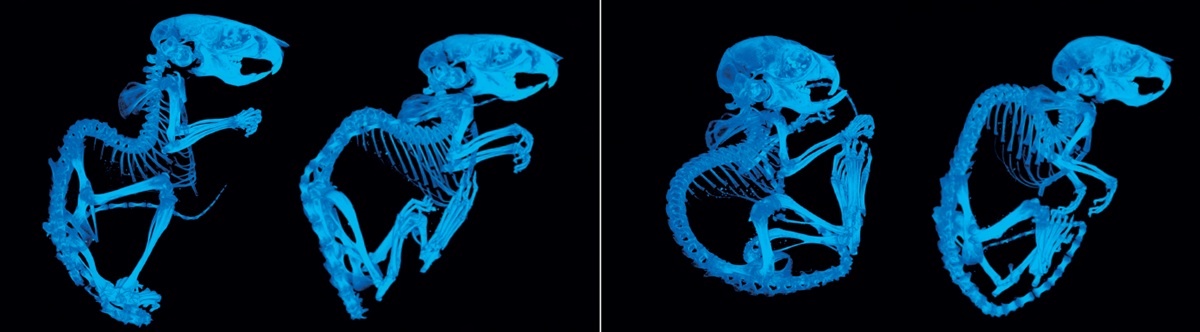
The two mouse skeletons on the left depict healthy animals without growth disorders. On the right is a mouse skeleton model of achondroplasia.
Some communication pathways, however, are already known, and stimulating the right signaling channels underlies Voxzogo, the first approved drug for achondroplasia, whose development Krejčí has been involved in from the beginning. The drug delivers an artificially created signaling molecule into the body that reduces the inhibitory activity of FGFR3 and thus promotes bone elongation. Administered as a daily subcutaneous injection, Voxzogo is intended for children with confirmed achondroplasia whose growth hasn’t yet been completed.
HOPE FOR THE FUTURE
The EU approved the drug in 2021, and it’s also used in the USA. Though it’s still too early for an optimistic verdict that would relegate dwarfism to the dustbin of medical history, the preliminary results are encouraging. According to available studies, children treated with Voxzogo grew 1.5 centimeters more per year than patients who received a placebo.
However, the drug is very expensive, and its short-term effects are modest. As a result, insurance companies have been reluctant to cover it, and physicians can’t prescribe Voxzogo to everyone who might benefit from it.
So far, most of the patients using the drug are in the USA (about a quarter of children with achondroplasia). In the Czech Republic, Voxzogo is currently used by several dozen patients. Meanwhile, experts from pharmaceutical companies and scientists – including Krejčí’s team – are working on a new generation of drugs that could be significantly more effective. Their aim is to find therapeutic approaches that would influence development at the earliest stages of life, ideally even prenatally. Although standard prenatal testing can’t detect the genetic mutation responsible for the growth disorder, an experienced gynecologist can recognize it on ultrasound.
|
ACHONDROPLASIA IN NUMBERS 771 rare growth disorders are currently known; the most common is dwarfism, or achondroplasia. 130 centimeters is the average height of an adult man with achondroplasia. 90 percent of parents of children with achondroplasia are of average height; the genetic mutations arise de novo in the father’s sperm. 350,000 patients is the estimated number of people with achondroplasia worldwide. 1 in 15,000–25,000 is the rate of children born with achondroplasia globally. 1 in 12 pediatricians in the Czech Republic has encountered a patient with achondroplasia. >100 patients are included in the clinical registry of individuals with achondroplasia in the Czech Republic and Slovakia. CZK 30 million is the amount Pavel Krejčí can use for research over the next six years thanks to the Academic Award he received from the CAS. |
“A specialist in growth disorders can detect it as early as the beginning of the second trimester. However, it must be acknowledged that a general gynecologist won’t recognize achondroplasia until much later,” Krejčí adds. “Our estimate suggests that, in practice, one in twelve Czech pediatricians will encounter achondroplasia at some point in their career.”
WORKING TOGETHER IN SYNERGY
A major advantage that helps Krejčí in researching rare growth disorders is the synergy between institutions. He has long been affiliated with the CAS as well as the Faculty of Medicine and the International Clinical Research Center of Masaryk University and St. Anne’s University Hospital in Brno. This provides him with both top-tier facilities and direct links to physicians and patients. At the Faculty of Medicine, he established the Registry of Achondroplasia (ReACH), which currently contains records of several dozen pediatric patients from the Czech Republic and Slovakia.
The registry helps researchers better understand the practical aspects of the disorder and identify volunteers for clinical trials. For patients and their families, it offers an opportunity to provide feedback to experts. The platform has also yielded a somewhat surprising finding. Most fathers of children with achondroplasia were of typical age at the time of conception – at least among Czech and Slovak parents, the assumption that advanced paternal age is a risk factor for mutations in the growth gene hasn’t been confirmed.
According to Pavel Krejčí, we only understand about ten percent of the disorder mechanism. (CC)
However, it’s known that the FGFR3 gene somehow impacts the development and function of sperm – one of many research aspects pursued by Krejčí’s team. The FGF signaling system evolved over approximately 700 million years, from jellyfish to humans, and is highly complex. In addition to bone development, it regulates most other cellular processes involved in human growth and development. From this perspective, studying achondroplasia offers scientists an exceptional opportunity to understand the mechanisms of life at the cellular level.
IN IT FOR THE LONG HAUL
Conducting large-scale research wouldn’t be possible without adequate funding – for Krejčí’s group, this has been provided since 2024 by the Academic Award grant. “We’re developing medicine for future generations. The development of Voxzogo took fifteen years. The next generation of treatments will be approved within a matter of years,” Krejčí says. The drugs his team is working on now – which may one day completely cure achondroplasia – are expected to become available within ten to fifteen years.
“It’s a long-distance run, and in many ways, research is comparable to elite sports. You train, fight, and push yourself to the limit, you try to stay at the top and compensate for waning strength. The grant has given me the energy to run another lap.”

The development of Voxzogo took fifteen years. Pavel Krejčí estimates the next generation of treatments will be approved within a matter of years. (CC)
The highest grant awarded by the CAS amounts to CZK 30 million over six years. Its advantage lies in its flexibility and the freedom it offers by reducing red tape. Krejčí doesn’t intend to spend the funds on upgrading lab equipment, not needing new instruments. Instead, he sees real value in people – their enthusiasm, intellect, and abilities – and plans to invest primarily in his team.
Krejčí knows many of the families of children with achondroplasia personally, both in the Czech Republic and Slovakia, and deeply wishes to ease their burden. At the same time, he’s aware of the limitations of the current therapy – it hasn’t been in use for very long, and its long-term benefits are yet to manifest.
“The ultimate goal is to relegate achondroplasia to the history books, but we aren’t there yet. My main ambition is to do everyday, ordinary scientific work well. I still find that immensely enjoyable,” the cell biologist says. “I’m like a car mechanic who looks forward to every new vehicle,” he adds. The automotive analogy is no coincidence. In addition to clearing his head by riding his motorcycle, Krejčí has always been interested in technology – he has long seen parallels between the world of engines and cellular communication. Human cells are like mechanical systems, and there’s nothing better than when each cell runs like a well-oiled machine – something Krejčí’s work helps make possible.
*
|
RNDr. PAVEL KREJČÍ, Ph.D.
As a cell biologist, Pavel Krejčí has long focused on research into intercellular communication mediated by growth factor receptors. He studies the role of FGF receptors, which are crucial for the development and growth of cartilage and bone, and how their genetic defects lead to severe, often fatal disorders of the human skeleton. Krejčí spent nearly twenty years working abroad, most notably at the Cedars-Sinai Medical Center and the University of California, Los Angeles. In the USA, he contributed to the development of treatments for achondroplasia, a genetic disorder caused by mutations in the FGFR3 receptor that leads to dwarfism. After returning to the Czech Republic, he established a clinical registry of patients with this rare disorder. In 2019 and 2023, he received awards for medical research and development from the Czech Minister of Health. In 2024, he received the Academic Award of the CAS. |
The article first came out in Czech in the 1/2026 issue of A / Magazine:

1/2026 (version for browsing)
1/2026 (version for download)
All Czech and English issues of A / Magazine – the official quarterly of the Czech Academy of Sciences, including its predecessor A / Science and Research – are available online.
We offer free print copies (of the Czech version and the two English issues from 2024 and 2025) to anyone interested – please contact us at predplatne@ssc.cas.cz.
Written and prepared by: Leona Matušková, External Relations Division, CAO of the CAS
Translated by: Tereza Novická, External Relations Division, CAO of the CAS
Photo: Pavlína Černoch Jáchimová, External Relations Division, CAO of the CAS; WikiMedia / Museo del Prado; František Špoutil; Gustavo Rico-Llanos
 The text and photos labeled CC (including the researcher's bio photo) are released for use under the Creative Commons license.
Read also
- Small but Mighty – The Enceladus Moon Is Flexing with Saturn’s Magnetic Field
- Light vs. Antibiotics – Can We Get Harmful Substances Out of Our Water?
- Better ECGs and Industrial Superlasers – Real-World Results of CAS Research
- Czech Academy of Sciences to launch a joint-stock company
- In the Age of AI, Spotting a Fake Photo Is Harder Than Ever, Expert Says
- How to Turn Ideas into Successful Grants: The New ERC Incubator Is Offering Help
- SciComm 360° Tackled How to Communicate Science in the Age of Disinformation
- The Academy of the Future? A New Vision for Attracting Scientific Talent
- When Cars Fly and Bullets Swerve – Physics Gone Wrong on the Silver Screen
- The Academy to Boost Excellence and Careers in Research with New Programs
The Czech Academy of Sciences (the CAS)
The mission of the CAS
The primary mission of the CAS is to conduct research in a broad spectrum of natural, technical and social sciences as well as humanities. This research aims to advance progress of scientific knowledge at the international level, considering, however, the specific needs of the Czech society and the national culture.
President of the CAS
Prof. Radomír Pánek started his first term of office in March 2025. He is a prominent Czech scientist specializing in plasma physics and nuclear fusion.