

Twenty years of EURAXESS: Supporting researchers in motion
02. 12. 2025
Moving to a foreign country can be stressful. That is why, for two decades now, EURAXESS Czech Republic has been guiding researchers and their families through it all, from visa formalities to settling into a new environment. To date, it has supported more than 10,000 researchers. Below, Markéta Padevětová and Zuzana Maršálková from the Centre of Administration and Operations of the Czech Academy of Sciences explain how the activities of the Czech branch of this European network are evolving.
When researchers come to the Czech Republic from abroad, they enter a world of confounding administrative obligations, language barriers, and cultural differences. EURAXESS is here to help them navigate all these potential pitfalls. Since 2005, the organization has helped over ten thousand researchers acclimatize.
Whether it’s negotiating residence permits, helping families settle in, or dealing with unexpected situations, the Czech EURAXESS team stands by researchers from the get-go. “The CAS institutes rely on our support in this regard for the long term and have often praised it. After all, it is the symbolic gateway into the Czech Academy of Sciences [CAS]. The researchers arrive in an unfamiliar environment – and it’s important they feel comfortable and find their footing as quickly as possible so that they can devote themselves to science,” emphasizes Kateřina Sobotková, Director of the External Relations Division at the Centre of Administration and Operations (CAO) of the CAS, under which EURAXESS operates.
The importance of the activities of EURAXESS Czech Republic is also praised by the CAS President, Radomír Pánek: “Many researchers working at our Academy’s institutes come to us by way of EURAXESS’s support. The Academy benefits from their work, both in terms of research and interpersonal relations. I am all the more pleased that, with the help of our Centre of Administration and Operations, we can assist them on their journey into our research environment,” Pánek says, adding that without the professional support EURAXESS offers incoming scientists, many research projects might never have gotten off the ground.
In the interview below, Markéta Padevětová, Head of the Section of International Mobility, and Zuzana Maršálková, Project Manager, explain the key milestones and history that have shaped the work of the Czech EURAXESS branch.
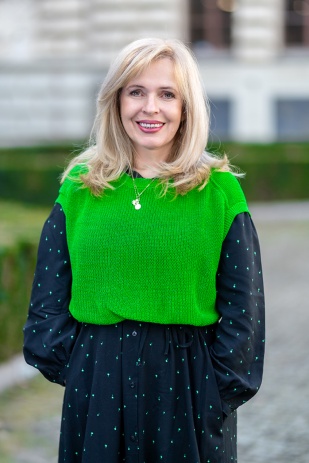
Markéta Padevětová (Head of the Section of International Mobility, CAO of the CAS) has been involved with EURAXESS since 2008.
How long have you been with EURAXESS?
Markéta Padevětová (MP): Since 2008. Over that time, I have held a number of roles – from handling the day-to-day agenda of assistance services to making sure our activities had stable financial backing. Today, I lead the Section of International Mobility at the CAO of the CAS, under which EURAXESS falls.
Zuzana Maršálková (ZM): In 2007, I was at the “beginnings” of the EURAXESS office at the University of South Bohemia in České Budějovice. I joined the Prague team in 2017 – initially, I was involved in the area of residence-permit matters, and now I am the main coordinator of the CZERA project, which funds the office’s operations.
What do you remember about those early days?
MP: It was a wonderful but also demanding time. We were looking for ways to improve the circumstances at the time when our “clients” sometimes had to queue overnight just to sort out their residence papers. Moving from those conditions to today’s – where the applicants have a comfortable, quiet office designated for this purpose – was by no means an easy feat. It took personal dedication and also support from the then-leadership of the Czech Academy of Sciences. Luckily, they stood by us and helped us in difficult negotiations with the Czech Ministry of the Interior.
Do you recall the first researcher whose case you handled?
MP: I have to admit I don’t remember the very first one, but I do remember those whose cases were complicated or where we experienced unusual, often even amusing, situations. I’ve kept in touch with these clients even after many years.
ZM: I can’t recall the first ones either – there have really been so many. What I do remember is a complicated case of a researcher’s wife from Pakistan, for whom it was nearly impossible to get an appointment at the Czech Embassy in Islamabad. I remember how happy I was when she finally arrived safely in the Czech Republic and we met in person. Today, she works with us as a researcher, and she and her husband have three children.
Which achievements stand out for you?
MP: So many milestones and successes come to mind that they would make a novel out of this article. For me, the most significant moment remains when we decided to change our way of working: not to limit ourselves to offering general advice from afar, but to get to know every individual personally, understand their situation, and guide them through the required official procedures. That change is what has advanced EURAXESS the most.
ZM: I’m pleased that we have been able to organize activities that are not just connected to residence-permit issues, but that help incoming researchers get to know each other and learn something new about life in the Czech Republic. I’m very happy that we keep seeing more and more applications for permanent residence and that our clients are planning to stay. And I hope that EURAXESS services have had a degree of influence on their decision.
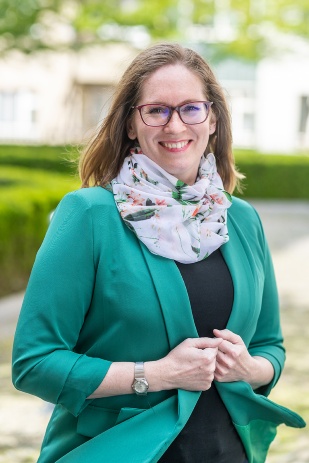
Project Manager Zuzana Maršálková runs the CZERA project, which funds the work of the EURAXESS office.
How does the EURAXESS network operate in practice?
ZM: The network’s structure is defined by the European Commission. In each participating country, there is a main center that coordinates the activities of regional service points. These provide primary assistance – whether with residence permits, housing, or integration. The Prague center plays a double role: it coordinates the Czech network and at the same time provides services to incoming researchers. Members of our national network usually meet twice a year, discuss procedural guidelines and updates in immigration legislation, and share experiences to ensure that the mobility of researchers is as streamlined as possible.
How many researchers have you helped so far, and what are the most common issues?
MP: On average, we arrange residence permits or their extension for about seven hundred researchers per year. Overall, that means we’ve helped more than ten thousand people. The most difficult task is the legalization of the researchers’ stay – obtaining a long-term residence permit (or long-stay visa). Although these terms refer to different procedures, they both serve a very similar purpose, and you may hear both referred to as a “visa.” Assistance with this accounts for roughly three quarters of our agenda.
ZM: But obtaining a “visa” is only the beginning. Then come all the practical issues related to life in a new country. We organize adaptation and integration courses and help incoming researchers with navigating the job market. We also support personal situations like the birth of a child – we make sure parents know what to expect and which social benefits they are entitled to. In short: our support lasts the entire stay, and it is comprehensive – from arrival to departure.
What can researchers expect when relocating to a new country?
ZM: When a future employer asks when they can expect the researcher to join their team, we typically give three months as a realistic timeframe. The applicant must prepare all the necessary documents for the embassy application, wait for approval, then travel to the Czech Republic and complete the process by picking up their residence permit at the Ministry of the Interior’s Department for Asylum and Migration Policy. However, sometimes unexpected complications arise, which can prolong and complicate the process.
What kind of complications, for instance?
ZM: Last year, we helped a researcher and his family come here from Sudan, a country affected by armed conflict. The entire process required a support letter from the leadership of the Czech Academy of Sciences. The Director of the Institute of Archaeology of the CAS, Prague, Jan Mařík, even went in person to pick up the visas at the embassy in Cairo. From first contact to their arrival, eight months passed. It required active communication with the embassy, the Visa Department of the Czech Ministry of Foreign Affairs, and also the Czech Ministry of the Interior. At the beginning, I thought it would be nearly impossible – but we managed to make it happen.
Do you also look after researchers’ families?
ZM: Family members often come to the Czech Republic as accompanying dependents. They suddenly find themselves in a foreign country, without knowing the language and without any contacts, which can be stressful. Sometimes, that very sense of isolation decides whether the researcher stays – or leaves early. That’s why, in 2019, we expanded our services to include families as well: we help them find their way into the Czech labor market and organize integration activities.
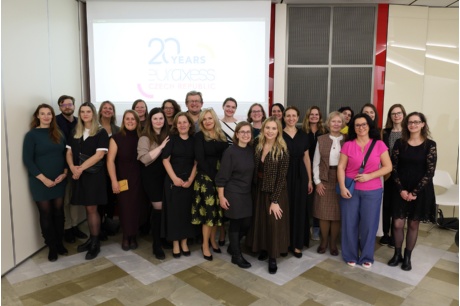
In November 2025, a gathering was held to mark twenty years of EURAXESS, attended by current and former staff.
What is the biggest challenge researchers face upon arriving in the Czech Republic?
MP: Our questionnaires, in which we track ongoing barriers to international researcher mobility, reveal that the hardest challenges are overcoming bureaucracy, the language barrier, and a certain sense of loneliness in a foreign country. That’s why we focus our support exactly on these areas. In addition to personalized assistance with official procedures, we organize Czech-language courses and social-cultural events.
And what about “culture shocks”?
Surprisingly, the biggest one is encountering Czech cuisine. (laughter)
Are the expectations of researchers and their families changing?
MP: Years ago, incoming experts from abroad – and their Czech employers – were often surprised and genuinely grateful that someone was there to help them in difficult situations. Today, cooperation with EURAXESS is taken for granted. And that’s a good thing!
ZM: Absolutely. Based on the questions and feedback we receive from clients, we’re constantly working to improve and expand our services. Some suggestions come from their employers as well.
What trends are shaping your work right now?
ZM: We would welcome the digitalization of the residence-permit process, which was expected to come with the new “foreigners’ law”. We’ll have to wait a bit longer for its introduction, but we’re ready for the changes.
Can you consult and comment on such legislation?
MP: Yes – and we appreciate being part of the consultations concerning the employment of foreign workers. We’re glad when we can help adjust draft laws so that they better reflect the specific situations that employing experts from abroad entails.
Who plays a key role in the development and support of the network?
MP: We owe thanks to the Czech Ministry of Education, Youth and Sports, which has provided funding to us for all twenty years of our existence – something truly exceptional. In the European context, such stable and continuous support is very rare, and our colleagues from other countries genuinely envy us. Special thanks also goes to the leadership of the Czech Academy of Sciences, under whose auspices EURAXESS has operated since the beginning. Having such a strong and stable foundation is both a great assurance and a great honor. And many thanks to the leadership of the Centre of Administration and Operations, its External Relations Division, and to everyone who provides us with support, resources, and trust.
Where would you like to take EURAXESS next, so that it will remain attractive to the next generation of researchers?
ZM: We would like to focus on expanding services in the direction of career counselling. It will be a major challenge. But thanks to our cooperation with the European network, we already have a good idea of what it will involve.
In one sentence, what does EURAXESS mean to you?
MP: For me, it’s a matter of the heart: a place that helps real people overcome obstacles and turn a major life transition in our country into something better.
ZM: For me, EURAXESS is a home base, fulfilling work – and a fantastic team of true professionals.
And finally, what would you like to say to the researchers?
MP: We’re here for you!
Written and prepared by: Luděk Svoboda, External Relations Division, CAO of the CAS
Translated by: Tereza Novická, External Relations Division, CAO of the CAS
Photo: Jana Plavec, External Relations Division, CAO of the CAS; Zdeněk Rerych, EURAXESS archive
 The text is released for use under the Creative Commonse license.
Read also
- Better ECGs and Industrial Superlasers – Real-World Results of CAS Research
- Czech Academy of Sciences to launch a joint-stock company
- In the Age of AI, Spotting a Fake Photo Is Harder Than Ever, Expert Says
- How to Turn Ideas into Successful Grants: The New ERC Incubator Is Offering Help
- SciComm 360° Tackled How to Communicate Science in the Age of Disinformation
- The Academy of the Future? A New Vision for Attracting Scientific Talent
- When Cars Fly and Bullets Swerve – Physics Gone Wrong on the Silver Screen
- The Academy to Boost Excellence and Careers in Research with New Programs
- Could an asteroid hit Earth? The risk is low, but astronomers are keeping watch
- At the nanoscale, gold can be blood red or blue, says Vladimíra Petráková
The Czech Academy of Sciences (the CAS)
The mission of the CAS
The primary mission of the CAS is to conduct research in a broad spectrum of natural, technical and social sciences as well as humanities. This research aims to advance progress of scientific knowledge at the international level, considering, however, the specific needs of the Czech society and the national culture.
President of the CAS
Prof. Radomír Pánek started his first term of office in March 2025. He is a prominent Czech scientist specializing in plasma physics and nuclear fusion.