
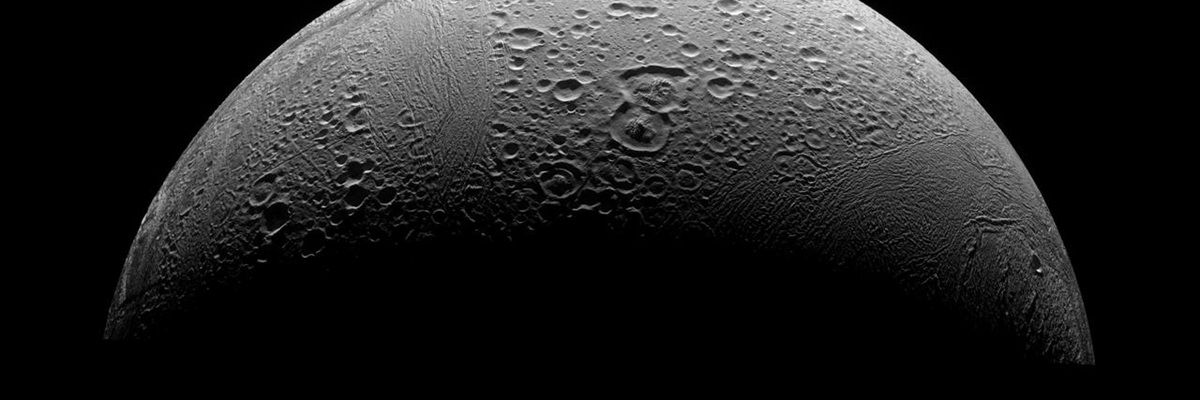
Small but Mighty – The Enceladus Moon Is Flexing with Saturn’s Magnetic Field
16. 03. 2026
The icy moon recently stunned the world by meeting key conditions for extraterrestrial life. A new international study, involving researchers from the Institute of Atmospheric Physics of the CAS, has brought further findings. It shows that this tiny celestial body also exerts an unexpectedly strong influence on the entire magnetic field of the giant planet Saturn.
It is named after the giant Enceladus, whom – according to Greek mythology – the goddess Gaia conceived from the blood spilled when the god Uranus was castrated. Although the icy moon Enceladus, orbiting near the edge of Saturn’s rings, is far from gigantic in size, it interacts with the planet’s magnetic field surprisingly strongly. According to current data from the Cassini spacecraft, this interaction extends to a record distance of more than 500,000 kilometers – more than two thousand times the moon’s radius. Scientists have never before observed such an enormous electromagnetic reach from a celestial body of comparable size.
“In the space ahead of Enceladus, we discovered a complex web of reflected electromagnetic waves that do not travel only in the plane of the orbit, but also shoot high toward Saturn’s north and south poles. Our analysis shows that Enceladus pumps energy into the entire environment of the giant planet,” says David Píša from the Institute of Atmospheric Physics of the CAS, co-author of the extensive new study published in February 2026 in the Journal of Geophysical Research: Space Physics.
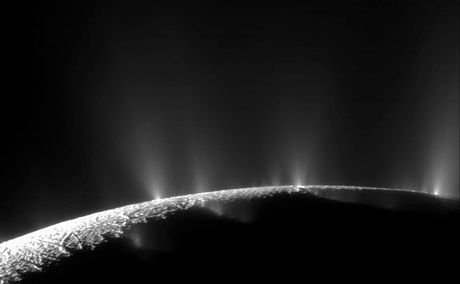
Jets of water vapor and dust erupt through fractures in Enceladus’s icy surface.
The Cassini spacecraft is the result of a unique collaboration between NASA, the European Space Agency (ESA), and the Italian Space Agency (ASI). Thanks to its research, we now know that Enceladus is not merely an icy body, but a geologically highly active one. From fractures in the icy surface of its southern hemisphere, geysers of water vapor and dust erupt into space. Water molecules and particles from these geysers become ionized when exposed to radiation, creating plasma. As this plasma flows around Enceladus, it interacts with Saturn’s magnetic field. The effect is so dominant that it influences energy flows throughout the entire system of Saturn’s moons and rings.
LIKE A WAVE ON A STRING
The new study also provides fresh evidence of the phenomenon known as Alfvén wings – specific vibrations that propagate along magnetic field lines much like a wave traveling along a string. Waves in the main Alfvén wing reflect back and forth both from Saturn’s ionosphere and from Enceladus’s plasma torus (a ring-shaped cloud of plasma), and together with reflected waves enable a complex exchange of energy between the moon and Saturn’s ionosphere.
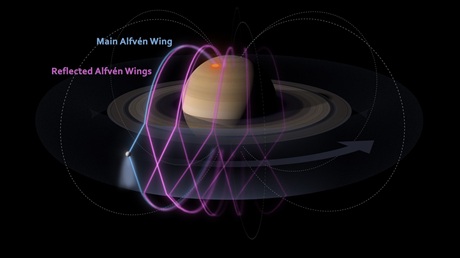
An illustration of the electrodynamic interaction between Enceladus and Saturn.
“These waves act like invisible pipelines that transport energy along magnetic field lines. Thanks to them, the moon and the planet can communicate with each other efficiently even across enormous distances,” explains David Píša, an expert in the analysis of plasma wave measurements.
Together with a team of researchers, he examined thirteen years of archival data taken from four instruments aboard the Cassini spacecraft. On thirty-six occasions, the spacecraft entered regions of magnetic connection between the moon and the planet. The researchers found that the waves are not only large and uniform, but also split into fine filaments under the influence of turbulence. “These small-scale structures can alter the trajectories of charged particles, which then create distinctive auroras near Saturn’s poles,” the physicist adds.
A KEY TO ADDITIONAL POTENTIAL FINDINGS
The new discovery could help scientists understand other, still unexplored parts of the universe – such as Jupiter’s icy moons or distant exoplanets. In 2040, ESA plans to send another probe to Enceladus that is expected to actually land on the moon. Scientists are already working on instruments that will be able to study the fascinating electromagnetic interactions of this celestial body with Saturn in even greater detail.
Enceladus was discovered in 1789 by the astronomer Frederick William Herschel. It is the sixth largest of Saturn’s fifty-three named moons. Its diameter is nearly 500 kilometers (for comparison, the diameter of our Moon is almost 3,500 kilometers).
Prepared by: Radka Římanová, External Relations Division, CAO of the CAS, drawing on the CAS press release
Translated by: Tereza Novická, External Relations Division, CAO of the CAS
Photo: NASA / JPL / Space Science Institute; Europlanet, Fabrice Etifier – École Polytechnique
 The text is released for use under the Creative Commons license.
Read also
- Light vs. Antibiotics – Can We Get Harmful Substances Out of Our Water?
- Better ECGs and Industrial Superlasers – Real-World Results of CAS Research
- Czech Academy of Sciences to launch a joint-stock company
- In the Age of AI, Spotting a Fake Photo Is Harder Than Ever, Expert Says
- How to Turn Ideas into Successful Grants: The New ERC Incubator Is Offering Help
- SciComm 360° Tackled How to Communicate Science in the Age of Disinformation
- The Academy of the Future? A New Vision for Attracting Scientific Talent
- When Cars Fly and Bullets Swerve – Physics Gone Wrong on the Silver Screen
- The Academy to Boost Excellence and Careers in Research with New Programs
- Could an asteroid hit Earth? The risk is low, but astronomers are keeping watch
The Czech Academy of Sciences (the CAS)
The mission of the CAS
The primary mission of the CAS is to conduct research in a broad spectrum of natural, technical and social sciences as well as humanities. This research aims to advance progress of scientific knowledge at the international level, considering, however, the specific needs of the Czech society and the national culture.
President of the CAS
Prof. Radomír Pánek started his first term of office in March 2025. He is a prominent Czech scientist specializing in plasma physics and nuclear fusion.