

Paleontologists discovered tiny larvae of 480 million years old arthropod
03. 10. 2023
Arthropods - creatures with jointed legs that contain today's crabs, beetles, or spiders - are the most successful animal group that ever existed on Earth. They contain over 1,200,000 described species, represent most of the animal biomass, and are one of the most fundamental parts of both marine and terrestrial ecosystems. Not only do their adults dominate the land and sea, but their juvenile and larval stages are as important as the mature individuals.
Today's arthropods often show very complex development with their juveniles and larvae living and feeding in a different way than the adults. A classical example is a flying butterfly with an edacious caterpillar or a sessile barnacle with a floating larva. But was such a complex kind of development present in the early members of Arthropoda? An international team of researchers led by Lukáš Laibl (Institute of Geology of the Czech Academy of Sciences) and Allison C. Daley (University of Lausanne) has studied a few millimeters-long larvae of 480 million years old arthropod species to answer such a question. To better understand the anatomy of this Paleozoic animal, they scanned the tiniest larvae using a powerful X-ray scanner at the Paul Scherrer Institut in Switzerland.
"Thanks to the high-resolution data obtained and meticulous processing from co-author Pierre Gueriau, we have been able to virtually extract and render in three dimensions the tiny specimen on a micrometer scale so we can recognize morphological details in a stage that is about 2 mm long. You can see every detail, from tiny claws to delicate hairs in the animal legs," says Lukáš Laibl.
Detailed examination of appendages of this early arthropod larvae tells a lot about its mode of life. On the head, it had sensory antennae, a pair of robust legs used to orientate its body or to anchor itself on the sediment, and a pair of walking limbs. Two additional pairs of legs on the trunk were also used for walking, while the rear limbs of the trunk bore spines and delicate hairs and were used for capturing small organic particles that the animal was eating. All trunk limbs also had a gill branch used for respiration.
These arthropod larvae belong to an extinct group called Marrellida which once thrived in Paleozoic seas. Interestingly the adult stages of various marrellids seem to have a very similar mode of life as these tiny babies, contrary to what is seen in many recent arthropods. The tiny larvae even lived in the same locations and environment as adults of the same species, that is, on the seafloor at the margin of an ancient continent called Gondwana, just below the storm wave base.
"Marrellids are considered to be very early arthropods, showing many ancestral features. We therefore think that such development, with no major change in feeding and ecology, was ancestral for arthropods as a whole. You can see something similar in other ancient arthropod groups, which supports our conclusions. Complex life cycles must have evolved independently later in several arthropod groups." adds Laibl.
The paper was published in Frontiers in Ecology and Evolution.
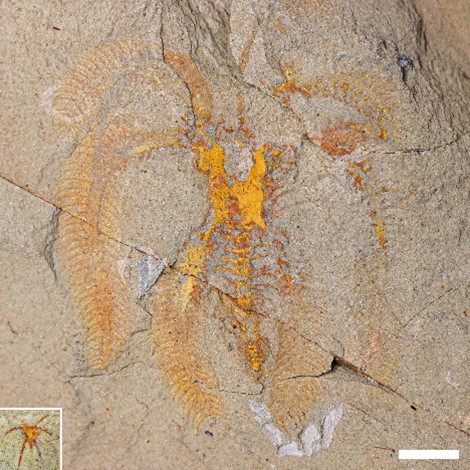
Figure 1 – Adult individual of marrellid arthropod from the Fezouata Shale of Morocco with its tiny larval stage (bottom left) in the same scale. Scale bar 1 cm.
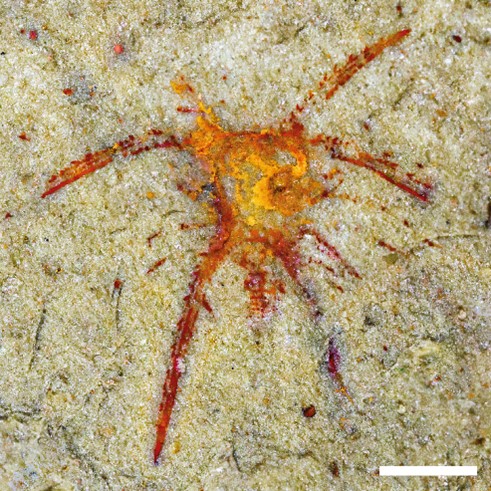
Figure 2 – Larval stage of marrellid arthropod from the Fezouata Shale of Morocco. Scale bar 1 mm.
Read also
- Scientists Solve a 45-Year-Old Mystery of Lightning on Saturn. New analysis of Voyager data provides long-awaited answers
- Czech Scientists Record Electrical Discharge on Mars Resembling Terrestrial Lightning
- Nuclear Physics Institute of the CAS Reaches Key Milestone in AlphaStar Project
- The Science Communication 360° conference will bring the Head of communications of the Max Planck Society
- Research reveals a previously unknown mechanism of genetic transcription
- Warming weakens natural enemies of insects, new research shows
- Hope for rare anemia patients: Czech scientists create "perfect" mouse model
- Czech Researchers Contribute to SOLAO Project on Soil-Transmitted Parasites
- Scholars from the Czech Academy of Sciences will help make key UN documents on refugee policy in post-communist Europe accessible
- New perspective on the climate crisis: an ERC Consolidator grant
The Czech Academy of Sciences (the CAS)
The mission of the CAS
The primary mission of the CAS is to conduct research in a broad spectrum of natural, technical and social sciences as well as humanities. This research aims to advance progress of scientific knowledge at the international level, considering, however, the specific needs of the Czech society and the national culture.
President of the CAS
Prof. Radomír Pánek started his first term of office in March 2025. He is a prominent Czech scientist specializing in plasma physics and nuclear fusion.