

New study reveals role of cell surface sugars in neuronal navigation
24. 07. 2024
An international team of scientists from the Faculty of Science at Charles University, the Institute of Molecular Genetics of the Czech Academy of Sciences, and Stanford University has uncovered the molecular mechanisms by which cell surface sugars influence the navigation of neurons in the nervous system. Their results were published in the prestigious journal PNAS.
The adult human brain contains approximately 100 billion nerve cells, or neurons. Each neuron forms an average of 1,000 connections with other neurons, resulting in approximately 100 trillion synaptic contacts. These connections are crucial for our cognitive abilities, sensory perception, and memory. Understanding how such a vast network of contacts develops in the brain is a central question in neurobiology.
During the development of the nervous system, neuronal projections called axons move through a complex environment. This path involves various turns and detours, and one of the fundamental questions is how axons know when to turn left, right, or travel in a straight line. Molecules known as semaphorins act as molecular GPSs that guide axons to their destinations by binding to receptors called plexins on the surface of axons. This binding triggers a signaling cascade that controls the movement of axons.
In addition to binding to plexins, semaphorins also interact with sugars on the cell surface. The research team investigated the molecular mechanisms of this interaction.
"We found that some semaphorins bind to sugars on the cell surface, especially negatively charged sugars. The higher the charge of the sugar, the stronger the binding. We also found that these sugars bind to a small part of the semaphorin, a little tail that is positively charged. Interestingly, when we removed this tail using protein engineering methods, the axons turned right instead of left in certain areas. This suggests that we could influence the growth and direction of axons using sugars," explains Farah Nourisanami, an Iranian PhD student at the Faculty of Science at Charles University.
The implications of these findings offer potential avenues for therapeutic interventions in neurodegenerative diseases and nerve injuries. "Some semaphorins inhibit the regeneration of damaged nerve tissue. Understanding their interaction with cell surface sugars could play an important role in the development of treatments for conditions caused by brain and spinal cord injury," said Daniel Rozbesky, Head of the Laboratory of Structural Neurobiology (Institute of Molecular Genetics of the Czech Academy of Science and the Faculty of Science of the Charles University) at the BIOCEV Research Centre in Vestec near Prague.
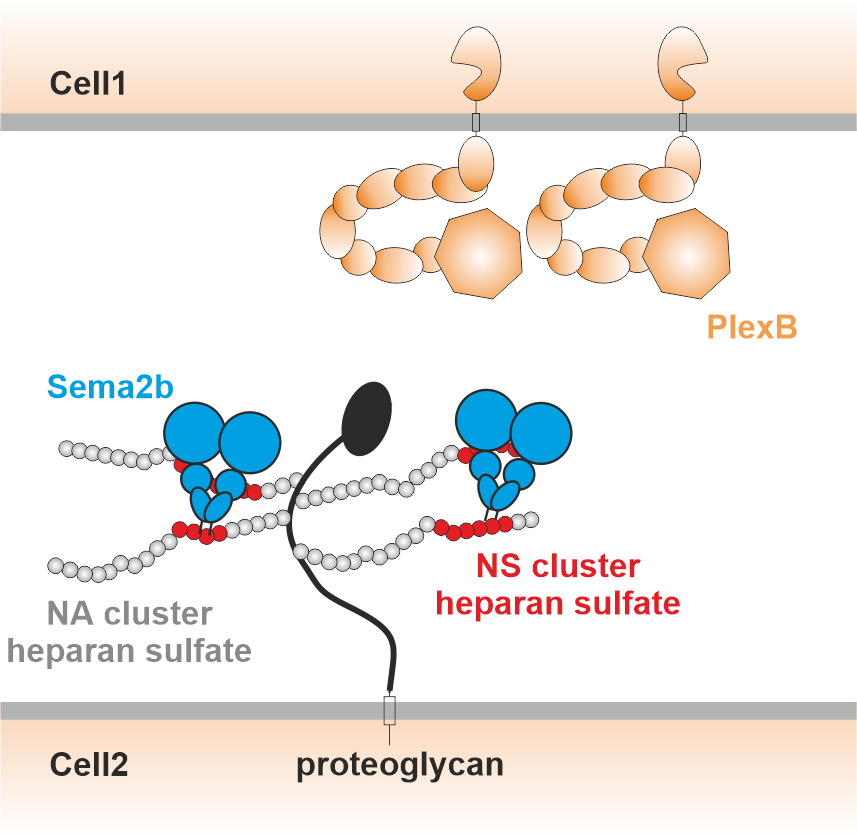
Proposed mechanism by which semaphorins (blue) bind to sugars (white spheres) on the cell surface and are thus presented to plexin receptors (orange) on surrounding axons. Source: PNAS
Contact:
Daniel Rozbeský
BIOCEV
daniel.rozbesky@natur.cuni.cz
Read also
- Space chirping has its order. Czech scientists have revealed when and where it sounds.
- Discovery by an NPI-led research team could contribute to safer wind turbine operation
- Unassuming Start–Stop “Gates” Regulate Protein Production in Cells
- Archaeologists search for traces of the persecution of German civilians in Africa
- Researchers Correct Genetic Defect Associated with Retinitis Pigmentosa Using Modified RNA Molecules
- Czech Scientists to Develop Key Instruments for ESA’s New Space Mission
- Scientists Uncover Hidden RNA Defect Behind Rare Childhood Brain Disorders
- The Secret Life of Blood Stem Cells
- Scientists Solve a 45-Year-Old Mystery of Lightning on Saturn. New analysis of Voyager data provides long-awaited answers
- Czech Scientists Record Electrical Discharge on Mars Resembling Terrestrial Lightning
The Czech Academy of Sciences (the CAS)
The mission of the CAS
The primary mission of the CAS is to conduct research in a broad spectrum of natural, technical and social sciences as well as humanities. This research aims to advance progress of scientific knowledge at the international level, considering, however, the specific needs of the Czech society and the national culture.
President of the CAS
Prof. Radomír Pánek started his first term of office in March 2025. He is a prominent Czech scientist specializing in plasma physics and nuclear fusion.