

Light vs. Antibiotics – Can We Get Harmful Substances Out of Our Water?
09. 03. 2026
Wastewater contains large amounts of antibiotics. Researchers from the J. Heyrovský Institute of Physical Chemistry of the CAS have now come up with a new idea for removing them more effectively by harnessing the power of light – photocatalysis. They shared their findings in the A / Magazine, published by the Czech Academy of Sciences.
It all began as a stroke of luck. The year was 1928, and Scottish physician and bacteriologist Alexander Fleming had just returned from vacation to his laboratory at St Mary’s Hospital in London. While surveying the lab, he discovered a culture plate with agar he had left out overgrown by mold that, to his surprise, was killing all the surrounding bacteria. The mold was Penicillium notatum – and just like that, the discovery of a miracle drug was upon us.
Thus began the era of antibiotics. And while it did take another decade before they became widely used, the progress in bacteriology and in the treatment of numerous diseases was colossal. Over the course of the 20th century, additional antibiotics gradually joined penicillin, and together they saved millions of lives.
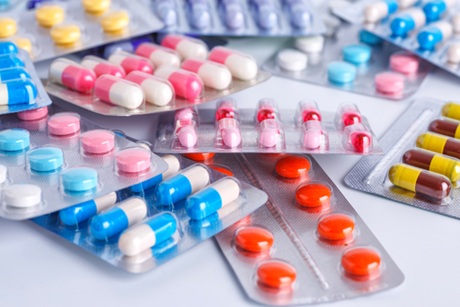
Today, Western medicine simply cannot function without antibiotics.
Fleming’s discovery can, without exaggeration, be described as one of the greatest in the history of medicine. Yet it is increasingly evident that, when used thoughtlessly, it has a darker side. Doctors and patients alike have grown so accustomed to having an effective weapon against bacterial infections that antibiotics are now overused and prescribed even when not strictly necessary. A new era has arrived – the era of antibiotic resistance.
PENICILLIN AND H₂O
As we know, clean water is essential for the health of humans, animals, and plants – but it is becoming ever scarcer. Water pollution is one of the major environmental challenges of our time. But what does this have to do with Fleming’s penicillin?
Wastewater contains a wide spectrum of pollutants harmful to health that cannot be fully removed and thus return to nature. Among the most dangerous are residual pharmaceuticals – especially antibiotics.
How do they enter the sewer system? The answer is simple: the more patients – human and animal alike – use them, the more residues end up in wastewater by way of urine and feces. They accumulate there, and conventional wastewater treatment plants are unable to effectively eliminate them.
|
ANTIBIOTIC RESISTANCE IN NUMBERS In Europe, more than 35,000 people die each year as a consequence of antibiotic resistance. In the Czech Republic, the figure is approximately 500 cases annually. These numbers may not even be final, as laboratory confirmation of the cause is not always possible. The World Health Organization estimates that if this negative trend continues, antibiotic-resistant bacteria could claim the lives of around 10 million patients per year by 2050 – more than cancer does. |
The greatest risk lies in the fact that pharmaceuticals remain active even at very low concentrations. Over time, they can promote the emergence of more resistant bacteria, thus fueling antibiotic resistance. Current treatment plants can handle most common organic substances, nitrogen compounds, and phosphorus compounds – but the breakdown of pharmaceutical substances is another matter. These molecules are often designed to be highly stable, which makes them difficult to remove. As a result, they spread into rivers and other bodies of water.
SCIENTISTS TURN TO LIGHT
So how can we remove harmful substances from wastewater to prevent them from circulating in nature, contaminating our environment, and entering living organisms? Responding to this increasingly urgent challenge, a research team led by Jiří Rathouský from the Center for Innovations in the Field of Nanomaterials and Nanotechnologies (part of the J. Heyrovský Institute of Physical Chemistry of the CAS) – set out to find a solution to antibiotics present in wastewater.
Unlike the famous Scottish bacteriologist, their discovery was no accident. Instead, they enlisted a powerful ally – photocatalysis. “The advantage of photocatalysis lies in its universality and high efficiency in removing organic substances present in water at low concentrations,” the chemist explains.
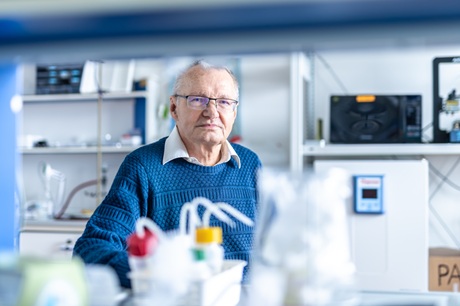
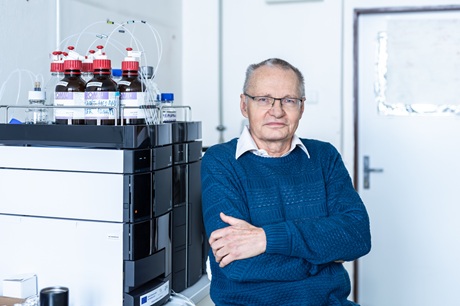
Jiří Rathouský from the J. Heyrovský Institute of Physical Chemistry of the CAS. (CC)
How does this method developed by the Czech team work? Photocatalysis relies on two key “ingredients” – light and a photocatalyst. Ultraviolet or visible radiation is typically used. When the photocatalyst absorbs light, it enables the breakdown of organic pollutants without being consumed itself. It may experience mechanical wear, but it can be easily cleaned and reused.
It is important to deposit the photocatalyst onto suitable supports – such as glass, stainless steel, glass fabric, or porous ceramics – to facilitate handling. Scientists are working on this aspect as well. “When the photocatalyst is exposed to photons with sufficient energy, positive and negative charges are generated in its structure. These initiate the formation of highly reactive oxygen species, which then decompose organic molecules into carbon dioxide, water, and mineral acids – a process we refer to as contaminant mineralization,” Rathouský explains, describing the principle of heterogeneous photocatalysis.
Titanium dioxide is most commonly used for removing antibiotics from water. It is cheap, non-toxic, and highly effective under ultraviolet light. Carbon nitrides are also promising – these are polymeric photocatalysts belonging to the group of organic materials that can efficiently utilize visible light while remaining stable and non-toxic.
|
INNOVATIVE MATERIALS FOR ENVIRONMENTAL PROTECTION AND MEDICINE Research into wastewater purification using photocatalysis is being carried out as part of the AMULET project (Advanced Multiscale Materials for Key Enabling Technologies). Its aim is to develop new multiscale materials for applications in electronics, medicine, and environmental technologies. The project is funded by the Johannes Amos Comenius Programme of the Czech Ministry of Education, Youth and Sports and co-financed by EU funds. The experimental part of the research uses the NanoEnviCZ infrastructure, which connects several Czech scientific institutions in the field of nanomaterials and nanotechnologies. |
OTHER TROUBLEMAKERS
The method offers several advantages. It is environmentally friendly, primarily because no additional chemicals need to be added for it to function. The reaction results in the complete breakdown of pollutants – not merely their transfer into sludge or secondary waste, as is the case with other methods. Moreover, some photocatalysts can be activated simply by sunlight. This reduces operating costs and makes the process even more environmentally sustainable.
As noted earlier, antibiotics are not the only contaminants in wastewater. It contains a diverse cocktail of substances – so-called micropollutants – that are difficult to remove. Particularly hazardous are endocrine disruptors. Although present in water at very low concentrations, they remain biologically active and negatively affect living organisms. They accumulate over time and can cause cancer or various genetic mutations.
“We also find substances from personal care products – residues of cosmetics, preservatives, or UV filters that enter water through everyday use. They disrupt the reproductive capacity of aquatic organisms and accumulate in the food chain,” Rathouský notes. Wastewater also contains drugs such as cocaine and methamphetamine, residues of other medications, and hormones – especially estrogens. To illustrate the seriousness of the threat, the physical chemist offers a stark example: “Hormones can have absolutely devastating effects on fish and other organisms. And as we already know, they can even change the sex of fish.”
The good news is that these dangerous substances can also be removed from wastewater using photocatalysis. Under the action of the photocatalyst, their molecules gradually break down into harmless compounds that no longer pose any risk to the environment.
AN AFRICAN TRIAL
For now, the method is being tested in smaller pilot projects, and researchers are actively seeking companies interested in collaboration. Photocatalysts intended for real-world use must be not only effective but also economically viable and scalable – meaning they must adapt easily to changing conditions, whether in pollutant type and concentration, or in the volume of treated water.
“Catalysts with enhanced functions are being studied as well, but if they are produced only in small laboratory quantities, they have no practical application. For real-world use, we need to develop methods that remain affordable at larger scales and can be readily integrated into standard wastewater treatment processes,” Rathouský explains.
The development of new technologies could also be supported by legislative changes regulating micropollutant levels in wastewater. Such measures would provide economic incentives for treatment plants planning investments in quaternary – that is, fourth-stage – water treatment, which specifically targets the removal of contaminants such as pharmaceutical residues and other chemicals.
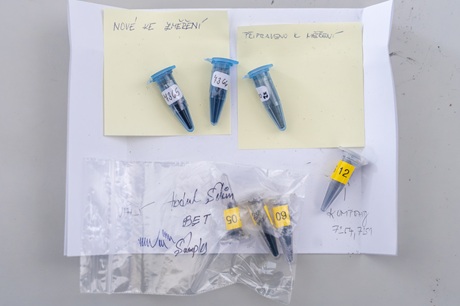
Samples of nanostructured materials intended for porosity determination via physical adsorption. (CC)
Let us shift, for a moment, to West Africa. One member of the Czech research team, Bukola Lois Ojobe, comes from Lagos, Nigeria, and decided to test the developed method in her home country. Lagos is a rapidly growing city, currently home to about 21 million people. To provide functional infrastructure for such a population, there are plans to build satellite cities connected to the center by high-speed rail.
“It will be important to ensure a sufficient supply of high-quality drinking water and to manage it efficiently. Wastewater treatment – especially the recycling of non-potable water – will be key. And this is where photocatalytic technology could prove extremely useful,” Rathouský notes. His colleague intends to apply the method specifically to remove undesirable substances from recycled non-potable water. When designing such a treatment unit, the possibility of using sunlight to activate the photocatalyst will play a major role. And in Africa, there is certainly no shortage of that.
FROM DIRTY TO CLEAN
Let us return to the Czech Republic. Wastewater treatment here is of a high standard, comparable to the rest of Europe. “We are highly effective at removing conventional pollutants. In this respect, treatment plants in the Czech Republic meet European standards, and water quality in rivers and streams has improved significantly over the past decades. When it comes to pharmaceutical residues and other micropollutants, we are in a similar position to most European countries,” the chemist observes. Current technologies cannot capture these substances, and the widespread deployment of advanced methods is so far being addressed in only a handful of countries.
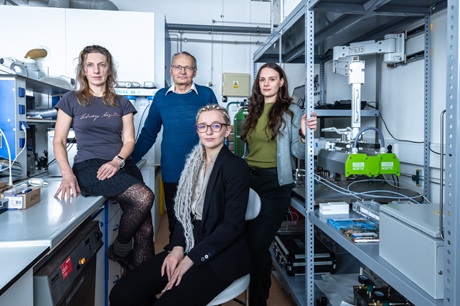
The photocatalysis team from the J. Heyrovský Institute of Physical Chemistry of the CAS. From left: Lenka Belháčová, Jiří Rathouský, Olha Zin, and Tereza Maříková. (CC)
Treatment plants play a crucial role in protecting both the environment and natural water resources. Several types exist, categorized for instance by size or by the technologies they employ. In the Czech Republic, mechanical-biological treatment plants are most common, where water is treated in several stages.
First, coarse impurities are removed, followed by most organic substances and nutrients such as nitrogen and phosphorus compounds. Next come biological processes carried out in so-called activated sludge, which contains various microorganisms capable of partially removing simple particles of certain pharmaceuticals. “However, they cannot cope with more complex molecules. That is why water must be further treated using appropriate methods capable of eliminating these substances present at very low concentrations. And that is precisely where photocatalysis comes in,” Rathouský adds.
Human health – an intact environment – clean water. They function like communicating vessels; one affects the other. As representatives of a species that has an immense impact on nature, we have to hope that modern-day innovations emerging from research labs will prove as transformative as the discovery of penicillin mentioned at the beginning. Only this time, preferably without the unintended negative consequences.
|
Ing. Jiří Rathouský, CSc.
Jiří Rathouský graduated from the University of Chemistry and Technology in Prague and later worked, among other institutions, at the University of Bremen and Leibniz University Hannover. He heads the Center for Innovations in the Field of Nanomaterials and Nanotechnologies at the Heyrovský Institute which focuses on the research, development, and technological applications of nanomaterials. One of his team’s successful application projects is a photocatalytic coating for building facades that effectively and long-term removes toxic substances from the air. As part of the AMULET project, Rathouský currently focuses on wastewater purification using photocatalysis. |
*
The article was first published in Czech in the 4/2025 issue of A / Magazine:

4/2025 (version for browsing)
4/2025 (version for download)
All Czech and English issues of A / Magazine – the official quarterly of the Czech Academy of Sciences – are available online.
We offer free print copies (of the Czech version and the two English issues from 2024 and 2025) to anyone interested – please contact us at predplatne@ssc.cas.cz.
Written and prepared by: Markéta Wernerová, External Relations Division, CAO of the CAS
Translated by: Tereza Novická, External Relations Division, CAO of the CAS
Photo: Jana Plavec, External Relations Division, CAO of the CAS; Shutterstock
 The text and photos marked CC (and the researcher’s profile photo) are released for use under the Creative Commons license.
Read also
- Better ECGs and Industrial Superlasers – Real-World Results of CAS Research
- Czech Academy of Sciences to launch a joint-stock company
- In the Age of AI, Spotting a Fake Photo Is Harder Than Ever, Expert Says
- How to Turn Ideas into Successful Grants: The New ERC Incubator Is Offering Help
- SciComm 360° Tackled How to Communicate Science in the Age of Disinformation
- The Academy of the Future? A New Vision for Attracting Scientific Talent
- When Cars Fly and Bullets Swerve – Physics Gone Wrong on the Silver Screen
- The Academy to Boost Excellence and Careers in Research with New Programs
- Could an asteroid hit Earth? The risk is low, but astronomers are keeping watch
- At the nanoscale, gold can be blood red or blue, says Vladimíra Petráková
The Czech Academy of Sciences (the CAS)
The mission of the CAS
The primary mission of the CAS is to conduct research in a broad spectrum of natural, technical and social sciences as well as humanities. This research aims to advance progress of scientific knowledge at the international level, considering, however, the specific needs of the Czech society and the national culture.
President of the CAS
Prof. Radomír Pánek started his first term of office in March 2025. He is a prominent Czech scientist specializing in plasma physics and nuclear fusion.