

ERC Consolidator Grant heads to the CAS for “wildlife on the move” project
09. 12. 2025
As climate change alters living conditions, animals are migrating toward new habitats. How are their relationships with humans being reshaped? The new research project INVANISH, funded by an ERC Consolidator Grant, sets out to answer this question. It will be led by Italian anthropologist Deborah Nadal at the Institute of Ethnology of the Czech Academy of Sciences.
The project, called INVANISH (INtruders and VANISHers), will begin in autumn 2026 and will run for five years. For the Institute of Ethnology of the Czech Academy of Sciences (CAS), this marks the fourth ERC grant to date – a remarkable achievement given the institute’s relatively small size. This year, only two ERC Consolidator Grants have been awarded to institutions in the Czech Republic, with one of them going to the Academy. The ERC Consolidator Grant is specifically aimed at mid-career researchers who received their Ph.D. seven to twelve years ago and already have a research team or program but need resources for expansion. Each awarded project receives two million euros.

Deborah Nadal is bringing the INVANISH project to the Institute of Ethnology of the Czech Academy of Sciences. (CC)
A world in motion
Deborah Nadal has long worked at the intersection of culture, health, and human-animal-environment relationships – following the “One Health” approach, which emphasizes multidisciplinary cooperation to address issues such as zoonotic diseases. Among her noteworthy works is the monograph Rabies in the Streets, focusing on rabies in Indian metropolises such as Delhi and Jaipur. In this work, she examined the complex network of factors that bring humans and animals into contact in urban spaces, creating conditions favorable for interspecies transmission of the rabies virus.
But new points of contact and shifting relationships are, very obviously, not limited to India. The world is constantly in motion. Half of all animal species monitored by scientists are on the move – driven by climate change – seeking habitats better suited for their survival. Traditional species (“vanishers”) are leaving their habitats, while new ones (“intruders”) are arriving in their place.
The INVANISH project aims to understand how people adapt their everyday life to the arrival of new animal species or the decline of traditional ones. It investigates how hunting, herding, forestry, and safety – for people and wildlife – change in response. “And whether it is even possible to find a balance between human needs and those of other species as the climate continues to change rapidly,” Nadal adds.
Walruses in Alaska and tigers in India
The anthropologist and her team will focus on four regions where climate-driven wildlife movement is especially visible and where human response is already necessary. On Alaska’s western coast, experts will study red foxes and walruses; in the Alps, they will look at bark beetles and mountain goats; in rural southern Italy, the focus will be on porcupines and rock partridges; and in the Sundarbans mangrove forests in India, they will study Bengal tigers and wild giant honeybees. In each locality, the researchers will investigate people’s lived experiences with one species that is “intruding” and another that is “vanishing.”
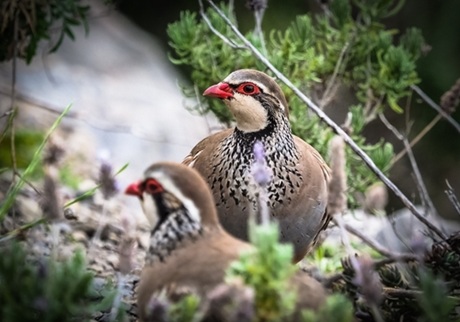
The research team will focus on the vanishing rock partridge in rural southern Italy.
Local people will also be involved in the project. “Citizen scientists like mushers, honey collectors, hunters, and more, will be invited to collect and then analyse data with the anthropologists and the ecologists,” Nadal says. They will use, for instance, footage from camera traps, photos taken by lay people while hunting, diaries in which individuals record changes they observe in their surroundings and in animal behavior, and similar methods.
The “migration” of species could lead to harmonious new ecosystems – but more often, it brings disruption. Experts are already seeing this. And the situation, they warn, is worsening. As the anthropologist explains, this is “leading to biodiversity loss and negative consequences for humans in terms of livelihood, food security, health, cultural identity, and so on.”
Still, the INVANISH project does not view the climate crisis solely through a catastrophic lens. Instead, it focuses on the impacts in everyday life and how relationships between humans and animals are changing right before our eyes. With 2024 being the hottest year on record, it is clear that the future shape of landscapes and biodiversity remains an open question.
*
European Research Council grants rank among the most prestigious targeted funding schemes in Europe for promising research projects. In 2024, a record ten ERC Consolidator Grants went to the Czech Republic, with four of them awarded to the Czech Academy of Sciences. In 2025, Czech institutions succeeded twice in this category: alongside the Institute of Ethnology of the CAS, Palacký University Olomouc also received a grant – likewise in the humanities and social sciences. The projects of both institutions are among this year’s 349 successful proposals in the ERC Consolidator Grant scheme, which shares a record budget of a total of 728 million euros invested in science.
Written and prepared by: Jana Kuřátková, External Relations Division, CAO of the CAS, drawing on the CAS press release
Translated by: Tereza Novická, External Relations Division, CAO of the CAS
Photo: Shutterstock; Jana Plavec, External Relations Division, CAO of the CAS
 The text is released for use under the Creative Commons license.
Read also
- Light vs. Antibiotics – Can We Get Harmful Substances Out of Our Water?
- Better ECGs and Industrial Superlasers – Real-World Results of CAS Research
- Czech Academy of Sciences to launch a joint-stock company
- In the Age of AI, Spotting a Fake Photo Is Harder Than Ever, Expert Says
- How to Turn Ideas into Successful Grants: The New ERC Incubator Is Offering Help
- SciComm 360° Tackled How to Communicate Science in the Age of Disinformation
- The Academy of the Future? A New Vision for Attracting Scientific Talent
- When Cars Fly and Bullets Swerve – Physics Gone Wrong on the Silver Screen
- The Academy to Boost Excellence and Careers in Research with New Programs
- Could an asteroid hit Earth? The risk is low, but astronomers are keeping watch
The Czech Academy of Sciences (the CAS)
The mission of the CAS
The primary mission of the CAS is to conduct research in a broad spectrum of natural, technical and social sciences as well as humanities. This research aims to advance progress of scientific knowledge at the international level, considering, however, the specific needs of the Czech society and the national culture.
President of the CAS
Prof. Radomír Pánek started his first term of office in March 2025. He is a prominent Czech scientist specializing in plasma physics and nuclear fusion.