

We Must Prioritize Science, Czech President Petr Pavel Says on His Academy Visit
02. 04. 2026
The development of drugs for cancer treatment, research into thermonuclear fusion, and global issues in sociocultural anthropology represent vastly different fields. But they share one thing in common. All are being tackled by researchers from the Czech Academy of Sciences. On 1 April 2026, the President of the Czech Republic, Petr Pavel, took a closer look at their work, accepting an invitation to visit three CAS institutes. His first stop was the Institute of Organic Chemistry and Biochemistry of the CAS, followed by the Institute of Ethnology of the CAS, and he concluded his tour at the Institute of Plasma Physics of the CAS.
It is no exaggeration to say that drugs developed on the basis of discoveries made by researchers at the Institute of Organic Chemistry and Biochemistry of the CAS have already saved millions of lives worldwide. These include antiviral drugs developed by Antonín Holý, used in the treatment of AIDS and hepatitis B, as well as peptide hormones such as oxytocin and vasopressin, and treatments for leukemia.
Thanks to agreements with pharmaceutical companies, the institute receives hundreds of millions of dollars annually in licensing fees, which it reinvests into further research, infrastructure, support for early-career scientists, and, particularly in recent years, into technology transfer.
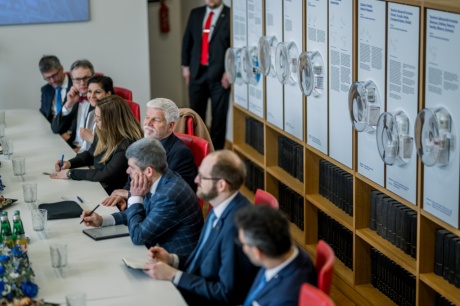
Czech President Petr Pavel during his visit to the largest CAS institute – the Institute of Organic Chemistry and Biochemistry of the CAS.
One example is the biotechnology spin-off company Taveren Therapeutics, founded last year by scientist Zuzana Kečkéšová. Her lab focuses on cancer research, specifically on identifying and characterizing novel tumor suppressors in human cells, with the aim of translating these findings into therapeutic applications.
“What defines us is the courage with which we take on even high-risk projects. We give our scientists considerable freedom in their research endeavors, and we accept that not everything will always succeed,” said Jan Konvalinka, Director of the Institute of Organic Chemistry and Biochemistry of the CAS, during the meeting with Czech President Petr Pavel.
Women comprise nearly half of the research institute’s staff, making it one of the most gender-balanced institutes of the CAS. The second research group that the Czech President Petr Pavel visited is headed by Hana Macíčková Cahová. The team studies chemical modifications of RNA and has discovered an entirely new class of these modifications, known as RNA caps. Their function remains largely unknown, but the team’s findings so far suggest they may play a role in the development of liver cancer. You can read more about the Czech President’s visit to IOCB Prague here.
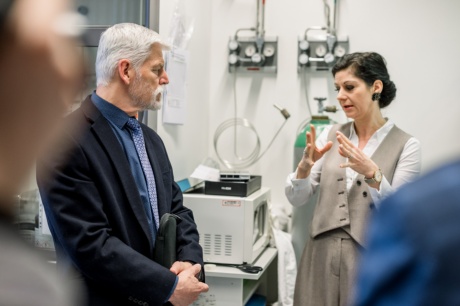
Hana Macíčková Cahová introducing the research carried out by her team to the President of the Czech Republic, Petr Pavel.
ROMA COMMUNITIES AND UKRAINE
While IOCB Prague employs around 1,100 people, the Institute of Ethnology of the CAS, with a staff of about eighty, is among the smallest of the CAS institutes. Even so, in recent years, it has achieved remarkable results. Its researchers have secured several international grants, including those from the European Research Council (ERC) and the MSCA Horizon Europe program. In addition, several promising researchers from abroad have recently joined the institute, bringing their grants with them – such as Italian researcher Deborah Nadal at the end of last year. You can read more about her project on the Czech Academy of Sciences website.
Similarly to biochemist Jan Konvalinka, the Director of the Institute of Ethnology of the CAS, Jiří Woitsch, also emphasized the importance of having the courage to take risks in research. He introduced Czech President Petr Pavel to several of his colleagues who explore unusual topics or approach them from unconventional perspectives. For instance, Martin Fotta has long worked with Roma communities in various countries around the world, studying how they cope with armed conflicts. In recent years, war has also become a central focus for Diána Vonnák, who has spent years conducting field research in Ukraine. Another researcher at the institute, May Tamimova, who focuses on conflict zones in Lebanon, explained to the Czech President how she works with Lebanese exile activists.
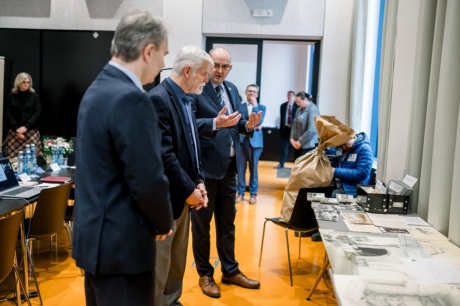
The Director of the Institute of Ethnology of the CAS, Jiří Woitsch, welcomed the Czech President Petr Pavel and CAS President Radomír Pánek to the institute.
NUCLEAR FUSION IS THE FUTURE
At both mentioned institutes, Czech President Petr Pavel showed a keen interest in the discussed topics, asking researchers detailed questions and taking notes. The same was true during his third stop at the Institute of Plasma Physics of the CAS in Prague’s Ládví district, the home institute of the current CAS President, Radomír Pánek.
The Czech President visited, for example, the materials engineering lab, where researchers work with the unique “cold spray” method. After changing into special protective clothing, he was also able to enter the cleanrooms of the PALS laser research center (Prague Asterix Laser System).
A particularly remarkable experience for Petr Pavel was the tour of the Tokamak COMPASS Upgrade, a high magnetic field experimental device currently under construction. “Nuclear fusion is undoubtedly the future of energy for humankind, and the Czech Republic – given its know-how and the high standard of its engineers, companies, and above all its scientists – has strong potential to contribute to this technology,” the Czech President said. He noted that he personally appreciated the entire day’s program at the Czech Academy of Sciences, and that the tokamak impressed him the most. “This is a topic I have long been interested in, and I welcome any opportunity to learn more about it,” he added.
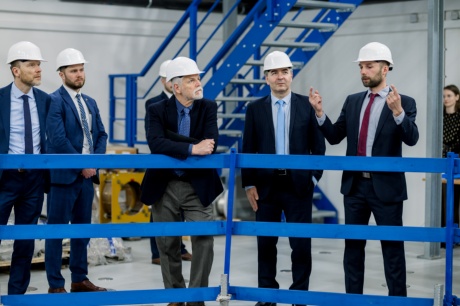
According to Petr Pavel, the tour of the tokamak at the Institute of Plasma Physics of the CAS was among the most fascinating parts of his visit.
At a briefing summarizing the visit, Czech President Petr Pavel highlighted the key areas he considers important. “If we were able to establish education, research, development, and innovation as a strategic priority – which I consider essential for our country – then the impact of the resources invested in them would be even greater,” he added.
“I would like to sincerely thank Czech President Petr Pavel for his focus on research, development, and innovation. I am also very pleased that he decided to devote an entire day of his busy schedule to visiting three institutes of the Czech Academy of Sciences,” concluded CAS President Radomír Pánek.
Written and prepared by: Leona Matušková, External Relations Division, CAO of the CAS
Translated by: Tereza Novická, External Relations Division, CAO of the CAS
Photo: Pavlína Černoch Jáchimová, External Relations Division, CAO of the CAS
 The text and photos are released for use under the Creative Commons license.


Read also
- Radomír Pánek Visits CAS Institutes, Aiming to Strengthen the Academy’s Unity
- Small but Mighty – The Enceladus Moon Is Flexing with Saturn’s Magnetic Field
- Light vs. Antibiotics – Can We Get Harmful Substances Out of Our Water?
- Better ECGs and Industrial Superlasers – Real-World Results of CAS Research
- Czech Academy of Sciences to launch a joint-stock company
- In the Age of AI, Spotting a Fake Photo Is Harder Than Ever, Expert Says
- How to Turn Ideas into Successful Grants: The New ERC Incubator Is Offering Help
- SciComm 360° Tackled How to Communicate Science in the Age of Disinformation
- The Academy of the Future? A New Vision for Attracting Scientific Talent
- When Cars Fly and Bullets Swerve – Physics Gone Wrong on the Silver Screen
Contacts for Media
Markéta Růžičková
Public Relations Manager
+420 777 970 812
Eliška Zvolánková
+420 739 535 007
Martina Spěváčková
+420 733 697 112