

Water as a safeguard of biomolecules
06. 10. 2016

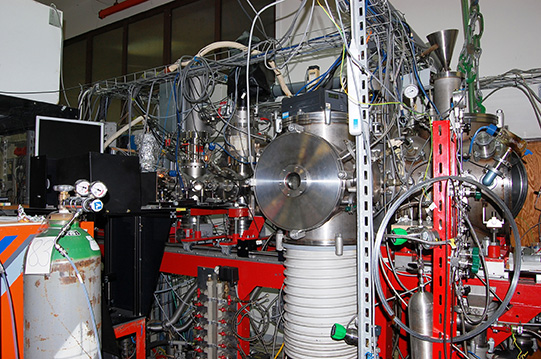
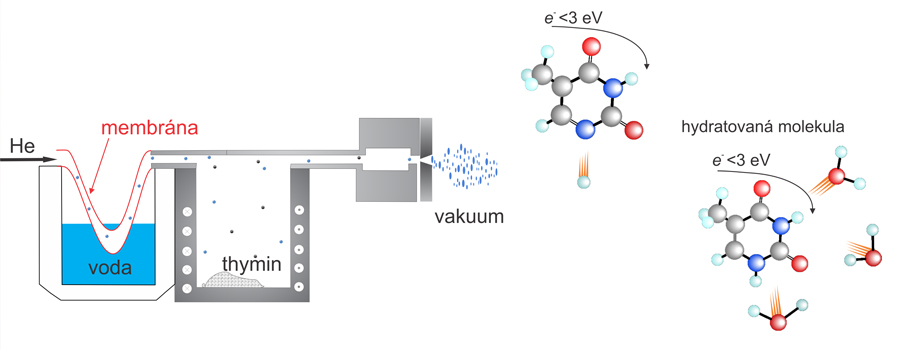
Scientists in the J. Heyrovský Institute of Physical Chemistry in Prague have introduced a new experimental technique which enables studies of biomolecules in vacuum, surrounded by just few molecules of water. For more than 20 years’ people were attempting to achieve this – molecular beam of ‘microhydrated’ biomolecules. However, all the previous methods generated at the best a mixture of biomolecular aggregates (clusters) and mixed biomolecule-water clusters. The newly introduced method allows the study of single hydrated biomolecule with well controlled number of water solvent molecules. This represents an experimental breakthrough.
The need for such technique arises from a quest to understand a molecular mechanisms of radiation damage to biological tissue (that results in, e.g., cancer). Naturally, the most common way of studying such damage is in a biological solution. However, there, many of the details about the radiation damages to DNA on the smallest – molecular – scale remains hidden, because many processes are running simultaneously and their effects are overlapping. The second extreme experimental approach is to look at isolated molecular components of DNA in vacuum and to determine how they are destroyed by various radiations. This approach provides the most detailed insight but completely neglects how the surrounding (in biological tissue mainly water) influences such destruction.
The newly introduced method bridges the gap between the two extreme approaches. Using it, the damage of the molecules can be studied in the deepest detail, but simultaneously taking into account the influence of an elementary water environment. The first results obtained at the Heyrovsky Institute focus on the destruction of nucleobases by slow electrons. Slow electrons are one of the most abundant secondary species formed during interaction of high-energy radiation with living matter. The nucleobases are components of DNA and carriers of the genetic code. When isolated, they are very effectively damaged by slow electrons via a process called dissociative electron attachment. The present work shows that already presence of a few water molecules around the nucleobases stabilizes these molecules – upon the collision with the electrons, the base does not break into fragments but rather forms stable negative ion. The water thus forms a cage that prevents the nucleobases to fall apart.
PUBLISHED: J. Phys. Chem. Lett. 2016, 7, 3401−3405, DOI: 10.1021/acs.jpclett.6b01601
http://pubs.acs.org/doi/abs/10.1021/acs.jpclett.6b01601
Microhydration Prevents Fragmentation of Uracil and Thymine by Low-Energy Electrons
J. Kočišek, A. Pysanenko, M. Fárník, and J. Fedor.
For more information please contact:
Dr. Jaroslav Kočišek (phone +420 608747534) nebo Dr. Juraj Fedor, Doc. Michal Fárník (phone +420 724410147); ÚFCH JH AV ČR, Dolejškova 3, 182 23 Praha 8, tel.:+420266053503.
jaroslav.kocisek@jh‐inst.cas.cz , juraj.fedor@jh‐inst.cas.cz, michal.farnik@jh-inst.cas.cz.
Read also
- Decoding Barley: Scientists Reveal It Acquired Genes from Distant Grasses
- Ombudspersons at the CAS Practised Navigating Difficult Conversations
- Highlights from the 2026 Week of the Czech Academy of Sciences
- New Cobalt Irradiator to Aid Radiobiology and Space Research
- Czech Academy of Sciences to Support Groundbreaking Research by Nine Scientists
- Cartilage, Step on the Gas: New Treatments for Rare Growth Disorders
- Water Is Not Enough for Settlement. Stone Was Equally Important
- A / Magazine: Toxins, Languages, and Lightning on Jupiter
- ERC-funded CLOSER Project Highlights the Middle East and North Africa Region
- Bernard Bolzano: An Inconvenient Genius Ahead of His Time
Contacts for Media
Markéta Růžičková
Public Relations Manager
+420 777 970 812
Eliška Zvolánková
+420 739 535 007
Lucie Peřinová
+420 777 728 090
Eliška Hadravová
+420 737 349 484