

Unique method will show how plants survive in unfavourable conditions
12. 10. 2018
In collaboration with their Swedish colleagues, scientists from the Czech city of Olomouc have developed an unusually efficient method which allows for measuring a record-breaking number of 101 plant hormones (phytohormones) and related compounds in a small sample of root or stalk. This method will lead to a better understanding of how levels of hormones change under unfavourable circumstances such as drought or freezing temperatures, thus allowing for a better exploration of mechanisms which help plants to survive.
Hormones – compounds which even in very little amounts influence physiological processes in an organism – take part in controlling important processes not only in humans but in plants, as well. Usually, more of them participate in controlling those processes in plants, and biologists therefore need to measure concentrations of all participating hormones, as well as compounds from which hormones are created or into which they are transformed. For purposes of this analysis, scientists develop methods which are more and more effective. Among those truly exceptional is the new procedure for identifying 101 plant hormones and related compounds.
A sample of 20 mg is enough
“Our method is fast, sensitive, and it works reliably with even small plant samples weighing as little as 20 milligrams. In each sample, we can identify 101 compounds, which is almost twice the count from previous methods of other authors,” stated docent Ondřej Novák who has developed the method together with his team in Olomouc and scientists from the agricultural university in the Swedish town of Umeå. Department of Metabolomics in the Laboratory of Growth Regulators, which is a joint institution of Palacký University, Institute of Experimental Botany of the CAS and the Centre of the Region Haná, uses an exceptionally precise method of mass spectrometry. According to another member of the Olomouc team, Jan Šimura, the whole analysis takes only 32 minutes.
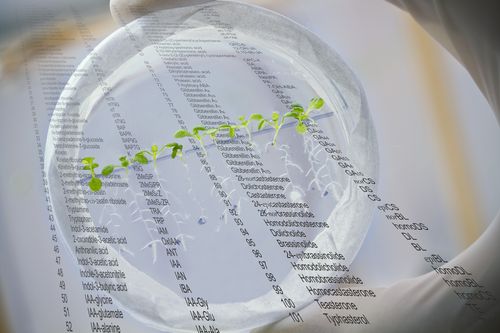
Plants of thale cress which were used in the research
The practical usefulness of the method was tested on seedlings of thale cress (Arabidopsis thaliana). After exposing them to salinity stress, the scientists found 45 hormones and related compounds (of 101 which they are capable of identifying) in samples of their roots and shoots. Salinity stress influenced levels of 23 of these compound in roots and 15 in shoots, meaning more different hormones participated in physiological reactions to salinisation. Concentrations of some hormones rose or dropped in relation to the activity of genes responsible for their biosynthesis or metabolism. By connecting data on reaction of genes and hormones to salinisation or other stimuli, the scientists will gain a more complex idea of processes that take place in plants.
“Drought, frost or salinisation of soil cause great losses in agriculture every ear. Therefore, we try to understand biological processes leading to activation of defense mechanisms which allow the plant to survive. We cooperate with scientists from the Czech Republic as well as from all over the world on analyses of hormones in various plants including crops. Our ‘101’ method will definitely be very useful in those projects. But for the future, we have other plans, as well. We would like to measure levels of phytohormones in various types of cells and also in individual parts of cells – organelles,” revealed Novák.
The article describing the new method, published by the science journal Plant Physiology, is available at the journal’s website (http://www.plantphysiol.org/content/177/2/476).
Prepared by: Department of Media Communication of the Head Office of the CAS, based on a press release by Palacký University in Olomouc
Photo: Ota Blahoušek
Read also
- Decoding Barley: Scientists Reveal It Acquired Genes from Distant Grasses
- Ombudspersons at the CAS Practised Navigating Difficult Conversations
- Highlights from the 2026 Week of the Czech Academy of Sciences
- New Cobalt Irradiator to Aid Radiobiology and Space Research
- Czech Academy of Sciences to Support Groundbreaking Research by Nine Scientists
- Cartilage, Step on the Gas: New Treatments for Rare Growth Disorders
- Water Is Not Enough for Settlement. Stone Was Equally Important
- A / Magazine: Toxins, Languages, and Lightning on Jupiter
- ERC-funded CLOSER Project Highlights the Middle East and North Africa Region
- Bernard Bolzano: An Inconvenient Genius Ahead of His Time
Contacts for Media
Markéta Růžičková
Public Relations Manager
+420 777 970 812
Eliška Zvolánková
+420 739 535 007
Lucie Peřinová
+420 777 728 090
Eliška Hadravová
+420 737 349 484