
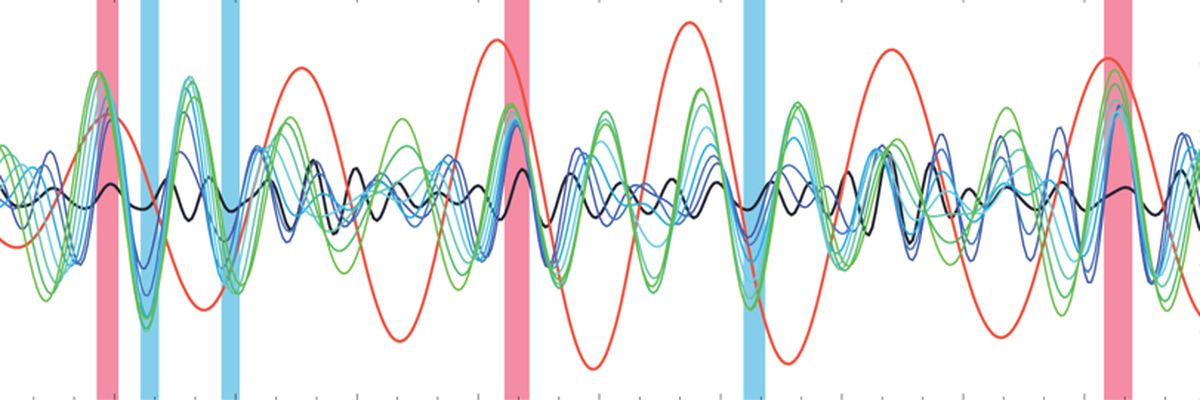
Good dissonance, dangerous consonance: The tones of El Niño
19. 11. 2018
When a musical group or orchestra play dissonant tones, listeners are disappointed and unlucky. In the nature of our planet there is an orchestra whose consonance can lead to disasters. It is known as El Niño. A Czech team from the Institute of Computer Science of the CAS has recently contributed to a better understanding of this phenomenon and its basic components or tones.
El Niño/Southern Oscillation is a gigantic natural pendulum which swings sea surface temperatures in tropical Pacific from its cold (La Niña) to warm phase (El Niño). Amplitudes of these swings change from small to extreme values. The latter have a tremendous influence on the global climate – they cause, for instance, droughts in Asia and Australia, and, simultaneously, floods in South America.
The period of this pendulum is variable, it changes from two to seven years. However, its maximum swings occur in a particular part of the year. Mathematically speaking, the slow El Niño cycles are synchronized with the annual cycle.
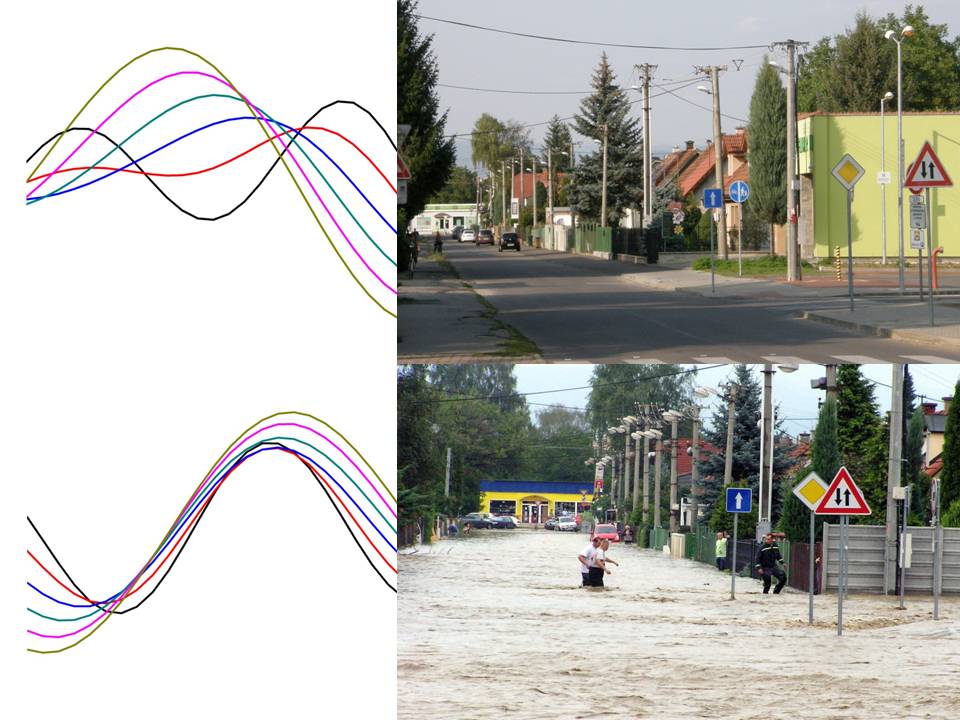
Dissonant El Niño tones (oscillations) characterize normal conditions, while consonant tones – synchronized oscillations lead to extreme events such as floods in one part of the world and droughts in another.
Synchronization and causal interactions of oscillatory phenomena of different frequencies is a research topic of a Complex Systems group at the Institute of Computer Science of the Czech Academy of Sciences in Prague. In cooperation with colleagues from the University of Wisconsin-Milwaukee and University of California San Diego, they identified basic oscillatory components – or tones – of the El Niño phenomenon.
“We have uncovered the network of causal interactions of these tones and showed how synchronization – or consonant performance of these tones – leads to extreme El Niño or La Niña events,” explained Milan Paluš, leader of the scientific team. Conversely, dissonant El Niño tones, or desynchronized oscillatory components characterize quiet periods without significant digressions from long-term temperature or precipitation means.
This important scientific result, published in Nature Partner Journal Climate and Atmospheric Science, helps to better understand and potentially predict extreme El Niño events and their disastrous consequences. The article (in English) can be found here.
Prepared by: Milan Paluš, Institute of Computer Science of the CAS, in cooperation with Milan Pohl, Department of Media Communication of the Head Office of the CAS
Illustration: Institute of Computer Science of the CAS
Read also
- Decoding Barley: Scientists Reveal It Acquired Genes from Distant Grasses
- Ombudspersons at the CAS Practised Navigating Difficult Conversations
- Highlights from the 2026 Week of the Czech Academy of Sciences
- New Cobalt Irradiator to Aid Radiobiology and Space Research
- Czech Academy of Sciences to Support Groundbreaking Research by Nine Scientists
- Cartilage, Step on the Gas: New Treatments for Rare Growth Disorders
- Water Is Not Enough for Settlement. Stone Was Equally Important
- A / Magazine: Toxins, Languages, and Lightning on Jupiter
- ERC-funded CLOSER Project Highlights the Middle East and North Africa Region
- Bernard Bolzano: An Inconvenient Genius Ahead of His Time
Contacts for Media
Markéta Růžičková
Public Relations Manager
+420 777 970 812
Eliška Zvolánková
+420 739 535 007
Lucie Peřinová
+420 777 728 090
Eliška Hadravová
+420 737 349 484