
First observation of controlled electron transfer within a single molecule
19. 03. 2020
A team of Czech scientists has demonstrated for the first time the controlled transfer of an electron within a single molecule. Published in the journal Nature Communications, the work presents important knowledge about one of the key processes in physics, chemistry, and biology and also provides inspiration for the construction of quantum computers based on molecular cellular automata and supercapacitors for storing energy in individual molecules.
“We managed to carry out a controlled electron transfer within one isolated molecule and, at the same time, measure the amount of energy released into the environment during this process. Supported by a theoretical model, these measurements provide a detailed understanding of quantum mechanical processes, such as charge transfer and energy conversion at the atomic level,” explains Pavel Jelínek of the Institute of Physics of the Academy of Sciences of the Czech Republic.
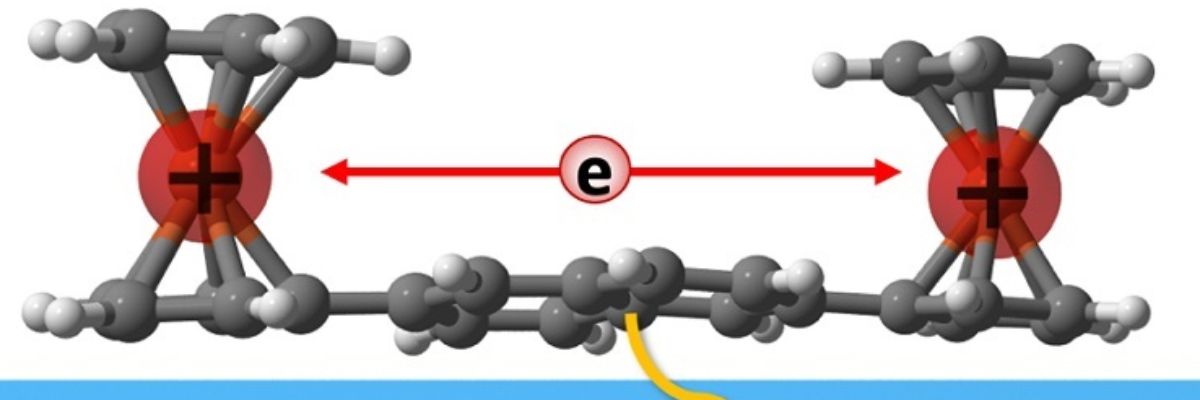
To carry out this study, scientists designed a molecule containing two iron atoms chemically bonded in ferrocene units. These so-called redox centres with defined distances then serve as reservoirs between which the electron transfer (i.e. unit charge) takes place.
The molecules were placed on an insulating surface of salt, and measurements were performed under ultra-high vacuum conditions. For controlled electron transfer between ferrocene units and charge positioning, scientists used an atomic force microscope. At the same time, this made it possible to detect energy that was irreversibly released into the environment during electron transfer.
Subsequent theoretical analysis has shown that the repeated electron transfer induced by the oscillating probe of an atomic force microscope takes the system out of thermal equilibrium, causing a weak temperature dependence of the electron transfer rate between ferrocene units.
Electron transfer plays key role
An important prerequisite for the successful advancement of quantum technologies is a detailed knowledge of the basic processes on which they are based, i.e. charge transfer and the associated energy conversion at the atomic level. Electron transport in molecules also plays an important role in many biological and chemical processes, such as photosynthesis, corrosion, and many enzymatic reactions. Despite the crucial importance of these processes and the efforts made to understand them, our current possibilities for studying and managing charge transfer at the level of individual atoms or molecules are still very limited.
Undertaken by a multidisciplinary team of Czech scientists from the Institute of Physics of the CAS, the Institute of Organic Chemistry and Biochemistry of the CAS, the Faculty of Mathematics and Physics of Charles University, and the Regional Centre of Advanced Technologies and Materials of Palacký University in Olomouc, the work represents a significant step forward in understanding the quantum processes related to electron transfer in single molecules and the associated energy conversion.
Image Caption – The electron transfer that takes place between two ferrocene units of an isolated molecule is controlled by the oscillating tip of an atomic force microscope. During this process, a certain amount of energy (DE) is released into the surroundings of the molecule.
Prepared by: Luděk Svoboda, Division of External Relations of the CAO of the CAS
Photo: Institute of Organic Chemistry and Biochemistry of the CAS
Read also
- Decoding Barley: Scientists Reveal It Acquired Genes from Distant Grasses
- Ombudspersons at the CAS Practised Navigating Difficult Conversations
- Highlights from the 2026 Week of the Czech Academy of Sciences
- New Cobalt Irradiator to Aid Radiobiology and Space Research
- Czech Academy of Sciences to Support Groundbreaking Research by Nine Scientists
- Cartilage, Step on the Gas: New Treatments for Rare Growth Disorders
- Water Is Not Enough for Settlement. Stone Was Equally Important
- A / Magazine: Toxins, Languages, and Lightning on Jupiter
- ERC-funded CLOSER Project Highlights the Middle East and North Africa Region
- Bernard Bolzano: An Inconvenient Genius Ahead of His Time
Contacts for Media
Markéta Růžičková
Public Relations Manager
+420 777 970 812
Eliška Zvolánková
+420 739 535 007
Lucie Peřinová
+420 777 728 090
Eliška Hadravová
+420 737 349 484