

Czechs feel comfortable and safe yet are succumbing to despair, survey shows
01. 12. 2022
In light of the war in Ukraine, people in the Czech Republic are worried about the deterioration of their economic situation and do not harbour any hope that the crisis could make them stronger. At the same time, however, they consider themselves as being well-off and feel safe. A completely different set of results arose from an international comparative public survey conducted in Ukraine, but also in Israel, Estonia, and Georgia. At the Facets of Resilience conference on 22 November 2022, philosopher Alice Koubová presented the results of the Czech part of the survey, while the international comparison was provided by Shaul Kimhi from Tel Aviv University.
The aim of the research was to compare the level of resilience of individuals, communities, and societies in different countries. The researchers looked at the measure of positive indicators of coping with stress (sense of wellbeing, hope, morale), negative indicators of coping with stress (anxiety and depressive symptoms, perceived threats, sense of danger), and the degree of support for the current government and attitudes towards Ukrainian refugees in the receiving countries.
“Compared to other countries, the Czech Republic has interesting specifics,” said Alice Koubová from the Institute of Philosophy of the CAS. “Czech respondents scored very high when it comes to their feeling of wellbeing. They have a feeling that they are still living a good life, feel safe, and have no intention of leaving the country. At the same time, however, they experience the lowest level of morale when it comes to dealing with crisis situations and demonstrated the highest level of hopelessness out of all measured countries,” the researcher pointed out.
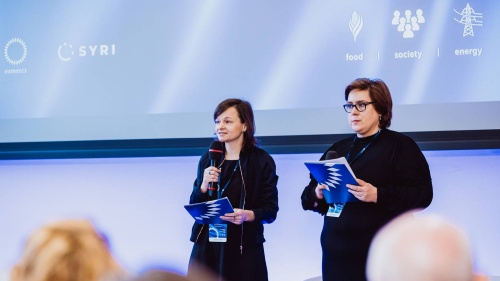
The co-organisers of the Facets of Resilience conference, Alice Koubová and Petra Guasti.
Czech citizens are most worried about a decline in their economic situation as a result of the war in Ukraine (67%) and the subsequent wave of refugees (44%). Czech society expresses the markedly lowest support for Ukrainian refugees of all the countries measured (the data was collected in the Czech Republic in October 2022). According to the survey, only 20% of Czechs are willing to personally help incoming refugees. 36% of Czechs identify with refugees and their suffering.
Ukrainians have more hope than Czechs
“What doesn’t kill you makes you stronger,” is a saying often heard in the Czech Republic. Yet Czechs do not seem to identify with this. The survey shows that the majority of those interviewed do not believe that the crisis situation linked to the war in Ukraine will strengthen them in any way. Only 15 percent of Czechs agreed that they would emerge from the crisis stronger as individuals. A quarter of Czech respondents said they had very little hope that they would be more resilient as individuals, and more than a fifth had little hope.
This is in stark contrast to the results of the same survey conducted in Ukraine – the direct victim of the Russian invasion and terror. Ukrainian respondents showed the highest levels of individual, community, and national (societal) resilience, despite feeling, for obvious reasons, the highest levels of a sense of danger and perceived threats.
“Our study showed the great importance of hope as a psychological dimension of a population that has to cope with a serious war crisis. The survey also showed that Ukrainians massively support their current government,” said Shaul Kimhi from Tel Aviv University. Poles and Israelis showed high levels of individual resilience in the poll, just after Ukrainians.
As for the hope that the crisis may eventually lead to something good, Ukrainians again ranked first in this stance, followed by Estonians and Poles. “This was a big surprise to us, and I must admit I did not expect Ukraine to rank at number one in this respect,” Kimhi remarked, adding that Ukrainian hope was by far at the highest level of all those surveyed (whereas Czech hope was the weakest).
The complete presentation of the Czech and international part of the research are available for viewing (in English) in the video recording of the Facets of Resilience conference. The philosopher Alice Koubová begins her presentation at 05:19:05 (video time), the Israeli researcher Shaul Kimhi at 05:34:25.
Prepared by: Leona Matušková, Division of External Relations, CAO of the CAS
Translated by: Tereza Novická, Division of External Relations, CAO of the CAS
Photo: Shutterstock
Read also
- Decoding Barley: Scientists Reveal It Acquired Genes from Distant Grasses
- Ombudspersons at the CAS Practised Navigating Difficult Conversations
- Highlights from the 2026 Week of the Czech Academy of Sciences
- New Cobalt Irradiator to Aid Radiobiology and Space Research
- Czech Academy of Sciences to Support Groundbreaking Research by Nine Scientists
- Cartilage, Step on the Gas: New Treatments for Rare Growth Disorders
- Water Is Not Enough for Settlement. Stone Was Equally Important
- A / Magazine: Toxins, Languages, and Lightning on Jupiter
- ERC-funded CLOSER Project Highlights the Middle East and North Africa Region
- Bernard Bolzano: An Inconvenient Genius Ahead of His Time
Contacts for Media
Markéta Růžičková
Public Relations Manager
+420 777 970 812
Eliška Zvolánková
+420 739 535 007
Lucie Peřinová
+420 777 728 090
Eliška Hadravová
+420 737 349 484