
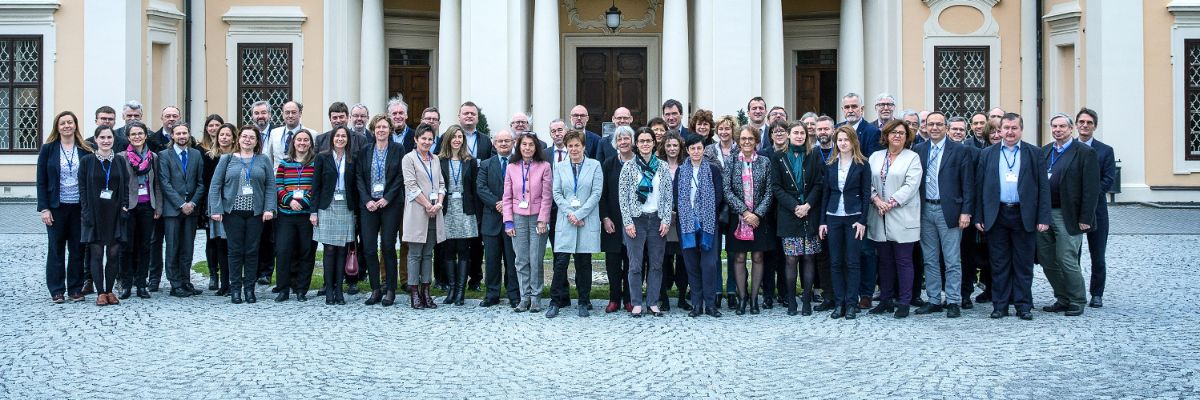
The Czech Republic hosted the 68th ESFRI Plenary Meeting
03. 04. 2019
The 68th Plenary Meeting of the European Strategy Forum on Research Infrastructures (ESFRI) took place in the Baroque Chateau in the town of Liblice in Central Bohemia. The main discussion topics included the preparation of the update of ESFRI Roadmap 2021, or the operational plan for the coming years.
The Plenary Meeting was held in the premises of Baroque Chateau in Liblice, Czech Republic, toward the end of March on the occasion of the beginning of the ESFRI Chair mandate by Jan Hrušák from J. Heyrovsky Institute of Physical Chemistry, who serves as the Chairman since January 1, 2019. ESFRI returned to the Czech Republic after four years.
The ESFRI Plenary Meeting was opened by Deputy Minister for Higher Education, Science and Research of the Ministry of Education, Youth and Sports Pavel Doleček, who in his speech commended the role of ESFRI in the European Research Area (ERA) and appreciated ESFRI’s benefits for research infrastructures in Europe and beyond.
Future directions
The main topics of the 68th ESFRI Plenary Meeting were, in particular, debates on the future directions of ESFRI and the preparation of ESFRI Roadmap update planned for 2021.
The discussion on future directions of ESFRI followed the conclusions of the “ESFRI: Future Directions” workshop, which was held in London in January 2019. These conclusions were summarised in three areas: “ESFRI Mission”, “ESFRI Vision” and “ESFRI Priorities for Action”, which were further divided in subareas aimed at strengthening the strategic role of ESFRI and its impact on the ERA, the role of ESFRI in the consolidation of the research infrastructures’ landscape in Europe, the organisation of ESFRI, and the evolution of ESFRI Roadmap.
The Roadmap
Within the preparation of the ESFRI Roadmap 2021 update the measures that need to be implemented before the actual update process is launched have been identified. For example, the methodology will be revised to reflect the lessons learned from 2018 update. No major changes are expected; however, the minimum key requirements of new European research infrastructures project proposals, as well as questionnaires and evaluation forms should be revised. In addition, the evaluation processes should be updated, with regards to larger involvement of external evaluators, as well as better coordination between the ESFRI Strategy Working Groups. These measures should lead to enhancement of the ESFRI evaluation process transparency. Greater emphasis will be put, among other things, on preparation of landscape analysis, which should serve as a future strategy planning tool for the European landscape of research infrastructures.
Other topics discussed at the ESFRI Plenary Meeting include cooperation on the preparation of the ERA Action Plan, the forthcoming cost analysis of European research infrastructures, and the information on the progress made by the European research infrastructures Monitoring Working Group, including the proposal of key performance indicators.
The next ESFRI Plenary Meeting will be held in Bucharest in June 2019 on the occasion of the Romanian Presidency of the EU Council.
Prepared by: Ilona Trtíková, CESNET, in cooperation with Milan Pohl, Department of Media Communication of the Head Office of the CAS
Foto: CESNET
Read also
- Three researchers from the Czech Academy receive prestigious ERC grants
- Ombudswoman of the CAS Dana Plavcová: I'm glad when things change for the better
- Early-Career Researchers from the CAS Received the 2026 Otto Wichterle Award
- Jackal Expansion Across Europe Facilitated by Humans, Curbed by Wolves
- Languages Don’t Overload the Brain, Psycholinguists Say
- Czech Academy of Sciences Evaluation – Beyond Metrics, Accent on Peer Review
- Ordovician Fauna Beneath Prague – New Arthropod Found During Metro Line Dig
- Wildfires on the Rise in Europe and Set to Double by 2100. What Can We Do?
- The CAS Photogenic Science Contest Invites Entries
- The CAS Launches New Research Programs as Part of Its Strategy AV21
The Czech Academy of Sciences (the CAS)
The mission of the CAS
The primary mission of the CAS is to conduct research in a broad spectrum of natural, technical and social sciences as well as humanities. This research aims to advance progress of scientific knowledge at the international level, considering, however, the specific needs of the Czech society and the national culture.
President of the CAS
Prof. Radomír Pánek started his first term of office in March 2025. He is a prominent Czech scientist specializing in plasma physics and nuclear fusion.