
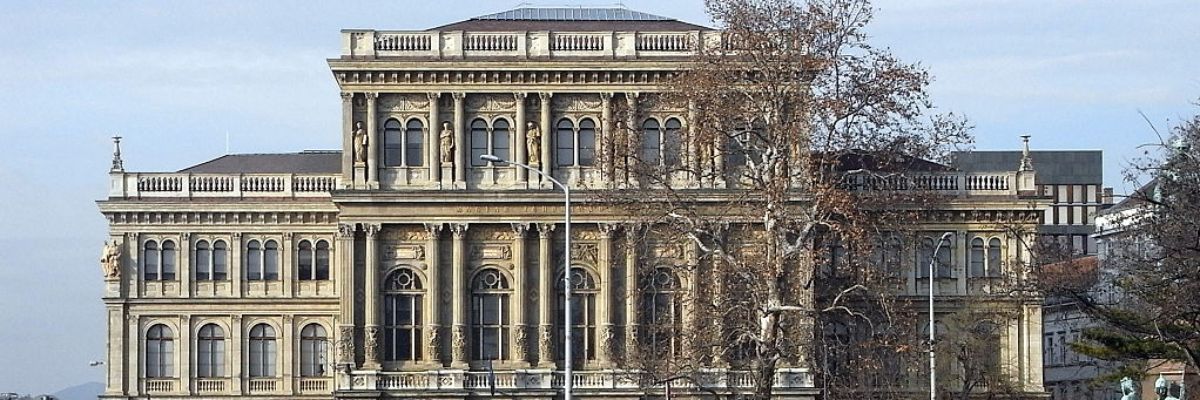
The CAS urges the Hungarian president to defend academic freedom
22. 07. 2019
On Friday, July 19, the Czech Academy of Sciences and the Learned Society of the Czech Republic sent a letter to the Hungarian President János Ánder in which they express their concern over the situation regarding management and financing of Hungarian science. As soon as September 1, a new law will come into effect meaning that organisation of research, financing of science, and establishing or abolishing of scientific institutes will now be in the competence of a 13-member political committee, taking these decisions out of hands of the Hungarian Academy of Sciences (HAS).
The law has already been passed by the Hungarian Parliament and signed by the country’s president. The Czech Academy of Sciences (CAS) has repeatedly expressed support to its Hungarian counterpart, also because of its own bitter experience. “The current situation in Hungary is strongly reminiscent of the situation in Czech Republic ten years ago. To this day, we still deal with damage from that time,” stated the CAS President Eva Zažímalová.
Before the most recent letter addressed to President Ánder, the CAS has taken several other steps to urge both Hungarian and Czech politicians to try to improve the dire situation of the Hungarian Academy of Sciences. In February, the CAS issued a statement regarding the situation in the Hungarian Academy, which was also sent to the Hungarian minister of innovation and technology. Then, at the end of June, the CAS together with the European federation of academies of sciences ALLEA sent letters to the Czech Minister of Foreign Affairs Tomáš Petříček and to Senator Jiří Drahoš, chairperson of the Committee on Education, Science, Culture, in which the CAS also warned of the imminent threat to academic freedom in Hungary.
“We fear that Hungarian government will control and regulate Hungarian science; that confinement, if not obliteration of free research in the Hungarian Academy of Sciences will ultimately lead to stagnation of Hungarian science, school system, and finally economy. All developed countries invest into free research. We still consider Hungarian scientists important partners, and we hope the situation can still be turned, just like it has been turned in our country,” concluded Eva Zažímalová.
Prepared by: Milan Pohl, Department of Media Communication of the Head Office of the CAS
Photo by: Aisano [GFDL (http://www.gnu.org/copyleft/fdl.html) or CC BY-SA 4.0 (https://creativecommons.org/licenses/by-sa/4.0)], from Wikimedia Commons
Read also
- Wildfires on the Rise in Europe and Set to Double by 2100. What Can We Do?
- The CAS Photogenic Science Contest Invites Entries
- The CAS Launches New Research Programs as Part of Its Strategy AV21
- Academy Assembly – Thirteen Priorities to Boost Basic and Applied Research
- We Must Prioritize Science, Czech President Petr Pavel Says on His Academy Visit
- Radomír Pánek Visits CAS Institutes, Aiming to Strengthen the Academy’s Unity
- Small but Mighty – The Enceladus Moon Is Flexing with Saturn’s Magnetic Field
- Light vs. Antibiotics – Can We Get Harmful Substances Out of Our Water?
- Better ECGs and Industrial Superlasers – Real-World Results of CAS Research
- Czech Academy of Sciences to launch a joint-stock company
The Czech Academy of Sciences (the CAS)
The mission of the CAS
The primary mission of the CAS is to conduct research in a broad spectrum of natural, technical and social sciences as well as humanities. This research aims to advance progress of scientific knowledge at the international level, considering, however, the specific needs of the Czech society and the national culture.
President of the CAS
Prof. Radomír Pánek started his first term of office in March 2025. He is a prominent Czech scientist specializing in plasma physics and nuclear fusion.